
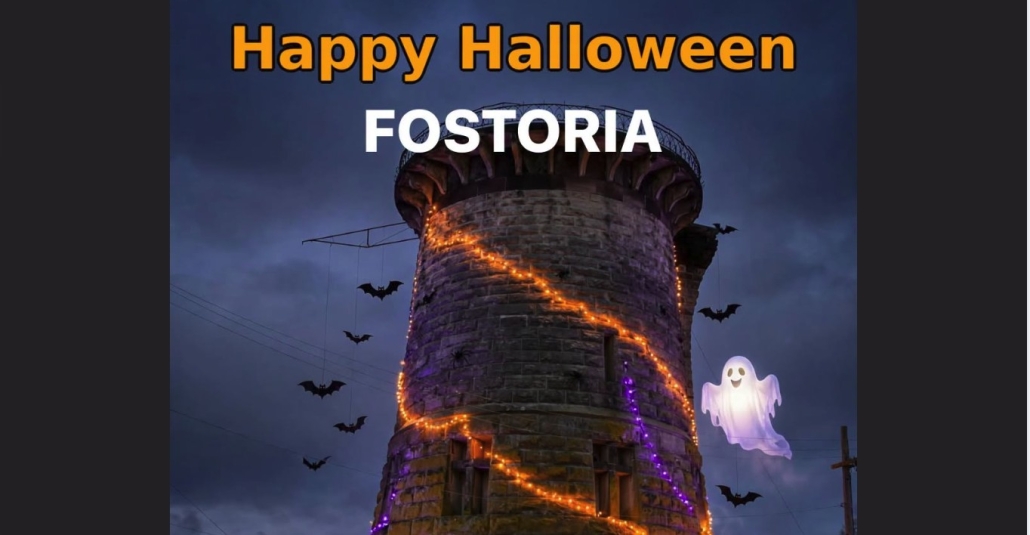
HAPPY HALLOWEEN #Fostoria! Did you know?
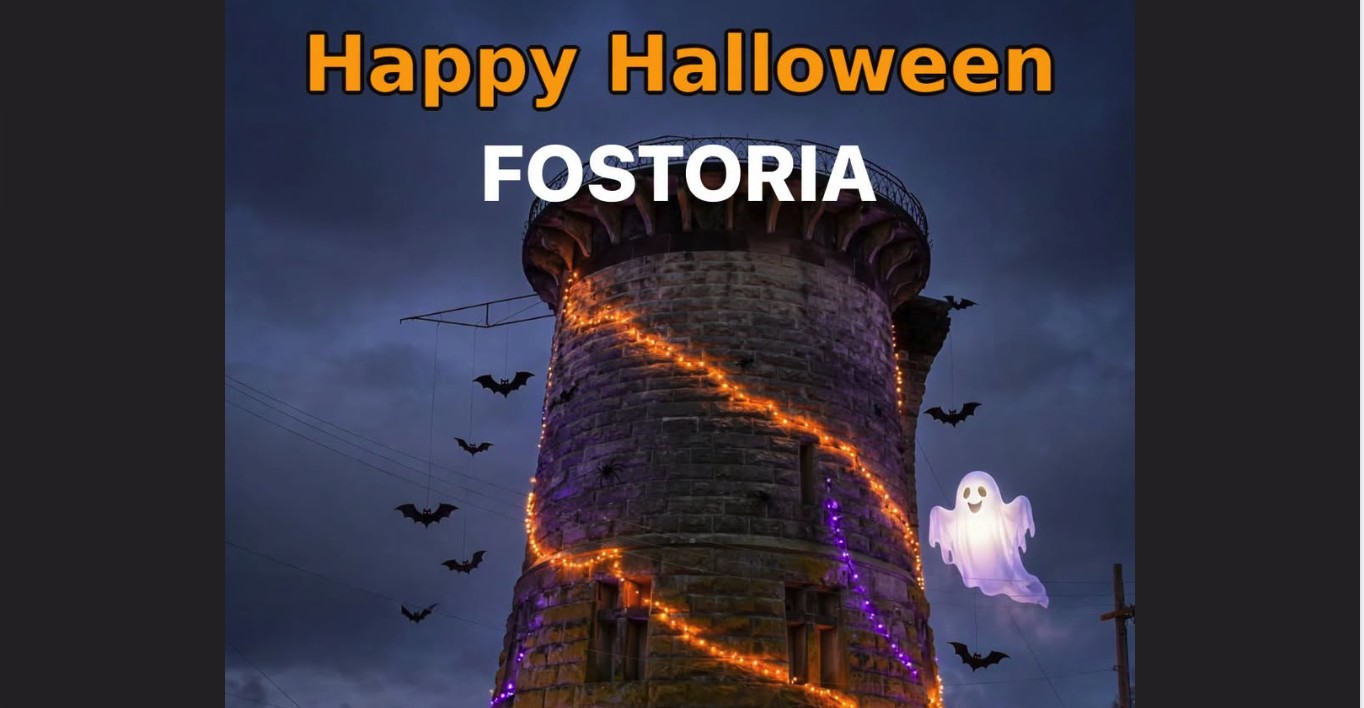
That stone tower is the old Fostoria Water Works standpipe — the original water tower at the end of West Fremont Street, on the same grounds where the city’s water treatment plant still sits today at 744 West Fremont. The stone structure in your photo is the tower’s base. The metal tank portion that once sat on top of it was dismantled in 1959, which is why it looks like a stone lookout tower now instead of a water tank.
How it worked:
A steam boiler drove the pump that forced water through the lines to homes and factories — the chimney in the old photos belonged to that boiler. Around 1954 the boiler was replaced by electric motors. Back when it was in service, visitors were allowed to climb to a viewing area partway up the tower for a panorama of Fostoria; a photo taken from that platform looking east down Fremont Street shows the Vine Street intersection and Woods Pond in the background, where Gray Park is now.
When it was  built:
The 1902 Centennial Biographical History of Seneca County records that the water-works plant cost $200,000 to build, and that Fostoria businessman Owen T. Brown served as city council president when the water works were established, then resigned from council to become president of the water-works commission that oversaw construction.
So the plant was definitely standing before 1902. The neighboring Reservoir No. 2 dates to 1891, and the tower appears in photographs from shortly after the turn of the century. That puts the tower’s origin in the late 1800s, but no source I found states the exact year.
The two reservoirs  beside it:
The tower sits by Reservoirs No. 2 and No. 3 — Lake Mottram (17 acres, built 1891) and Lake Lamberjack (31.7 acres, built 1919). Fostoria owns six reservoirs totaling more than 450 acres of water and about 2 billion gallons, five named for local war heroes and the newest dedicated to all veterans.
The ice  connection:
Before electric refrigerators, Reservoir No. 2 doubled as the town’s ice supply. Crews cut blocks in winter, floated them by pike pole to the ice houses beside the water works, and stored them four tiers high in double-walled buildings insulated with 12 inches of sawdust — cutting and storing an estimated 60,000 pounds per hour. The last ice harvest on the reservoir was in 1913, after the Fostoria Ice & Coal Co. opened its manufactured-ice plant on East North Street.
Why it’s out of service now:
now:Today’s system works differently: raw water is pumped from the East Branch of the Portage River into Reservoirs No. 5 and 6, flows by gravity to the treatment plant at 744 West Fremont, and treated water goes out through about 100 miles of pipe. Storage and fire protection now come from the Culbertson and Zeller Road towers, leaving the old stone standpipe as a landmark rather than a working part of the system.



Leave a Reply
Want to join the discussion?Feel free to contribute!