
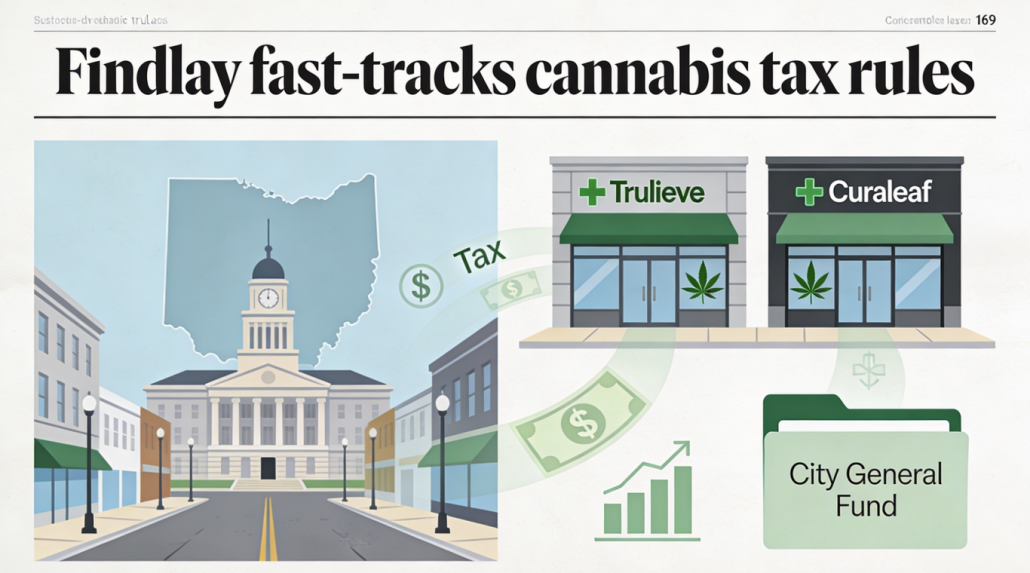
DEVELOPING | Findlay fast-tracks cannabis tax rules
Mar 10, 2026 7:00 AM
FINDLAY — Findlay City Council swiftly approved an ordinance on March 3 setting rules for how the city will handle adult-use cannabis tax revenue.
In a Feb. 11 letter to council, Deputy Auditor Ginger Sampson noted that two local dispensaries will be collecting the tax and said the legislation was needed to route the money into the city’s general fund so Findlay can receive and track distributions as soon as the state begins sending them. She added that the city still does not know how much revenue to expect or when payments will start.
Findlay’s first cannabis dispensary, Trulieve, opened Dec. 19 at 1501 W. Main Cross St. after council approved zoning changes last year that cleared the way for adult-use and medical cannabis businesses. Curaleaf, at 2205 Tiffin Ave., opened just over two months later on Feb. 25. Both locations sell adult-use and medical cannabis. City rules cap the number of dispensaries at two and restrict them to specific zones.
To push the ordinance through, council waived its three-reading rule on a 10-0 vote, then passed the measure as an emergency, also 10-0. Taken together, those steps shrink the public’s window to review proposed ordinances from roughly two months to only a few days after council packets are released on Friday afternoons, sidestepping both the traditional three-reading process and the 30-day waiting period that applies to non-emergency legislation.
Statewide, Ohio has already distributed more than $35 million in adult-use cannabis tax revenue to about 100 local governments, representing roughly 14 months of backlogged collections that accumulated while lawmakers finalized authorization for the payouts. Adult-use cannabis sales in Ohio are subject to a 10% excise tax at licensed dispensaries, paid by consumers and deposited into the state’s Adult Use Cannabis Fund, where the Ohio Department of Taxation oversees accounting and distributions.
Most of that revenue stays with the state. Only 36% of the excise tax is returned to cities and townships that host dispensaries, while the remaining 64% is retained by the state and deposited into its general fund, which can be used for any purpose approved in the biennial budget, including statewide operations, public safety and regulatory programs, social services, and other general government spending.

















 “
“