


The Babbitt case is being revisited in the shadow of another controversial shooting: the recent killing of Renee Nicole Good by an ICE officer in south Minneapolis. Federal officials claim the officer fired because Good “weaponized her vehicle,” suggesting she tried to run over or ram agents during an immigration enforcement operation.
But that narrative was quickly challenged by Minneapolis officials, eyewitnesses, and new video released by local outlet Alpha News and amplified by national media. The 47‑second clip, filmed from the perspective of the officer who fired, shows agents approaching Good’s vehicle, yelling commands, and breaking a window as she sits behind the wheel; then, as she maneuvers the car, shots ring out and the vehicle lurches forward before crashing. Some witnesses have told reporters they saw a Honda Pilot approached by multiple agents, the driver try to pull away, and then heard three shots before the SUV rolled into another car.
The Department of Homeland Security has said the agent fired because Good used her car as a weapon, while the mayor of Minneapolis and the governor of Minnesota have publicly disputed that characterization and warned against portraying her as a would‑be killer before the investigation is complete. Civil‑rights advocates argue that the video does not clearly show an intentional attempt to run down officers, and they question whether agents escalated too quickly to deadly force instead of disengaging or repositioning.
At first glance, the Babbitt and Good cases are very different: one involved a riot at the heart of American government, the other an immigration enforcement operation on a Minneapolis street. But they raise parallel questions that go beyond politics:
Who gets labeled the aggressor?
In Babbitt’s case, federal and local authorities emphasized the violent nature of the mob and the risk to lawmakers, framing her as part of a dangerous assault on democracy. In Minneapolis, DHS has stressed that Good “weaponized her vehicle,” while city officials and witnesses insist she posed little or no threat as she tried to pull away.
What counts as a “reasonable” belief of danger?
DOJ closed the Babbitt criminal investigation by saying there was no evidence Byrd did not reasonably believe shooting was necessary to protect himself and members of Congress, even if others watching the same video strongly disagree. In Minneapolis, ICE and DHS likewise insist the agent perceived a deadly threat from the moving vehicle, while critics say the footage and eyewitness accounts show a panicked driver, not an attempted murderer.
Why do officers almost never face criminal consequences?
In both cases, the core standard is not just whether the shooting feels excessive or tragic, but whether prosecutors can prove that the officer’s fear and judgment fell outside the very broad zone that courts label “reasonable.” Evidence of fear, confusion, or split‑second miscalculation tends to protect officers from 18 U.S.C. § 242 and similar statutes, even when civilians die. That gap between legal standards and moral outrage is exactly where public anger grows.
Ashli Babbitt went to Washington on January 6, 2021, as a 35‑year‑old Air Force veteran and Trump supporter who believed she was standing up for her country. She died on the floor outside the Speaker’s Lobby, unarmed, shot once by U.S. Capitol Police Lt. Michael Byrd as she tried to climb through a shattered window during the Capitol riot.
In April 2021, the Department of Justice quietly announced that it would not bring criminal civil‑rights charges against Byrd, saying investigators could not prove beyond a reasonable doubt that he acted with the kind of “willful” bad intent required under 18 U.S.C. § 242. The Capitol Police’s own internal review later declared the shooting “lawful and within Department policy,” shielding Byrd from internal discipline as well.
For Babbitt’s family and many Americans watching the footage, none of that erased what they saw: an unarmed woman shot at point‑blank range while there were heavily armed officers standing just behind her in the hallway. Her estate and Judicial Watch filed a $30 million wrongful‑death lawsuit alleging excessive force, negligence, and a failure to de‑escalate, arguing that “Ashli posed no threat to the safety of anyone” and that her hands were visible and empty when the shot was fired.
In 2025, the federal government agreed to settle the case for about $4.975 million, according to court records and multiple national outlets. The payment resolves the civil suit but does not include any admission of wrongdoing, and DOJ has maintained publicly that its earlier decision clearing Byrd of criminal liability still stands. Yet for many observers, a nearly $5 million payout is a tacit acknowledgment that the government wanted to avoid putting its use‑of‑force decisions in front of a civil jury.
Even among those who condemn the January 6 riot, there is a serious debate about whether lethal force against Babbitt was necessary or morally defensible. Video from multiple angles shows a mob smashing the doors and windows leading to the Speaker’s Lobby, while lawmakers were being evacuated on the other side. Babbitt climbs into the broken window and is shot before fully entering the doorway, collapsing immediately backward.
Supporters of Byrd argue that he was facing a volatile mob, that the barrier was about to be breached, and that he had only seconds to protect members of Congress and staffers sheltering in place. Critics respond that Babbitt was unarmed, that officers in the hallway behind her did not appear to view her as an immediate deadly threat, and that non‑lethal options and further verbal warnings were available but not used.
What is not in dispute is that Babbitt’s decision to join a mob and climb through a broken window was reckless. But recklessness is not a death sentence, and many Americans believe that in a country built on due process and graduated force, she did not deserve to die for that choice. The civil settlement has only deepened that conviction among her family and supporters.
For Babbitt’s family, the nearly $5 million settlement is a financial acknowledgment that something went terribly wrong, but it is not the criminal accountability they wanted. For friends and supporters of Renee Good in Minneapolis, the worry is that they are watching the beginning of the same pattern: a quick official narrative painting the victim as a deadly threat, followed by a prolonged investigation that may ultimately clear the officer without charges.
Calling these shootings “killings” in the legal sense skips over the hard reality: prosecutors are extremely reluctant – and often legally constrained – to second‑guess violent split‑second decisions by armed agents of the state, especially in politically charged contexts. But insisting on that nuance does not mean conceding that these deaths were acceptable, inevitable, or beyond criticism.
A more honest public conversation starts from two simple points:
Ashli Babbitt was unarmed and should not have died for climbing through a broken window during a chaotic, if criminal, protest.
Whatever final investigations conclude in Minneapolis, an encounter that ends with an ICE agent firing into a car and a woman dead should be treated as a profound failure first, and a justifiable split‑second choice only if evidence truly leaves no other conclusion.
Both cases demand transparency, rigorous independent review, and a readiness to hold agents criminally responsible when the evidence shows that lethal force crossed the line – not because officers are villains by default, but because the power to kill in the name of the law must never be treated as beyond the law.
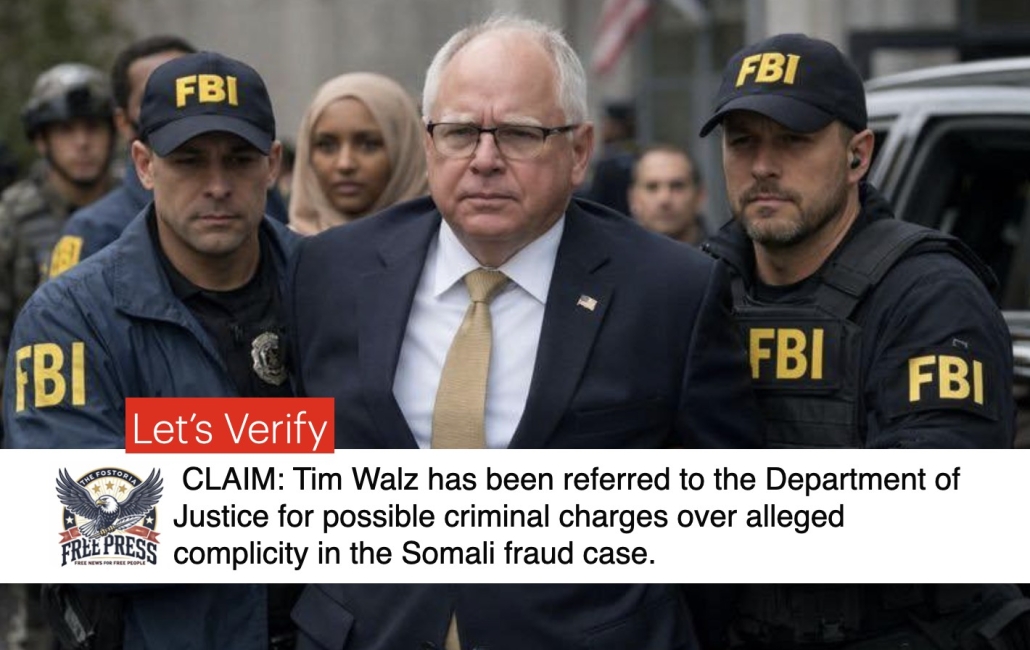
This claim is partially accurate but missing key context and is not evidence that Tim Walz is being charged with a crime.
Rep. Anna Paulina Luna has publicly said she “referred” Minnesota Gov. Tim Walz and Attorney General Keith Ellison to the U.S. Department of Justice for potential criminal charges related to the Minnesota Somali-linked fraud scandal, specifically the large “Feeding Our Future” child-nutrition fraud case.
A “referral” from a member of Congress is essentially a request or recommendation that DOJ investigate; it is not an indictment, not a finding of guilt, and does not mean DOJ has agreed to prosecute.
Federal prosecutors have charged dozens of people, many of Somali descent, in multiple Minnesota fraud schemes involving federal funds for child nutrition and other programs; more than 90 individuals have been charged and many convicted.
Walz faces intense political criticism over oversight and is under congressional scrutiny, and he has ended his reelection bid amid the scandal, but there is no public evidence that DOJ has charged him personally with any crime as of today.
The statement that “Tim Walz has been referred to the Department of Justice for possible criminal charges” is technically describing a political referral by an individual member of Congress, not an official DOJ action.
Sharing this as if Walz has been formally charged or is officially considered a criminal suspect by DOJ would be misleading and overstates what is currently known.


 Illegal Dumping Case Closed – No Snoozing on This One

The community spirit of the close-knit Swiss resort where at least 40 people died in a fire is strong even as inhabitants say they feel crushed by the tragedy
Mourners have continued to bring flowers and light candles at a makeshift memorial in the Swiss ski resort of Crans-Montana to commemorate those who lost their lives when a blaze ripped through a packed bar popular with young people celebrating the new year, killing at least 40.
“We came to light a candle,” said Sisi Boisard, a regular visitor to Crans-Montana from France for the last 20 years. “We have five children and can’t begin to imagine what these families are going through. This is a tragedy that has cut profoundly, but not just here – it’s being felt across the world.”


Donald Trump’s recent admission that he takes a higher daily dose of aspirin than his own doctors recommend has sparked a fresh round of partisan fire, with critics questioning both his medical judgment and his honesty about his health. As Democrats and liberal Facebook commentators seize on the remark with taunts about “addiction” and overmedication, the incident underscores how even a common drug like aspirin can become political ammunition.
In a lengthy interview with The Wall Street Journal, Trump, 79, said he takes what he called a “larger” daily dose of aspirin specifically to keep his blood “nice and thin.” He explained that “aspirin is good for thinning out the blood” and said he does not want “thick blood pouring through my heart,” directly linking the medication to his fears about heart disease.
Trump acknowledged that the regimen has visible side effects, saying the bruises often seen on his hands are caused by the higher dose, which he has taken for years. His physician, Navy Capt. Sean Barbabella, told reporters that Trump is taking 325 milligrams of aspirin daily for cardiac prevention, which is the upper end of the range typically used for aspirin therapy.
Medical guidelines normally describe “low‑dose” aspirin therapy as 75 to 100 milligrams per day, with 81 milligrams being the most common prescription for people at risk of heart attack or stroke. Cardiologists note that while daily aspirin can reduce clotting, higher doses increase the risk of dangerous internal bleeding without clearly improving protection against heart attacks.
Experts quoted in coverage of Trump’s remarks stressed that 325 milligrams is not an unheard‑of dose, but questioned why someone would stay at that level long term for prevention when lower doses generally provide the best balance of benefit and safety. One cardiologist said a 325‑milligram daily regimen “heightens the bleeding risk without enhancing its effectiveness,” which is why most patients are kept on lower doses unless there is a specific medical reason.
Trump’s disclosure immediately drew ridicule from some Democrats and anti‑Trump commentators on social media, who portrayed his decision to ignore his doctors’ advice as reckless and obsessive. On social media, critics amplified clips and headlines about the interview alongside memes and commentary accusing him, often hyperbolically, of being “addicted” to aspirin or unable to follow basic medical guidance.
Short‑form videos and commentary posts framed the aspirin comments as part of a broader pattern of Trump resisting expert advice, with some progressive influencers explicitly using the word “addict” as a punchline or insult. Supporters and conservative commentators pushed back, arguing that the rhetoric trivializes real substance‑use disorders and turns a common heart‑health medication into a political cudgel.
Trump’s aspirin regimen is being debated in the larger context of ongoing questions about his transparency on health matters. In the same interview, he discussed an October CT scan (which he had previously referred to as an MRI), later saying he regretted doing it because it “gave them ammunition” and fueled speculation that “something was wrong.”
Barbabella has insisted that Trump remains in “exceptional” health, saying his cardiovascular profile looks like that of someone more than a decade younger and that his overall metabolic health is “excellent.” Critics counter that such broad assurances, combined with selective disclosures like the aspirin admission, leave voters with more questions than answers and highlight how presidential health has become another partisan battlefield.
Beyond the political spin, Trump’s comments have prompted renewed public discussion about how and when people should use aspirin for heart health. Major medical organizations have already shifted in recent years toward more cautious recommendations, warning that routine aspirin use in older adults without clear cardiovascular risk can do more harm than good because of bleeding risks.
Health experts emphasize that no one should copy a public figure’s medication regimen without consulting a doctor, especially when that regimen involves exceeding typical preventive doses. As the debate over Trump’s aspirin intake continues, it illustrates how personal health choices by a sitting president can ripple into public behavior, political narratives, and the language Americans use around drugs, risk, and even the idea of being an “addict.”

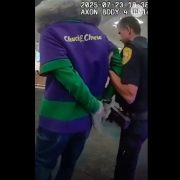

The Tallahassee man whose arrest in a Chuck E. Cheese costume went viral online maintains his innocence as he waits for his criminal case to move forward. He has entered a not‑guilty plea and is now watching the court process unfold.
Police arrested 41‑year‑old Jermell J. Jones in July at the Tallahassee Chuck E. Cheese, pulling him from the family restaurant while he was still dressed as the chain’s mouse mascot. Cellphone videos recorded by customers inside the Sharer Road location captured the moment, including a child crying out, “Oh, Chuck E.!”
According to court records, Jones faces charges of credit card theft, fraudulent use of a credit card, and criminal use of personal identification information. He is represented by the Public Defender’s Office and has formally denied the allegations in court.

The case has been moving through a series of case management conferences, routine hearings where a judge and attorneys check on the status of a case and discuss next steps. The next conference is set for Jan. 13 and is labeled “final” on the docket, though filings do not indicate whether a plea agreement is currently being negotiated.
Body‑camera footage and bystander videos of Jones’ arrest sparked significant public debate in Tallahassee about how and where officers choose to take people into custody. In the police‑released bodycam video, two officers approach Jones while he is in costume, handcuff him, and escort him out to a patrol car for questioning as nearby children react in confusion and alarm.

A department spokesperson has said there is no specific rule about making arrests in public settings like a children’s restaurant, explaining that officers rely on their judgment about safety and the risk of evidence being destroyed. She noted that once officers contacted Jones, he appeared to tense up and resist, prompting them to secure him in handcuffs out of concern for the safety of customers, the suspect, and the officers. She also remarked that it was “unfortunate” the suspect happened to be in costume at the time.
One officer wryly acknowledged the awkwardness of the situation, telling another on camera that parents were not pleased about “detaining Chuck E. Cheese” in front of their kids. As the footage spread and late‑night shows picked up the story, Chuck E. Cheese’s president and CEO, David McKillips, traveled to Tallahassee to meet with local police, including Chief Lawrence Revell, at the restaurant in an effort to project unity and goodwill between the company and law enforcement.

Published: November 28, 2025 | Last Updated: November 28, 2025
In a recent press conference held in Memphis on November 24, Housing and Urban Development (HUD) Secretary Scott Turner unveiled a new initiative from the Trump Administration: a dedicated tip line for reporting illegal immigrants or wanted criminals residing in public housing.
This move builds on earlier efforts by the administration to restrict access to public housing programs, such as Section 8, ensuring these resources are prioritized for American citizens in need rather than being allocated to undocumented individuals.
The tip line aims to enhance enforcement by allowing community members to report violations directly, facilitating investigations and potential arrests of those unlawfully using these benefits.
During the announcement, Secretary Turner was joined by Attorney General Pam Bondi and Tennessee Governor Bill Lee. He emphasized the importance of safety in public housing, stating, “At HUD, we believe public housing should be safe. That’s our conviction. A safe community starts with safe housing. If the housing is safe, the community is safe, and we want to take good care of the most vulnerable people in our country.”
Turner further detailed that the tip line, managed by the HUD Office of the Inspector General, will enable residents to report issues involving criminals, illegal immigrants, sex offenders, human traffickers, gang members, drug distributors, and those committing fraud.
The program will initially launch in Memphis, where the local Housing Authority oversees assistance for over 9,700 households with a $1.7 million budget. Summarizing the intent, Turner urged, “Here’s our message: Protect your home. Protect your family. If you see it, if you hear about it, report it.”
Attorney General Bondi also spoke on the initiative, highlighting the Department of Justice’s commitment to combating threats from gangs, traffickers, and illegal immigrants. She noted, “We cannot allow criminals—whether gangs, traffickers, or illegal aliens—to terrorize our communities, especially in places meant to protect the vulnerable like public housing. This tip line is a tool to empower residents and hold perpetrators accountable.”