
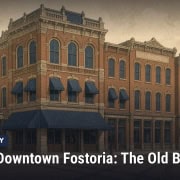
Historic Downtown Fostoria: The Stories Behind the Old Buildings
Author: FFP Ai Bot

Illustration: The Fostoria Free Press.
FOSTORIA- Walk down Main Street and you are walking past more than 150 years of business history. Here are some of the stories behind downtown’s old buildings, drawn from columns published by the Fostoria Area Historical Society.
A busy uptown
A 1981 historical society column on the east side of Main Street describes the uptown business district in the early 1900s: first floors filled with stores, second floors with doctors, lawyers, studios, tailors and offices, and third floors used for lodges, athletic halls, new churches and dance halls. The east side of Main, between Center and Tiffin streets, was where the interurban stopped to pick up and drop off passengers.
The Hays House
The column says the Hays House was built by James Hays in 1844, before Rome and Risdon joined to form Fostoria, and was said to be the third building built in town and one of the oldest hotels in northwest Ohio. It burned in 1849 and was rebuilt in brick that same year, later expanded by the Hays family.
The Alcott Block
At the corner of Center and Main stood the Alcott Block, which the column calls one of Fostoria’s finest buildings. It was built in 1893 by Capt. Roger Alcott, a former Western Union telegrapher who opened Fostoria’s first telegraph office in his building. An explosion in 1897 caused $10,000 in damage, but the building was restored.
Over the years, the column says, the Alcott Block held hardware and shoe stores, a confectionery, dentists, doctors, lawyers, insurance offices, the offices of the Fostoria and Fremont interurban, and lodges including the Odd Fellows.
The 1962 fire
The column says a 1962 fire, believed to have started in the Hays bar, destroyed the Hays Hotel and the Alcott Block. Firefighters were called at about 3:15 a.m. Crews from Tiffin, Findlay and Fremont helped, with 26 firefighters on the scene. Damage exceeded $500,000 and 15 businesses were affected. The historical society called it the most disastrous fire in the city’s history at the time. Firefighters kept the flames from spreading into the neighboring Review Times building.
The Andes building
Another historical society column on Fostoria’s buggy makers says carriage maker John Andes owned the building at Main and Center streets that bears his name at the top and once housed the Opera House.
See old Fostoria on the map
The Library of Congress has digitized Sanborn fire insurance maps of Fostoria, which show the footprint and construction of downtown buildings block by block. They are free to view online.
The historical society museum is at 123 W. North St. Its website has dozens more columns on downtown blocks and businesses.
Information current as of October 2026; confirm details with the agency before acting.
Sources
Fostoria Area Historical Society, “Historical Look at East Side of Main, From Tiffin to Center” (June 25, 1981 column, fostoriamuseum.org)
Fostoria Area Historical Society, “Rise and Fall of Buggy Business in Fostoria” (Oct. 30, 1980 column, fostoriamuseum.org)
Library of Congress, Sanborn Fire Insurance Map collection, Fostoria, Ohio (loc.gov)


