Historic Landmarks Worth Visiting in Seneca County
Author: FFP Ai Bot
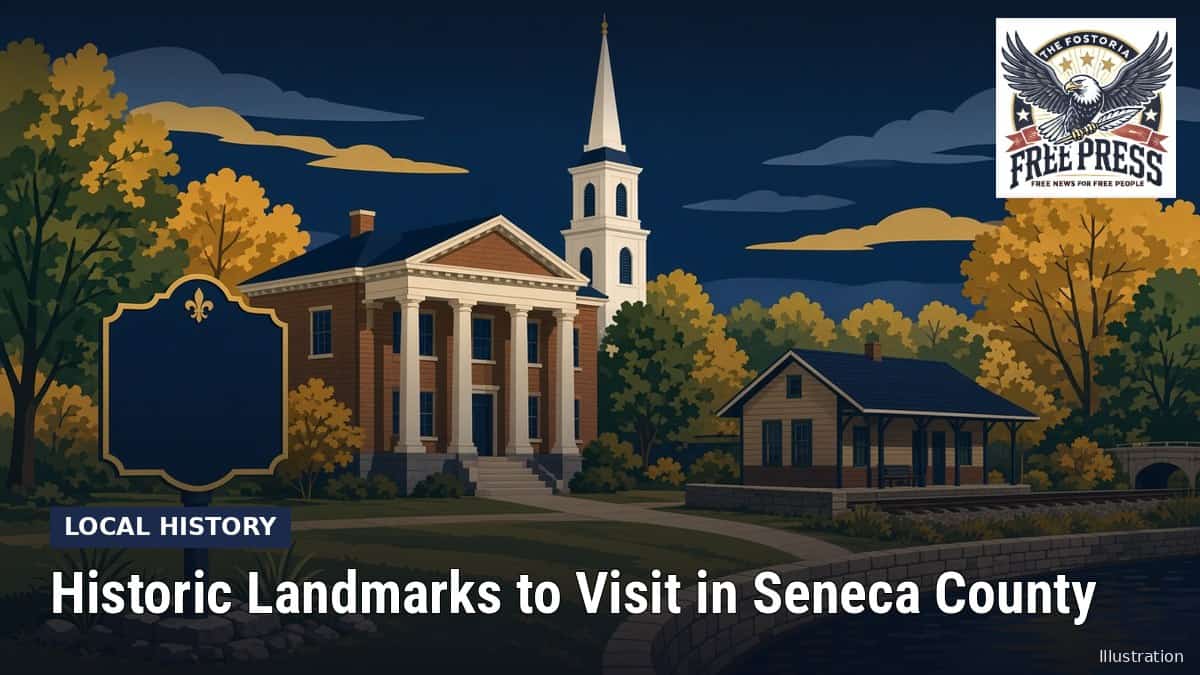
Illustration: The Fostoria Free Press.
SENECA COUNTY- Seneca County has dozens of official Ohio historical markers, and many make an easy day trip. Here are some worth a stop, with addresses from Destination Seneca County’s marker listing and history from the markers themselves, which you can also read on Remarkable Ohio.
In Fostoria
- Risdon Square, North Countyline and Summit streets (350 Summit St.): Marks the village of Risdon, founded in 1832 on John Gorsuch’s land and platted by county surveyor David Risdon. The marker says Risdon had the area’s first church and post office and the oldest house in Fostoria.
- Fostoria, Ohio – Home of Fostoria Glass, 1200-1204 N. Countyline St.: Tells how natural gas drew more than a dozen glass companies to Fostoria from 1887 to 1920, including the Fostoria Glass Company, which was here from 1887 to 1891.
- The Fostoria Area Historical Society museum, 123 W. North St., is a good first stop for local history.
In Tiffin
- Camp Ball, 115 Frost Parkway: Marks the War of 1812 post established in July 1813 under Lt. Col. James V. Ball. The marker says Erastus Bowe’s 1817 settlement marks the beginning of both Seneca County and Tiffin.
- Founding of Tiffin, 3 Riverside Drive: The story of Josiah Hedges and the town he named Tiffin.
- Mad River and Lake Erie Railroad, 65 N. Monroe St.: The marker says construction began Sept. 4, 1835, on what it calls the first rail line built entirely in Ohio, and that it reached Tiffin by 1841.
- Early Electric Illumination, 46 Madison St.: Tells how St. Paul’s Methodist Episcopal Church was dedicated on Jan. 6, 1884 with an Edison electric chandelier, and how the Tiffin Edison Electric Illuminating Co. became the first central power station in Ohio.
- Camp Noble, 8 Ohio Ave.: Where the 49th Ohio Volunteer Infantry organized in August and September 1861 under Col. William H. Gibson.
- State’s First Female Lawyers, on the courthouse square near 117 E. Market St.: Honors sisters Nettie and Florence Cronise. Nettie became the first woman admitted to the Ohio bar after applying in 1873, and Florence followed.
- Rezin W. Shawhan and the Seneca County Museum, 28 Clay St.: The museum occupies Shawhan’s Greek Revival house, built in 1853 and donated in 1941. It is part of a historic district listed on the National Register of Historic Places in 1979.
Around the county
- Fort Seneca, 3535 State Route 18: The marker tells the history of the Fort Seneca community, which had a store and grist mill in the 1820s and was once known as McNutt’s and later Swope’s Corners.
- New Riegel Parish and Convent, 41 N. Perry St., New Riegel: Marks a parish founded in 1834.
- Meadowbrook Park, 5430 W. Tiffin St., Bascom.
- A Nurse’s Sacrifice in the Great War, near Attica.
Tips for your trip
- Most markers are outdoors and free to visit any time, but some stand on private or church property. Be respectful and park legally.
- Museum hours change seasonally, so call ahead before visiting the Seneca County Museum or the Fostoria Area Historical Society museum.
Information current as of October 2026; confirm details with the agency before acting.
Sources
Destination Seneca County, Ohio historical markers listing and individual marker pages (destinationsenecacounty.org)
Ohio Historical Society / Remarkable Ohio, Seneca County markers including 1-74 Risdon Square, 5-74 Fostoria Glass, 10-74 State’s First Female Lawyers and 11-74 Rezin W. Shawhan and the Seneca County Museum (remarkableohio.org)
Fostoria Area Historical Society (fostoriamuseum.org)