
FOSTORIA | Main, Perry and Sandusky: The City Mills and Downtown Fostoria at the Turn of the Century
Author: FFP Ai Bot
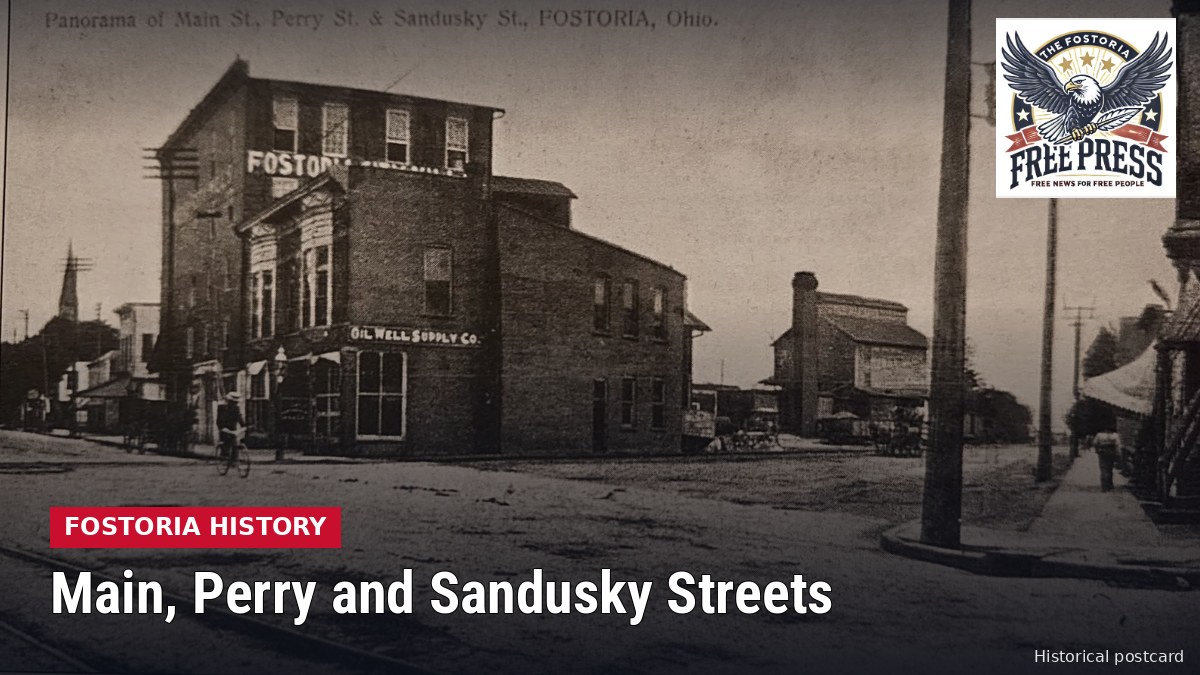
“Panorama of Main St., Perry St. & Sandusky St.,” postcard, about 1900-1915
FOSTORIA — Where Main, Perry and Sandusky streets come together on Fostoria’s north end, the old postcard above shows a dirt street crossed by rail tracks, a man on a bicycle, horse-drawn wagons, a brick block with an “Oil Well Supply Co.” sign and, in the background, the bulk of a flour mill. For about two decades this corner was the home turf of the Franke brothers and their Fostoria City Mills.
This installment of our local history series looks at that corner around the turn of the 20th century. Our main sources are 1978 and 1983 history columns republished by the Fostoria Area Historical Society, a local history blog and the 1896 Sanborn fire insurance map. Where a detail rests only on local memory, we say so.
Quick timeline
| Year | What happened |
|---|---|
| Early 1860s | A flour mill known as Union Mills is built on Sandusky Street, according to a local history blog. |
| Aug. 8, 1893 | A boiler explosion and fire at the Sandusky Street mill kill two men. |
| 1893 | Charles and August Franke open a flour and feed store on East North Street with $300. |
| 1896 | The Sanborn map shows the Lake Erie Elevator on North Main Street. |
| 1899 | The Frankes buy an old elevator on North Main and turn it into the Fostoria City Mills. |
| 1900 | The brothers build the Franke Block on North Main Street. |
| 1901 | The Toledo, Fostoria & Findlay interurban begins running, with tracks onto Perry Street. |
| About 1919-1920 | The City Mills is sold and renamed the Fostoria Milling Co. |
| About 1931 | The Sandusky Street mill burns for the last time. |
Times Square
The meeting point of Main, Perry and Sandusky was once called Times Square. According to a 1983 historical society column, it took the name from the time when Roscoe Carle published The Times and The Democrat from the triangular building at the point of Main and Perry. The 1896 Sanborn fire insurance map, held by the Library of Congress, shows that wedge-shaped block lined with small shops: agricultural implements, a harness maker, a grocery, a printing office, a flour and feed store and a marble works.
The square was busy. Sandusky Street carried two sets of tracks side by side, the Lake Erie & Western railroad and later the Fostoria & Fremont electric interurban, and a third line, the Toledo, Fostoria & Findlay interurban, turned onto Perry Street from 1901 until 1932. From the square, the columnist wrote, you could watch the trains and interurbans coming and see down Main Street and out Sandusky.
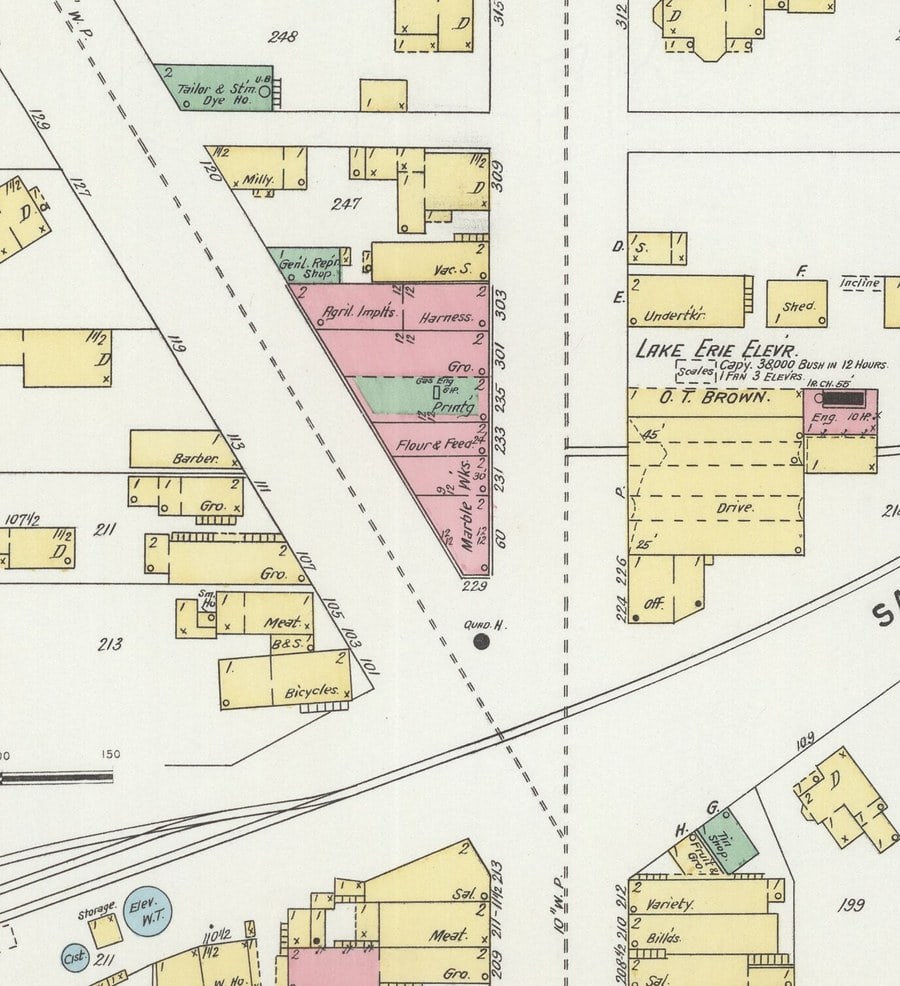
Sanborn fire insurance map detail, the Main and Perry point and the Lake Erie Elevator, 1896
The Franke brothers and the City Mills
Charles Franke came to Fostoria in 1893 and, with his brother August, who had worked for the Harter milling company in town for about a year, opened a small retail flour and feed store in the Longfellow block on East North Street. They started with $300, according to a 1978 historical society column. In those days families baked their own bread and many kept chickens, a cow or a horse, and the farmers around town came in for feed.
The brothers prospered. By 1898 they had bought a room in the Ghaster Block on East North Street, where a third brother, James, later ran a feed and grain store, and they were also running a grist mill on East Tiffin Street near the Toledo & Ohio Central tracks. In 1899 they bought an old grain elevator on North Main Street, installed modern machinery for a flour mill that could turn out 125 barrels a day, and named it the Fostoria City Mills.
The 1896 map shows a large grain elevator, labeled “Lake Erie Elevr.” with the name O.T. Brown, on the east side of North Main near the Sandusky Street tracks, rated to handle 38,000 bushels in 12 hours. An old city directory listing puts the Fostoria City Mill at 228 N. Main, close to that spot. It is likely, though we could not confirm it, that this is the elevator the Frankes bought.
In 1900 the brothers built the Franke Block on North Main Street for their retail flour, feed and grain store. The historical society’s columns say the building later held the Oil Well Supply Co. and, for many years, the Pappas family’s Candyland restaurant. That suggests the brick block with the “Oil Well Supply Co.” sign in the postcard is the Franke Block, and that the card dates from after 1900. The sign high on its wall begins “FOSTORIA,” but the rest of the lettering is lost in the printing.
The other mill
The mill in the right background of the postcard stood on Sandusky Street. A local history blog says it was built in the early 1860s by E.J. Cunningham as Union Mills, became the Livingston Roller Mill and, by 1891, the Cadwallader Milling Co. On Aug. 8, 1893, a boiler explosion and fire killed two men, George C. Davis and Fred C. Myers, according to a Review news item quoted by the historical society. The mill was rebuilt, later operating as the Buckeye Roller Mills, and burned for good around 1931. A filling station later used the site.
At the far right of the postcard, the corner of a frame building carries a sign reading “The Old Homestead.” The 1983 column says it was part of a row of frame business rooms and homes owned by the Cadwallader family.
When was the postcard made?
The 1983 column described a version of this panoramic view as taken in the late 1800s, but it also identified the foreground tracks as those of the Toledo, Fostoria & Findlay interurban, which began running about 1901. If the Franke Block identification is right, the card can be no earlier than 1900. We date it to roughly 1900 to 1915, still well within the public domain.
After the mills
August Franke owned four farms near Fostoria by about 1917 and sold his interest in the mill, the 1978 column says. Around 1919 or 1920 the City Mills was sold to a local group and renamed the Fostoria Milling Co., which sold Triumph and Tri-Co. flours. By 1922 the city directory no longer listed it. Lawyer Perry Bigham later bought and demolished the old mill and put up a new building on the site. When workers tore down the mill, they found yards of silk fabric once used to sift the flour.
The rooftop photo below, taken in the 1920s from near North Main and North streets looking west and northwest, shows how the north end looked a generation later: brick storefronts, utility poles, a church tower and a line of parked automobiles where horses once stood.
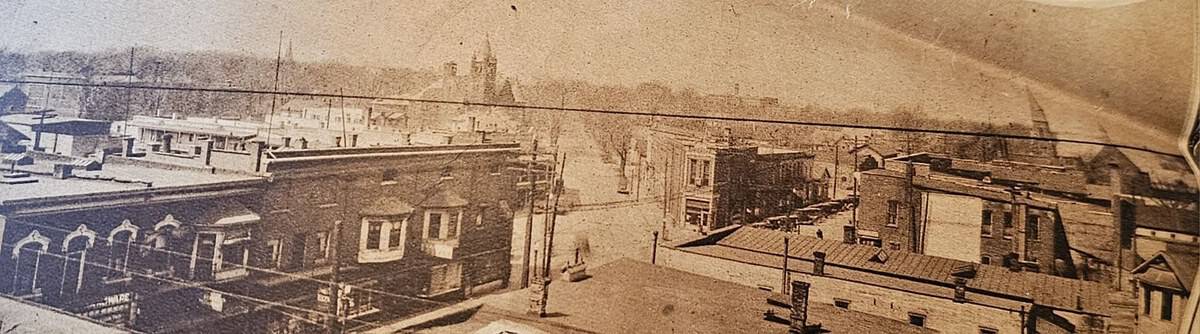
Looking west and northwest from near North Main and North streets, 1920s
Do you have old photos of Times Square, the City Mills or the Sandusky Street mill? We would like to hear from you.
More from FFP: 10 Original Business Ideas to Revitalize Fostoria’s Main Street Vibe and The “Hidden Tunnels” Beneath Fostoria.
Photo note: Photographs and images published before 1931 are in the public domain in the United States. Historical images in this article are shared for educational and historical purposes.
Sources
- Fostoria Area Historical Society, $300 in Capital Started Local Mill (1978): https://www.fostoriamuseum.org/300-in-capital-started-local-mill/
- Fostoria Area Historical Society, Sandusky Street History (1983): https://www.fostoriamuseum.org/sandusky-street-history/
- Fostoria Area Historical Society, North Main Block Shows Changes Thru Years: https://www.fostoriamuseum.org/north-main-block-shows-changes-thru-years/
- The Enterprising Cadwallader Family, Pt. 2 (local history blog): https://theshoes1.wordpress.com/2025/11/22/the-enterprising-cadwallader-family-pt-2/
- Library of Congress, Sanborn Fire Insurance Map, Fostoria, 1896: https://www.loc.gov/item/sanborn06698_003/


