FOSTORIA | The Alcott Block: Main and Center’s 1893 Landmark and the Fire of 1962
Author: FFP Ai Bot

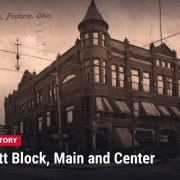
Alcott Block, Main and Center streets, postcard, early 1900s
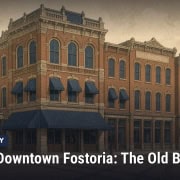
FOSTORIA — For almost 70 years, the southeast corner of Main and Center streets belonged to the Alcott Block, a three-story brick showpiece with a round corner tower that anchored downtown Fostoria. It held hardware stores, lodge halls, offices and the town’s first telegraph office. Then, in the early morning hours of a 1962 fire, it was gone.
This installment of our local history series tells the story of the building and the man who built it. Our main source is the Fostoria Area Historical Society’s archive of local history columns, supported by Library of Congress fire insurance maps and a local history blog. Where a detail rests only on local memory, we say so.
Quick timeline
| Year | What happened |
|---|---|
| 1837 | Roger Alcott is born in Toledo. |
| 1845 | H. Cover builds a frame house on the corner; it later serves as a boarding house, a tin shop and a drugstore. |
| 1891 | The old frame building is sold to Ira Cadwallader and moved to North and Cadwallader streets. |
| 1893 | Capt. Roger Alcott builds the Alcott Block. |
| 1897 | An asphaltum barrel explodes in the basement, causing $10,000 in damage; the building is restored. |
| 1905 | Roger Alcott dies on Aug. 5. |
| 1918 | Crowds fill Main and Center to celebrate the end of World War I. |
| 1962 | Fire starting in the neighboring Hays building destroys the Alcott Block and the Hays Hotel. |
| Early 1980s | The corner is the “Park and Shop Lot.” |
Captain Roger Alcott
Roger Alcott was born in Toledo in 1837 and came to Fostoria from Fremont, where he had worked as a Western Union telegrapher, according to the historical society. He earned the title “captain” leading the Fostoria Light Guards, a local militia company that later became Company I of the 164th Ohio Volunteer Infantry.
Alcott bought the store and tin business of a Mr. Bement, located in an old frame building on the corner. Drawing on his telegraph background, he opened Fostoria’s first telegraph office there, at a time when Morse code was recorded as dots and dashes on paper tape. Alcott died on Aug. 5, 1905.
From frame house to brick block
The frame building Alcott bought was itself a landmark. It was built in 1845 by H. Cover as his home and later served as a boarding house, Bement’s tin and stove shop and, at about the same time, the drugstore of J.B. Van Dorn, one of Fostoria’s first. In 1891 the old building was sold to Ira Cadwallader and moved to the northeast corner of North and Cadwallader streets, where it became the O.C. (Ohio Central) Hotel.
In 1893 Alcott built the brick block that carried his name. It was one of what a local history writer has called the “big five” downtown buildings of Fostoria’s glory days, along with the Andes Block, the Foster Block, the Emerine Block and the Security Building. The 1896 Sanborn fire insurance map, held by the Library of Congress, labels it “Alcott Bl.” at the corner of Main and Center, with the old Hays House hotel next door to the south.

Sanborn fire insurance map detail, Alcott Block and Hays House, 1896
A first fire, and who was inside
In 1897, four years after the building opened, a barrel of asphaltum being emptied in the basement exploded. The fire did $10,000 in damage, but firefighters held it to the Alcott Block and saved the Hays Hotel next door. The building was fully restored.
Early tenants, from 1893 to 1897, included the Alcott Hardware Co., the American Express Co., Robinson Bros. & Co. jewelers in the corner room, a restaurant, doctors and a dentist, the City Waterworks office, the Columbian Club, Vogel Bros. tailors, the Odd Fellows Lodge and Lafe Arnold’s barbershop in the basement.
The corner room at 102 S. Main became a favorite for hardware stores. After Alcott came D.R. Ballmer, who bought out his partners in Alcott Hardware in 1898 and whose name was first attached to the Security Building at Main and South. Over the decades the third floor hosted the Odd Fellows and the Loyal Order of Moose, and sometimes dances and wrestling matches.

Main and Center streets during the World War I armistice celebration, 1918
The fire of 1962
The end came in 1962. According to the historical society’s account, a passing motorist spotted flames at the Hays Hotel at about 3:15 a.m. and reported it to police. The fire was believed to have started in the Hays Bar, the only part of the old hotel still operating. By 4 a.m. the hotel interior was nearly gutted and the fire had spread to the Alcott Block.
Fire departments from Tiffin, Findlay and Fremont came to help. Twenty-six firefighters, 10 of them from out of town, fought the blaze until mid-morning. Damage topped $500,000, and the fire was described as the most disastrous in the city’s history. Fifteen businesses were damaged, including shoe stores, a hat shop, barbershops, law and insurance offices, a lodge and The Review Times, whose building adjoined the Alcott Block on Center Street. Firefighters broke out the newspaper’s skylight to get onto the roof and pour water on the Alcott Block, keeping the flames from spreading.
The Hays Hotel, whose oldest section dated to the 1840s, was at the time called the oldest hotel in northwestern Ohio. Just a week before the fire, one of the Hays building owners had announced plans to demolish it and put up a new building.
Then and now
Then: a turreted brick landmark full of shops, offices and lodge halls at the busiest corner in town.
Now: no building has replaced it. A 1982 history column described the corner as the “Park and Shop Lot,” a public parking lot. Local accounts today describe the site as open community green space used for events. We were not able to independently confirm how the city currently designates the lot. Across the street, the 1878 Andes Block still stands, and much of the surrounding area is part of the Fostoria Downtown Historic District, listed on the National Register of Historic Places in 2001.
Do you remember the 1962 fire or the shops in the Alcott Block? We would like to hear from you.
More from FFP: The “Hidden Tunnels” Beneath Fostoria and Circus Memories: When the Big Top Marched Down South Main.
Photo note: Photographs and images published before 1931 are in the public domain in the United States. Historical images in this article are shared for educational and historical purposes.
Sources
- Fostoria Area Historical Society, Historical Look at East Side of Main, From Tiffin to Center (1981): https://www.fostoriamuseum.org/historical-look-at-east-side-of-main-from-tiffin-to-center/
- Fostoria Area Historical Society, Hays Hotel Quite a Place in Fostoria’s Early Days: https://www.fostoriamuseum.org/hays-hotel-quite-a-place-in-fostorias-early-days/
- Fostoria Area Historical Society, A Look at East Center Street (1982): https://www.fostoriamuseum.org/a-look-at-east-center-street/
- The Shoes (local history blog), Fostoria, Ohio’s Security Building (2025): https://theshoes1.wordpress.com/2025/10/30/fostoria-ohios-security-building/
- The Shoes, What Makes the Security Building So Great? (2026): https://theshoes1.wordpress.com/2026/09/22/what-makes-the-security-building-so-great/
- Library of Congress, Sanborn Fire Insurance Map, Fostoria, 1896: https://www.loc.gov/item/sanborn06698_003/
- National Park Service, NRHP, Fostoria Downtown Historic District: https://npgallery.nps.gov/AssetDetail/NRIS/01001065