
OPINION | 30 Minutes Struggling to Breathe After a Lethal Dose. She Lived. Just or Un-American?
Author: FFP Ai Bot
OPINION: This is an opinion piece. The views expressed are the author’s and are based on published news reports, court filings and official statements cited below.
Thirty minutes of struggling. That is what the attorney who sat in the witness room says he watched after Tennessee’s lethal drug went into Christa Pike’s veins: half an hour of straining, flinching and fighting to breathe, on top of the long stretch she had already spent strapped to the gurney while the IV team hunted for a vein, and the people responsible for her life and death had no written plan for what to do next.
Here is the sentence from the Associated Press report that should stop every American cold: “Over the next 30 minutes Pike strained, flinched, moved her head and seemed to struggle to breathe, Spivey said, and when he asked to use a phone he was led on a circuitous, seven-minute route through the facility instead of being allowed to use the phone in the execution witness room.”
That account comes from Randy Spivey, one of Pike’s attorneys with the Tennessee Office of the Post-Conviction Defender. It is one witness’s sworn description, not a finding by any court or investigator. But it is the most detailed account yet of what happened inside Riverbend Maximum Security Institution in Nashville on the night of Sept. 30, and the state has not offered a competing version of those minutes.
Christa Pike did not die that night. She survived two doses of pentobarbital, was rushed to a hospital and, according to AP, spent several days on a ventilator before regaining consciousness. She is back in prison today. The question this country has to answer is not whether Christa Pike deserved punishment. It is whether what happened on that gurney is something the Constitution allows.
What the Witness Says Happened
Spivey’s account is contained in a declaration dated Oct. 15 and filed Thursday, Oct. 22, in Davidson County Chancery Court, as part of a separate lawsuit in which people on Tennessee’s death row are challenging the state’s lethal injection procedures, according to AP and WKRN.
According to that declaration, as reported by AP:
- The IV team began trying to place the two required IV lines at 6:34 p.m. Central time. The right arm took about 6 minutes. The left arm took nearly an hour.
- Pike was “wincing and grimacing” as needles were moved inside her left arm. The team went through about 10 needles and tried several sites on both arms. Pike herself suggested where they might find a usable vein.
- At 6:57 p.m., one team member said a vein “might be blowing.” At 7:07 p.m., after a needle came out appearing severely bent, a team member said, “I think it’s blown.” The team decided at 7:13 p.m. that the left IV was in place.
- At 7:34 p.m., Pike told the room, “I feel like my arm is about to bust. It burns.”
- About 10 minutes later she began making what Spivey called an “agitated snoring sound.” Then came the 30 minutes of straining, flinching and labored breathing.
- Spivey reached a phone at 8:22 p.m. and asked fellow attorneys to stop the execution, because the state’s protocol does not authorize a third dose of pentobarbital. He then told the deputy attorney general in the witness room that Pike needed immediate medical care.
- He was told at 8:50 p.m. that an ambulance was on the way. An ambulance was seen arriving at the hospital at 9:14 p.m.
Read that timeline again. From the first needle to the ambulance, that is well over two hours. And in the middle of it, the one person in that witness room trying to get a court on the line was walked through a maze of locked doors for seven minutes instead of being handed the phone in the room.
What the State Has Said
The night of the attempt, the Tennessee Department of Correction released a short statement saying it “followed every step of the State’s lawful, established execution protocol approved by the Attorney General’s Office,” and that “the protocol does not allow for additional procedures beyond what was carried out this evening.” You can read it on the Tennessee Department of Correction website.
That is precisely the problem. Tennessee’s protocol calls for a second dose of pentobarbital if the first does not kill, but, as AP reported, it does not say what happens if a person survives the second one. The state followed its plan right off the edge of the map.
To its credit, the state has not pretended everything was fine. Gov. Bill Lee ordered a “comprehensive, third-party review,” called off the only other execution set for 2026, and paused executions through the end of the year. Attorney General Jonathan Skrmetti’s office said, “We need to know what happened.” Correction Commissioner Frank Strada announced his resignation on Oct. 3 while maintaining the department had followed the protocol. A Davidson County judge has ordered the state to preserve all evidence from the attempt. This was also not Tennessee’s first failure this year: in May, the state halted the execution of Tony Carruthers after more than an hour of failed attempts to set an IV line, and the governor granted him a one-year reprieve.
The Free Press did not find any public response from the state to Spivey’s new declaration as of Thursday night.
What the Constitution Says
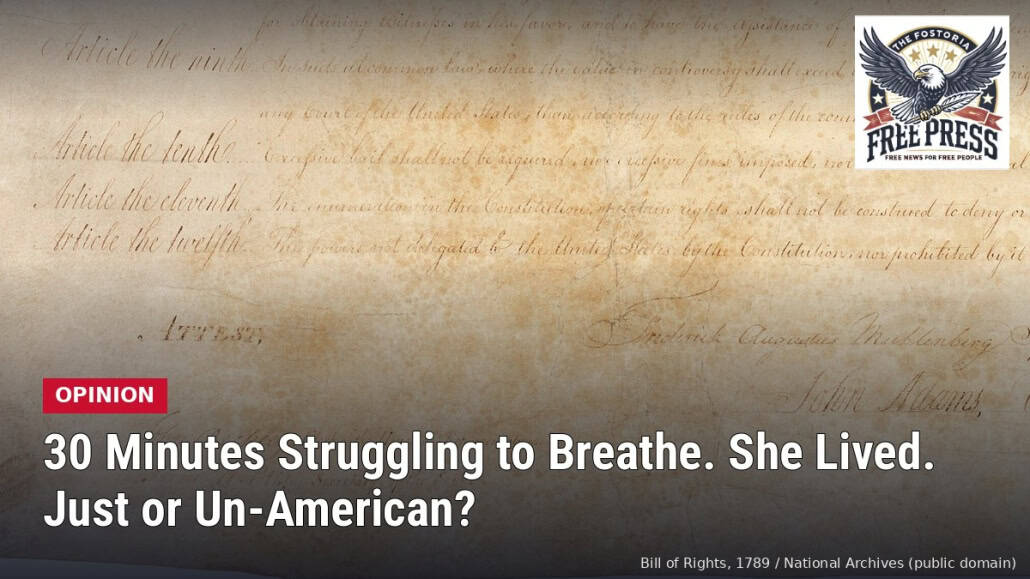
The Eighth Amendment to the U.S. Constitution, ratified in 1791 as part of the Bill of Rights, is one sentence long: “Excessive bail shall not be required, nor excessive fines imposed, nor cruel and unusual punishments inflicted.” The text is posted by the National Archives.
Tennessee’s own Constitution says the same thing, word for word, in Article I, Section 16 of its Declaration of Rights: “That excessive bail shall not be required, nor excessive fines imposed, nor cruel and unusual punishments inflicted.”
The founders borrowed that language from the English Bill of Rights of 1689. They put it in our founding charter because they believed a government strong enough to take a life must never be allowed to take it with cruelty. That is about as American as an idea gets.
What the Courts Have Said
In fairness, the U.S. Supreme Court has set a very high bar for proving an execution method unconstitutional, and it is worth understanding exactly where that bar sits.
- Furman v. Georgia (1972) struck down the death penalty as it was then being applied, because it was being handed out in an arbitrary and inconsistent way, voiding death penalty laws across the country.
- Gregg v. Georgia (1976) allowed executions to resume under revised state laws, holding that the death penalty itself does not automatically violate the Eighth Amendment.
- Baze v. Rees (2008) upheld Kentucky’s three-drug lethal injection method. The lead opinion said “some risk of pain is inherent in any method of execution” and that a method violates the Eighth Amendment only if it presents a “substantial risk of serious harm.”
- Glossip v. Gross (2015) upheld Oklahoma’s use of the sedative midazolam and added a requirement that prisoners challenging a method must identify a known and available alternative that would significantly reduce the risk of severe pain.
- Bucklew v. Precythe (2019) applied that same test to a prisoner with a rare medical condition. Justice Neil Gorsuch wrote that the Eighth Amendment “does not guarantee a prisoner a painless death,” but forbids methods that “superadd” terror, pain or disgrace beyond what is needed to carry out a death sentence.
There is also a darker precedent that has suddenly become relevant again. In Louisiana ex rel. Francis v. Resweber (1947), a teenager named Willie Francis survived Louisiana’s electric chair when it malfunctioned. A divided Supreme Court ruled the state could try again, calling the failure an “unforeseeable accident.” Francis was put back in the chair and executed in 1947.
Pike’s lawyers saw this coming. Months before Sept. 30, they argued in court that her small veins and a blood disorder created a substantial risk of superadded pain, and that lethal injection would be cruel and unusual in her case. The Tennessee Supreme Court rejected that challenge a week before the execution date, and the U.S. Supreme Court lifted a last-minute federal stay so the execution could proceed.
The Other Side
None of this should erase Colleen Slemmer. She was 19 years old in January 1995 when Pike, then 18, and her boyfriend lured her to a remote spot on the University of Tennessee campus in Knoxville and tortured and killed her. A jury convicted Pike of first-degree murder and sentenced her to death, and court after court upheld that sentence for three decades.
Slemmer’s mother, May Martinez, has spent years asking the state for justice for her daughter. “She did the crime. I think she should pay for it,” she told WBIR in August. Her grief deserves respect, and so does the jury’s verdict.
Supporters of the death penalty make serious points. The Supreme Court has said plainly that the Constitution does not promise a painless death. The pain Slemmer suffered was far worse, and far longer, than anything described on that gurney. Tennessee’s protocol was approved by its attorney general, upheld by its courts, and cleared by the nation’s highest court hours before it was used. And Resweber suggests a failed attempt, by itself, is not unconstitutional if no one acted with malice.
Just or Un-American?
Here is where this writer lands. The Eighth Amendment was never written to protect the innocent. Innocent people are not supposed to be punished at all. It was written to protect the guilty, the people we are most tempted to treat cruelly, because that is the only place a limit on government power means anything.
A state can believe in the death penalty and still owe the public a method that works, a plan for when it does not, and a phone in the witness room for the one person whose job is to call a court when something goes wrong. Tennessee had none of those on Sept. 30.
The data says this is not a fluke. Researcher Austin Sarat, in his book “Gruesome Spectacles,” found that 75 of 1,054 lethal injections in the U.S. from 1890 to 2010, about 7 percent, were botched, the highest rate of any method studied, according to the Death Penalty Information Center. Tennessee has now failed twice in five months.
When a government cannot carry out the most serious act it is allowed to perform without leaving a woman straining for breath for half an hour behind a curtain, the problem is not the prisoner. The problem is the system. Whether you call that torture or simply a failure, it is exactly the kind of “superadded” suffering the Supreme Court said the Constitution forbids.
Justice for Colleen Slemmer is a real and lasting obligation. So is the promise written into both the U.S. and Tennessee constitutions. A country that keeps one by breaking the other has not delivered justice. Tennessee’s independent review must be public, complete and honest, and no one should be strapped to that gurney again until it is.
The Fostoria Free Press welcomes responses. Opinion pieces reflect the views of the author and not necessarily those of every member of our staff.
Sources
- https://apnews.com/article/christa-pike-execution-vein-0af6fb15b756a8c47ece2ff5848a44fb
- https://www.pbs.org/newshour/nation/iv-team-warned-christa-pikes-vein-might-have-blown-during-failed-execution-court-filing-says
- https://www.wkrn.com/news/tennessee-news/christa-pike-timeline-of-botched-tn-execution/
- https://www.tn.gov/correction/news/2026/9/30/media-advisory–christa-pike–261368.html
- https://www.tn.gov/governor/news/2026/5/21/gov–lee-grants-temporary-reprieve-for-tony-von-carruthers.html
- https://www.wivk.com/2026/10/04/63367/
- https://www.archives.gov/founding-docs/bill-of-rights-transcript
- https://constitution.congress.gov/constitution/amendment-8/
- https://publications.tnsosfiles.com/pub/2023%20TN%20Constitution.pdf
- https://deathpenaltyinfo.org/executions/botched-executions
- https://www.npr.org/2026/10/06/nx-s1-5991669/failed-execution-christa-pike-tennessee-reporter-witness




Leave a Reply
Want to join the discussion?Feel free to contribute!