

FOSTORIA | 80% of New Beekeepers Quit? The Famous Figure Is Hard to Trace, but Hive Losses Are Real
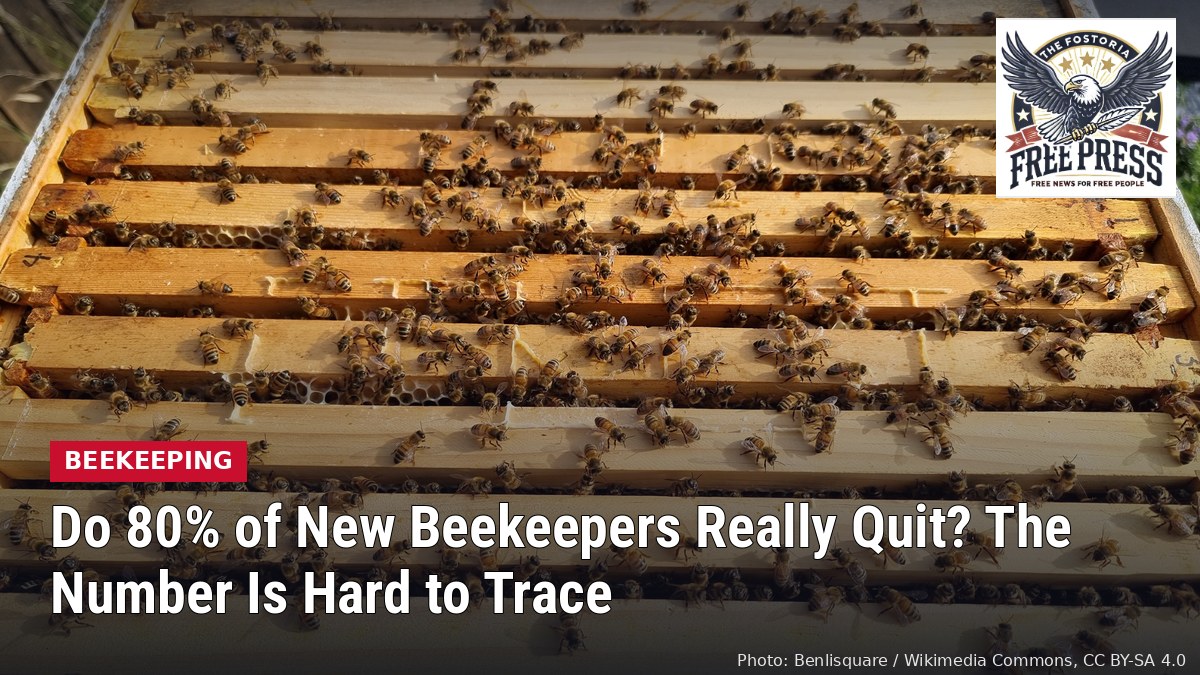
It is one of beekeeping’s most repeated statistics: about 80 percent of new beekeepers quit within two years, and even more within five. But when The Fostoria Free Press tried to trace it back to a study, there wasn’t one.
Where the 80 percent figure comes from
The earliest widely cited version we found is an April 2017 post on the blog Honey Bee Suite by writer Rusty Burlew, titled “Beekeepers: are you one of the 80% who will quit?” The post opens with the claim, but the author qualifies it immediately: “Rumor has it that 80% of new beekeepers will quit within the first two years. I don’t know how accurate that estimate is. Like other statistics related to beekeeping, it seems to survive with no one keeping score.”
A May 2017 post on Britain’s Seven Kings Apiary site repeats that “rumour” wording and lists Honey Bee Suite as its source.
The number also turns up in a federally funded project, with a different timeframe. A Pennsylvania mentoring program paid for by a USDA Northeast SARE grant says in its final report that “it has been estimated that 80% of new beekeepers quit after their first 3-years of beekeeping due to the inability to keep their bees alive.” The report does not say who made that estimate or how.
The five-year version is even harder to pin down. In a March 2024 post, the author of the Substack newsletter “Zen and the Art of Beekeeping” wrote that he first read that “up to 80% of people who start beekeeping give up in the first five years” in a Facebook discussion, but “had never been able to verify that figure.” He cited a British lecture describing membership churn at a national beekeeping group, where new members join every year but totals stay flat. That is an observation, not a measured dropout rate.
The bottom line: the 80 percent claim is widely repeated but could not be traced to any survey, extension study or peer-reviewed paper. No national program appears to track how many beginners stop keeping bees.
What the data does show: heavy colony losses
Hard numbers do exist on how many colonies die. The U.S. Beekeeping Survey, run by Auburn University, Oregon State University and the Apiary Inspectors of America, continues the national loss survey the Bee Informed Partnership began in 2007.
Preliminary results released in June 2026 estimate that U.S. beekeepers lost 39.9 percent of their managed colonies between April 2025 and April 2026. Backyard beekeepers, defined as those with 50 or fewer colonies, fared worse, losing 54.8 percent over the year, compared with 38.7 percent for commercial operations. The backyard 15-year average is 49.1 percent. In 2024-25, national losses hit a record 55.6 percent.
For a hobbyist with one hive, roughly even odds of losing a colony each year can mean an empty box by the first spring.
Why beginners quit
The most common villain is the varroa mite. Penn State Extension calls varroa “the most serious honey bee pest” and says beekeeping “is no longer possible without close attention to mite control.” In June 2025, the USDA Agricultural Research Service reported that mite-spread viruses were behind recent colony collapses, and that nearly all mites it tested showed resistance to amitraz, a widely used treatment.
Burlew’s post also lists rising equipment costs, more work than expected, missing honey harvests, stings, neighbor complaints and first-winter losses.
Josh Tolento, owner of Mindful Beekeeper LLC in Seneca County, OH, said the workload is a big part of why people leave. “Beekeeping is not a hobby, it’s a lifestyle choice, and that is where I believe a lot of the turnover occurs,” he said. “It is a lot of work. Especially when you go beyond managing just one or two hives.”
He also pointed to the sheer volume of advice. “I believe the bee industry has a major barrier to entry for new beekeepers,” Tolento said. “There is so much information out there that often conflicts with opinions of multi year generation beekeepers.”
Tolento said that when he started, the amount of information was so overwhelming that he spent a full year studying before he got his first hive. He is now finishing his third season and said he set a goal of going into winter with 10 hives. “I’m happy to say that I am going into this winter with 16 beehives,” he said, adding that it is a 13 hive increase since the start of the 2026 season. “Sadly, I must always keep in mind that I could lose 40%+ of my hives over winter due to disease or mites. I plan for the worst and the best will take care of itself.”
What helps new beekeepers stick with it
Start with two hives. Penn State Extension advises that “it is better to begin with at least two or three colonies,” saying a second colony takes little extra time and can help fix problems in the first.
Monitor mites, not just treat. The Honey Bee Health Coalition’s varroa guide recommends checking mite levels by sampling about 300 bees, roughly half a cup, and treating when counts pass seasonal thresholds of 1 to 2 mites per 100 bees.
Get training and a mentor. A 2015 University of Idaho Extension study in the Journal of Extension followed 56 new beekeepers and 137 colonies for one year. Beekeepers who attended a training workshop had 14 percent fewer colony deaths than those who didn’t. The small Pennsylvania SARE cohort of 31 beekeepers reported a 35 percent winter loss rate after a year of meetings, field days and monthly mite checks.
Look for free bees! Tolento said beginners don’t need to pay for their first colonies. “I don’t see any reason why a new beekeeper should be buying bees online or from another beekeeper,” he said. “This year I have offloaded over 10 honeybee colonies that I have rescued to other beekeepers at zero cost. That is the way that I feel beekeepers should work together.”
He said swarms are plentiful each spring. “When swarm season hits in May in Northwest Ohio, there are literally dozens and dozens of free honeybee colonies all over the region hanging from trees, waiting to be collected and given a new home,” Tolento said, adding, “I have never bought bees online or from another beekeeper.”
Register your bees: it’s Ohio law
Under Ohio Revised Code 909.02, anyone who owns or keeps bees must register their apiaries with the Ohio Department of Agriculture by June 1 each year, or within 30 days of getting bees. The 2025 state budget, House Bill 96, effective Sept. 30, 2025, lengthened the old 10-day window to 30 days and dropped the $5 fee, according to OSU Extension.
The 80 percent figure may never be proven. But the loss numbers show why so many beginners feel like giving up, and the research points to what helps: more than one hive, regular mite checks and an experienced beekeeper to call.
Sources:
https://projects.sare.org/project-reports/one24-432/
https://plotdevelopments.substack.com/p/newsletter-5-188
https://www.apiaryinspectors.org/US-beekeeping-survey-25-26
https://apiaryinspectors.org/US-beekeeping-survey-24-25
https://extension.psu.edu/beekeeping-honey-bees
https://www.ars.usda.gov/news-events/news/research-news/2025/usda-researchers-find-viruses-from-miticide-resistant-parasitic-mites-are-cause-of-recent-honey-bee-colony-collapses/
https://honeybeehealthcoalition.org/wp-content/uploads/2026/08/Tools-for-Varroa-Management-Guide-9th-Edition.pdf
https://commons.joe.org/joe/vol53/iss1/20/
https://codes.ohio.gov/ohio-revised-code/section-909.02
https://commons.wikimedia.org/wiki/File:Open_Langstroth_hive_of_Italian_honeybees.jpg
