
FOSTORIA | Light Bulbs, Carbon and Barrels: Fostoria Factories on Early Postcards
Author: FFP Ai Bot
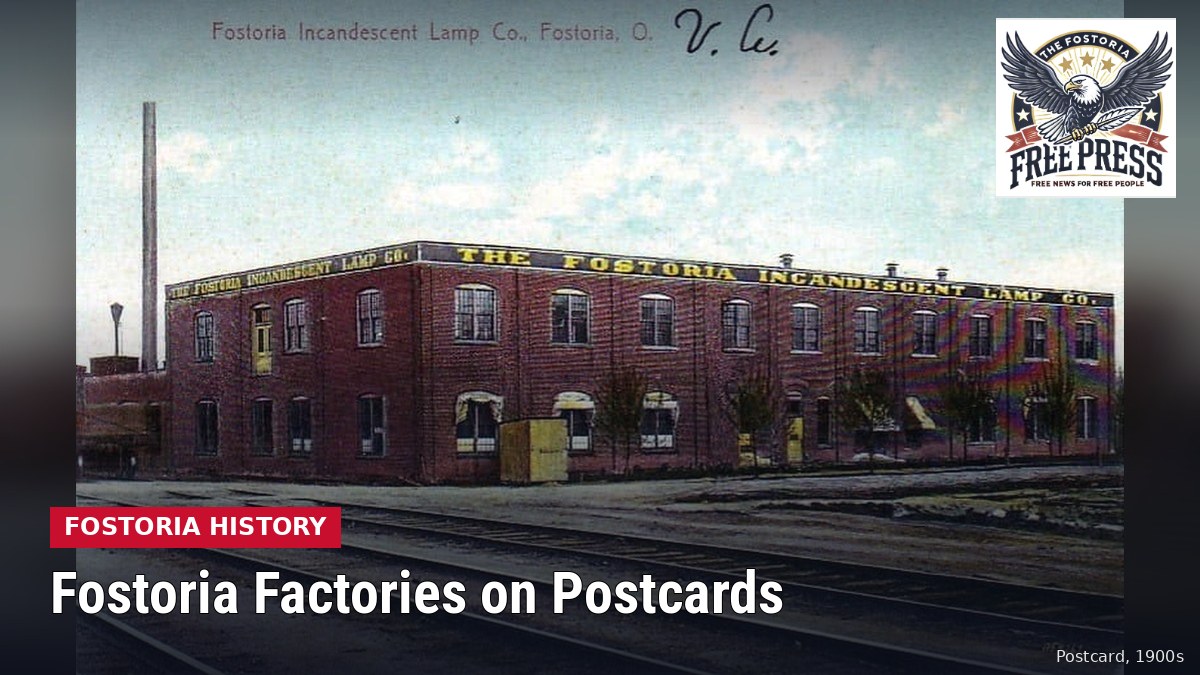
Fostoria Incandescent Lamp Co., early 1900s postcard
FOSTORIA — Around the turn of the last century, a factory was something to be proud of. Printers turned them into colorful postcards, and Fostorians mailed them to friends and family: here is where we work, here is what we make.
This installment of our local history series looks at five of those cards. Together they show a small city that built light bulbs, glass, carbon, pulleys and barrels, and a local economy that changed quickly as the gas boom faded.
Quick timeline
| Year | What happened |
|---|---|
| Mid-1880s | Natural gas is found near Fostoria; free gas draws more than a dozen glass companies between 1887 and 1920. |
| 1893 | Clevelanders J. B. Crouse and H. A. Tremaine organize the Crouse-Tremaine Carbon Co. at the east end of Tiffin Street. |
| 1897 | The Fostoria Incandescent Lamp Co. is started. |
| 1899 | The Fostoria Glass Specialty Co. is formed to make bulbs and glass tubing. |
| 1901 | The Fostoria lamp business becomes part of the National Electric Lamp Co., 75 percent owned by General Electric. |
| By 1906 | National Carbon Co. of Cleveland has bought the Crouse-Tremaine works. |
| 1911 | A federal court case leads GE to absorb National fully. |
| 1914 and 1920 | The two Fostoria lamp and glass plants close. |
Light bulbs on South Poplar Street
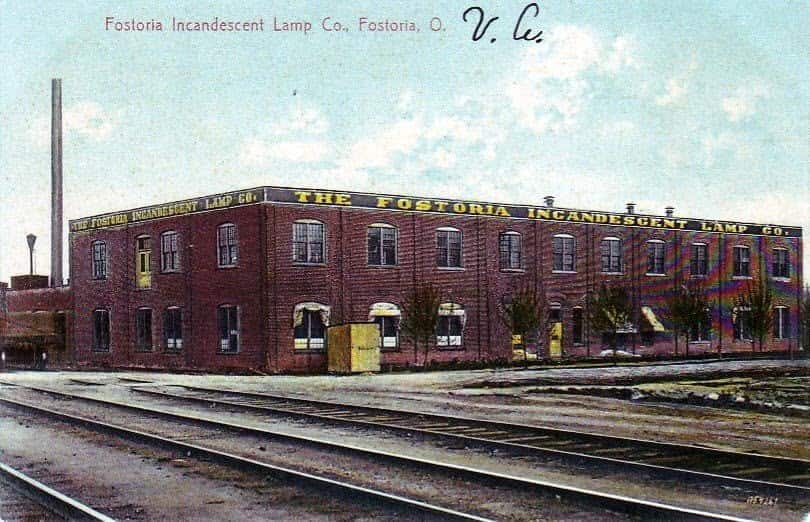
Fostoria Incandescent Lamp Co., postcard, 1900s-1910s
The long brick building on this card, with “THE FOSTORIA INCANDESCENT LAMP CO.” painted across its top, stood on South Poplar Street at the east end of Fourth Street, right beside the tracks. According to the Fostoria Area Historical Society, the company was started in 1897 by J. B. Crouse and H. A. Tremaine, the same Cleveland businessmen who had started the city’s carbon plant.
Fostoria was a real player in the early light bulb business. General Electric’s own history of Nela Park names Burton G. Tremaine of the Fostoria Incandescent Lamp Co. as one of two small-company leaders who formed the National Electric Lamp Co. in 1901, with GE quietly buying 75 percent. After a 1911 federal antitrust case, described in a Federal Trade Commission working paper, GE absorbed the business outright.
The building had a second life. After the lamp works closed, it housed the Fostoria Light Car Co. and then the Seneca Motor Car Co., which our story on the Fostoria Light Car covers.
Glass for the bulbs
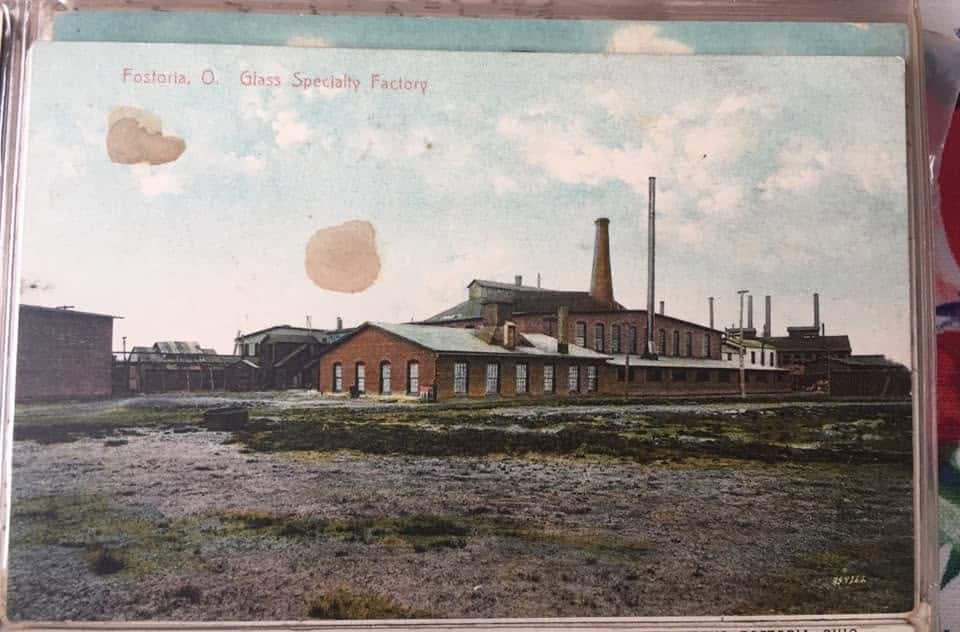
“Fostoria, O. Glass Specialty Factory,” postcard mailed in 1911
A light bulb needs glass, and Fostoria had the gas to make it. The Fostoria Glass Specialty Co. was formed in 1899 to supply bulbs and tubing for the lamp company. It took over the old Mambourg Glass Co. building south of town, which locals called the “lower” plant; the lamp works on Poplar was the “upper” plant. Lamp historians also credit the company with hand-formed decorative glass, such as lampshades.
The historical society reports that the upper plant shut down in 1914 and the lower plant in 1920, as the gas ran out and General Electric moved production to machine-made glass elsewhere. The copy of this card shown here appears to have been mailed in September 1911.
Carbon on East Tiffin Street
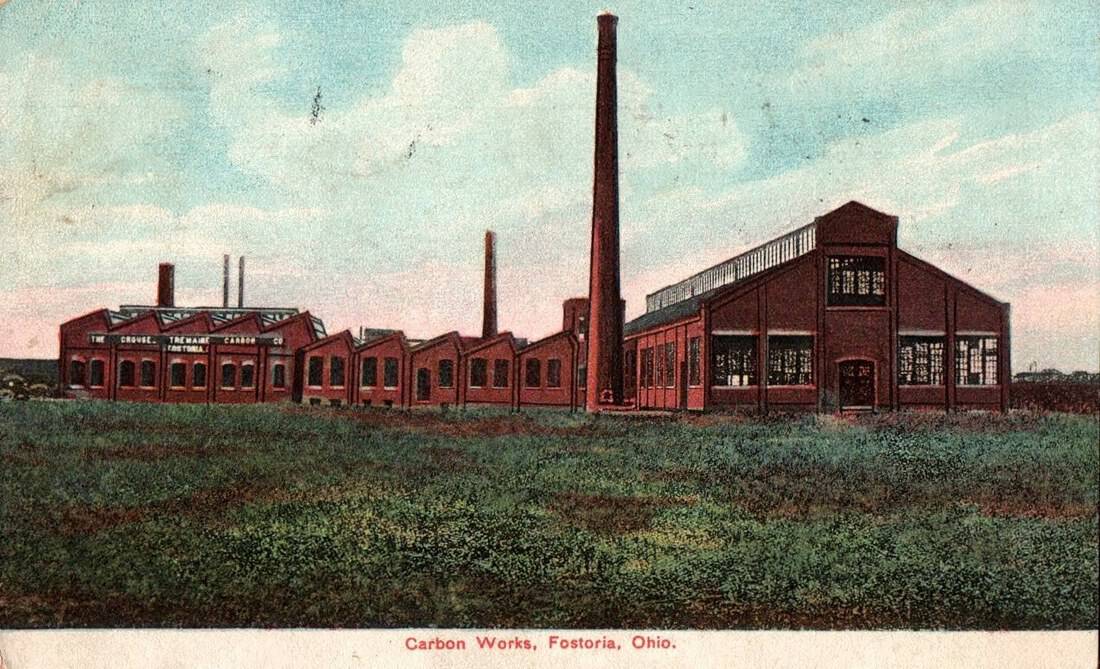
“Carbon Works, Fostoria, Ohio,” postcard, about 1909
The “Carbon Works” on this 1909 card began in 1893, when Crouse and Tremaine organized the Crouse-Tremaine Carbon Co. According to a historical society column, Fostoria’s railroads won out over other towns, including Ashtabula, and the plant went up at the eastern edge of Tiffin Street. It first made carbon rods for arc street lights.
National Carbon Co. of Cleveland bought the works; a company history lists Crouse-Tremaine among more than 20 firms it had acquired by 1906. National Carbon later became part of Union Carbide, and the Fostoria plant grew into one of the city’s largest employers, still on its original site decades later.
Pulleys and barrels
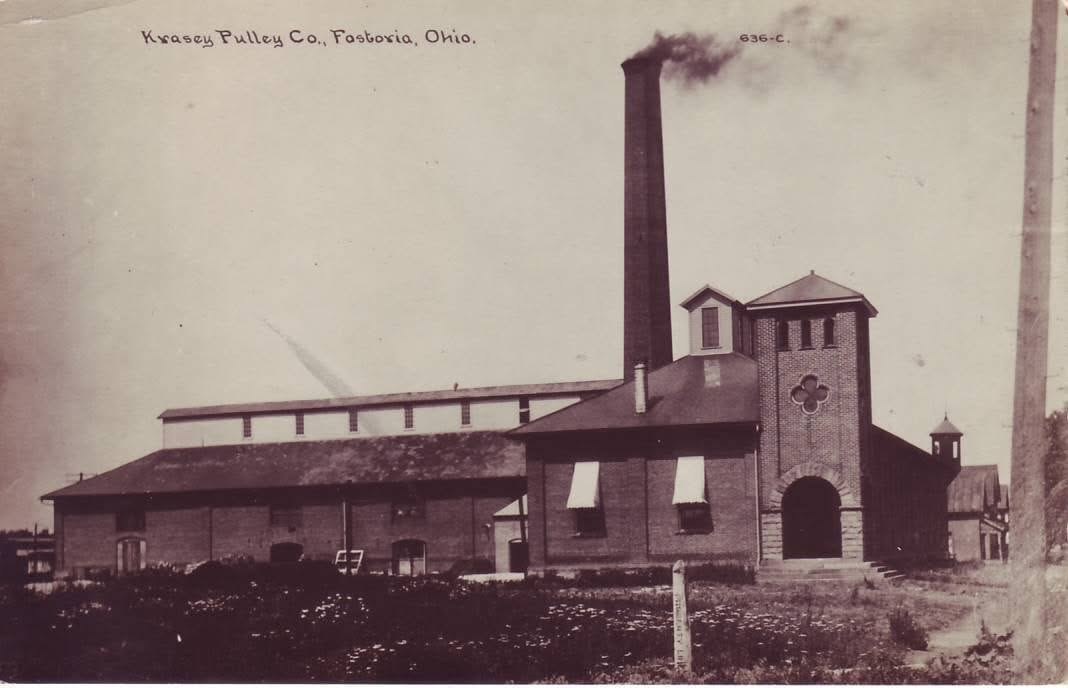
“Krasey Pulley Co., Fostoria, Ohio,” real-photo postcard, early 1900s
Not every factory left a big paper trail. This real-photo card shows the Krasey Pulley Co., a long, low brick works with a tall smokestack and a square entrance tower topped by a small cupola. In the age of line shafts, when one engine drove a whole shop through belts and wheels, pulleys were in steady demand. We were not able to find reliable records of when the company operated or where its plant stood, and we would welcome help from readers.
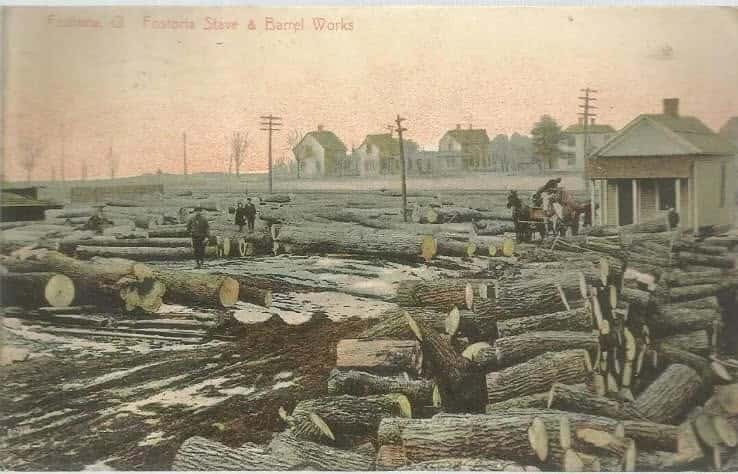
“Fostoria Stave & Barrel Works,” postcard postmarked 1910
The Fostoria Stave & Barrel Works card, postmarked 1910, is all logs: a yard heaped with timber, a few workers and a horse team, with houses in the distance. Barrel staves were cut from logs like these. A historical society column places the company on Findlay Street and notes that pioneer industrialist E. J. Cunningham, of the Cunningham spoke works, held an interest in it.
More to find
Factory postcards like these are scattered across private albums and public archives. Ohio Memory, from the Ohio History Connection and the State Library of Ohio, and the Library of Congress Sanborn fire insurance maps are good places to start looking for factory locations and layouts. For another local maker, see our story on Independent Tack Co..
Do you have a photo, pay envelope or product from any of these factories? We would like to hear from you.
Photo note: Photographs and images published before 1931 are in the public domain in the United States. Historical images in this article are shared for educational and historical purposes.
Sources
- Fostoria Area Historical Society, 12 Glass Companies Sprang Up When Free Gas Was Offered: https://www.fostoriamuseum.org/12-glass-companies-sprang-up-when-free-gas-was-offered/
- Fostoria Area Historical Society, Union Carbide Has 86-Year History: https://www.fostoriamuseum.org/union-carbide-has-86-year-history/
- Fostoria Area Historical Society, City Used to Have Many Woodworking Factories, Mills, and Center St. Passed in Review (Stave & Barrel references): https://www.fostoriamuseum.org/
- Fostoria Ohio Glass Association, Fostoria Incandescent Lamp Company: http://fostoriaglass.com/fostoria-incandescent-lamp-company/
- Lamptech, Factory – USA – Fostoria Glass Specialty: https://www.lamptech.co.uk/Documents/Factory%20-%20US%20-%20Fostoria%20Glass.htm
- General Electric, Nela Park history: https://www.ge.com/news/sites/default/files/4490.pdf
- Federal Trade Commission, The Impact and Relevance of the 1911 General Electric Lamp Case: https://www.ftc.gov/system/files/documents/reports/impact-relevance-1911-general-electric-lamp-case/wp078.pdf
- GrafTech, Redefining limits for 125 years (National Carbon acquisitions), via USPTO filing: https://ptacts.uspto.gov/
- Destination Seneca County, Ohio Historical Marker: Fostoria, Ohio – Home of Fostoria Glass: https://www.destinationsenecacounty.org/place/ohio-historical-marker-fostoria-ohio-home-of-fostoria-glass/






Leave a Reply
Want to join the discussion?Feel free to contribute!