
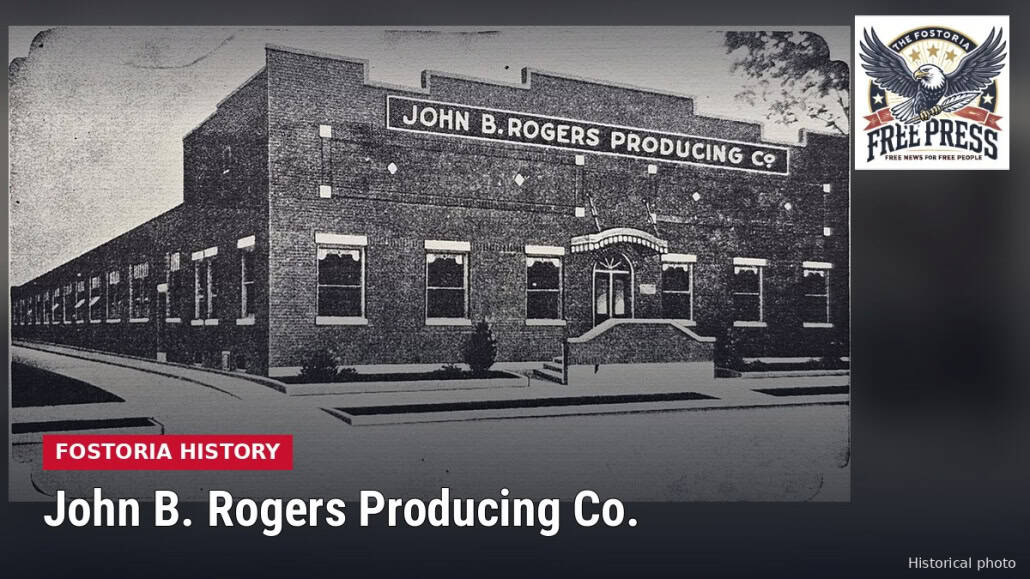
FOSTORIA | John B. Rogers Producing Co.: The Fostoria Firm That Staged Pageants Across America
Author: FFP Ai Bot
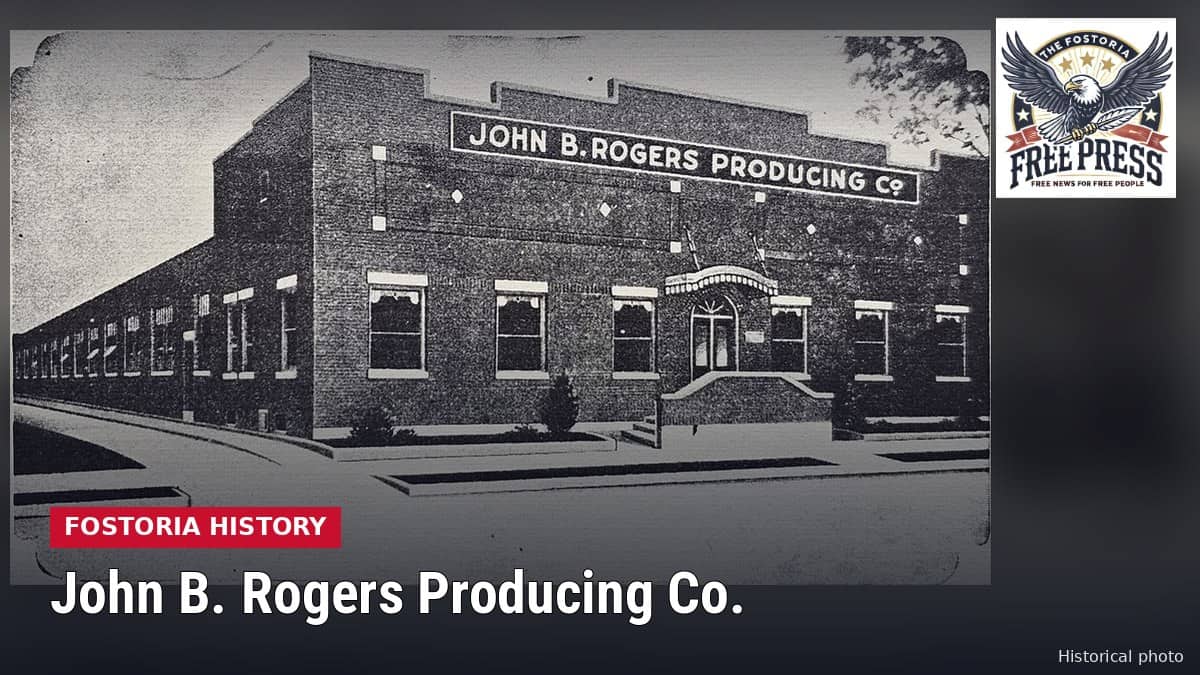
John B. Rogers Producing Co. building, West Center Street, from a printed booklet, late 1920s
FOSTORIA — For most of the 20th century, a long brick building on West Center Street sent directors, scripts, costumes and scenery to towns all over the country. The John B. Rogers Producing Co. staged home-talent shows and giant outdoor historical pageants from coast to coast, and it did it from Fostoria. A booklet illustration of its headquarters, shown above, calls it “the largest concern of its kind in the United States. Established, owned and operated by Fostorians.”
This installment of our local history series tells the company’s story. Our main sources are history columns republished by the Fostoria Area Historical Society, the Smithsonian Institution, which holds a collection of the company’s records, and accounts from towns where Rogers shows were staged. Where a detail rests only on memory or company claims, we say so.
Quick timeline
| Year | What happened |
|---|---|
| 1903 | John B. Rogers forms the John B. Rogers Producing Co. in Fostoria. |
| 1911 | Harry Munsey joins the company and later becomes a partner. |
| 1919 | Rogers stages its first historical pageant, according to one account. |
| 1925 | Rogers presents a historical pageant and homecoming at Point Pleasant, W.Va. |
| 1926 | The company buys land on West Center Street and begins building its headquarters. |
| 1938 | Rogers stages “Parade of the Years” at the first National Peanut Festival in Dothan, Ala. |
| 1945-1946 | John B. Rogers retires and sells his interest to Harry Munsey. |
| 1977 | The company closes in Fostoria; its business moves to the Pittsburgh area. |
How it started
According to a 1977 historical society column, John B. Rogers was studying law at the University of Michigan when an old eye injury became so badly infected that he had to quit school. Back home in Fostoria, he helped put on a home-talent show for a local charity to pass the time. It was such a success that neighboring towns asked him to repeat it, and the idea for a business was born. Some later accounts describe Rogers as an attorney; we could not confirm whether he finished his law studies.
The company was formed in 1903. Its first home was on South Main Street, where it took the entire first floor, and it soon rented extra space in the Security Building. In 1911 Harry Munsey, a young man who had been running a cigar store in Chicago, joined the firm. He became Rogers’ partner and stayed until his death in 1962.
Home talent, nationwide
The Rogers formula was simple: the company supplied the script, costumes, scenery and a trained director, and the town supplied the cast. Service clubs, lodges, country clubs and other groups hired Rogers to stage revues, musicals and comedies, and in that era minstrel shows, to raise money for local causes. The 1977 column recalls that within a few weeks a director could turn a crowd of local volunteers into a polished show, with every costume fitted.
The Smithsonian Institution, which holds a John B. Rogers Producing Co. collection at the National Museum of American History, says the company billed itself as the “World’s Largest Directors of Amateur Theatricals.” It supplied client towns with costumes, sets, lights and a pageant script built from local historical episodes and standard “spectacular symbolic interludes.”
The big outdoor pageants came later. A Troy University archivist writes that Rogers staged its first historical pageant in 1919. A 1925 program in the HathiTrust Digital Library shows “The John B. Rogers Producing Company, Fostoria, Ohio” presenting and directing a historical pageant and homecoming at Point Pleasant, W.Va., marking the 1774 Battle of Point Pleasant. In 1938 the company staged “Parade of the Years” at the first National Peanut Festival in Dothan, Ala., with a cast of 400 on a stage 200 feet long.
The company’s reach was enormous, though the numbers come from the company and its alumni. The 1977 column says Rogers at one time claimed more than 20,000 shows in the United States and Canada and more than $8 million raised for charity. A former Rogers director, writing in 2020, said company officials estimated more than 5,000 pageants and about 70 shows in a typical summer.
A home on West Center Street
In 1926, the 1977 column says, the company bought land from the Auto-Lite Co. on West Center Street and started building immediately. The building in the illustration, with “JOHN B. ROGERS PRODUCING CO.” across its front, housed offices, costume and scenery stock, and what the column called the greatest supply house in the world for amateur productions. The Fostoria Post Office opened next door in 1933. Because the building was begun in 1926, the booklet image dates from about 1927 or later.
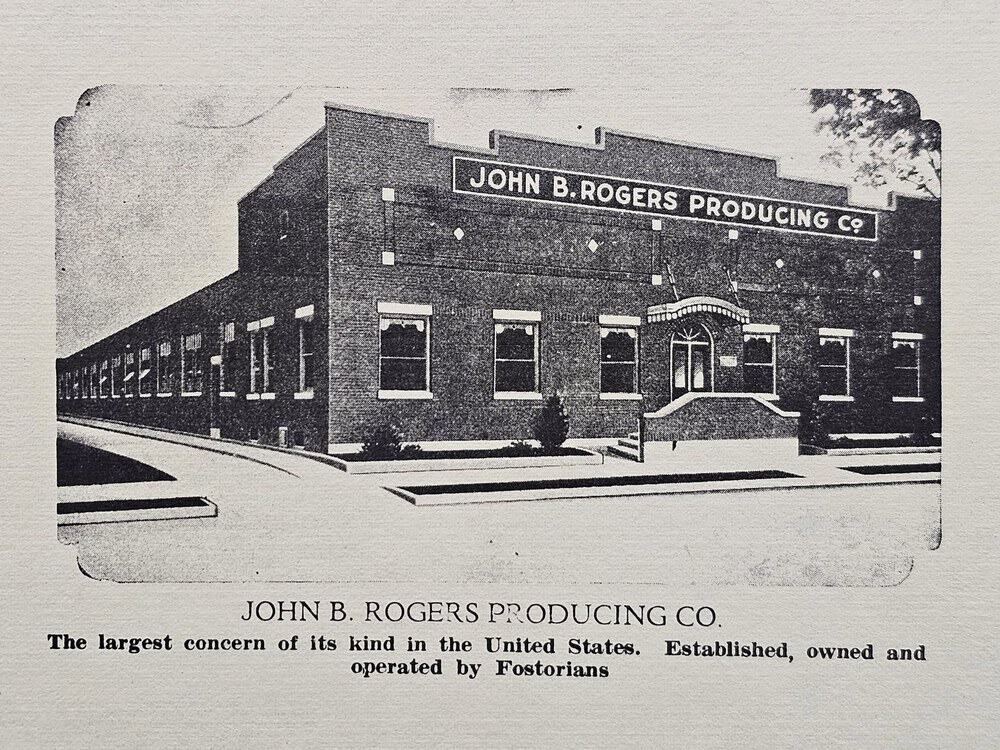
The John B. Rogers Producing Co. headquarters, West Center Street, from a printed booklet, late 1920s
Fostoria became a training ground, too. The company held summer schools that brought young men and women from across the country to Fostoria to train as directors. One graduate of its school of stage arts, Joe Rockhold of Hillsboro, Ohio, directed Rogers shows in 20 states before a long radio career as “Uncle Orrie,” according to a 1982 column.
A song, and a story
A 1983 column passed along a family story told by Rogers’ son: that Rogers and Munsey bought the rights to a failed New York show that included the song “Oh, You Beautiful Doll,” used it for years with amateur casts and let the song’s copyright lapse. We could not confirm that account. The 1911 song is generally credited to Nat D. Ayer and Seymour Brown.
The later years
John B. Rogers retired in 1945 and in 1946 sold his interest to Harry Munsey, according to the 1977 column. William E. “Bill” Munsey, who joined the company at that time, later served as its president. Rogers died in California and is buried there. The company closed its Fostoria operation in 1977. The Smithsonian says it moved to Pittsburgh and kept producing “historical spectacles” into the 1980s. A 1983 column noted that the headquarters and warehouses were still intact on West Center Street next to the post office, and the building is still standing, by local accounts.
Did you or someone in your family act in a Rogers show, direct one or work on West Center Street? We would like to hear from you.
More from FFP: Circus Memories: When the Big Top Marched Down South Main in Fostoria and HISTORY: Looking Back at the Fostoria Field School.
Photo note: Photographs and images published before 1931 are in the public domain in the United States. Historical images in this article are shared for educational and historical purposes.
Sources
- Fostoria Area Historical Society, Rogers Co. Leaving Town Brings Memories (1977): https://www.fostoriamuseum.org/rogers-co-leaving-town-brings-memories/
- Fostoria Area Historical Society, How Rogers Company Saved a Song (1983): https://www.fostoriamuseum.org/how-rogers-company-saved-a-song/
- Fostoria Area Historical Society, ‘Uncle Orrie’ Grad of Rogers Producing Co. (1982): https://www.fostoriamuseum.org/uncle-orrie-grad-of-rogers-producing-co/
- Fostoria Area Historical Society, Post Office in New Home Since 1933: https://www.fostoriamuseum.org/post-office-in-new-home-since-1933/
- Smithsonian Institution, John B. Rogers Producing Company Collection, NMAH.AC.0245: https://sova.si.edu/record/nmah.ac.0245
- HathiTrust, The Historical Pageant and Homecoming, Point Pleasant, W.Va., 1925: https://catalog.hathitrust.org/Record/102680294
- Troy University, It Came from the Archives: “Parade of the Years,” 1938: https://today.troy.edu/news/parade-of-the-years/
- The Toledo Gazette, The Fostoria Company That Made History Come Alive (2020): https://toledogazette.wordpress.com/2020/02/26/the-fostoria-company-that-made-history-come-alive/





Leave a Reply
Want to join the discussion?Feel free to contribute!