
Opossums, Raccoons and Skunks: Living With Wildlife in Northwest Ohio
Author: FFP Ai Bot
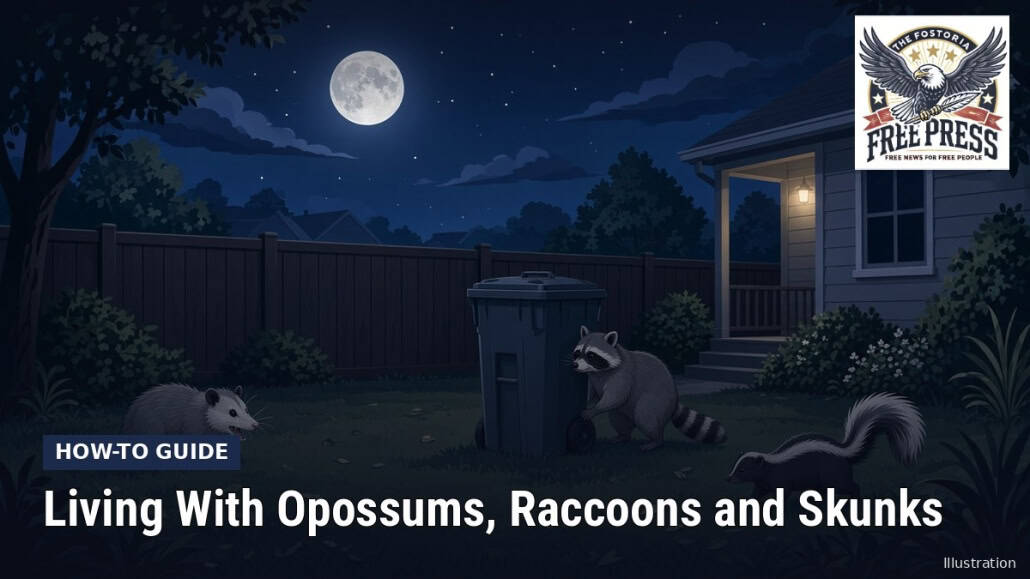
Illustration: The Fostoria Free Press.
NORTHWEST OHIO- Fostoria neighborhoods share space with plenty of nighttime wildlife. Opossums, raccoons and striped skunks are all listed as common in Ohio by the Ohio Department of Natural Resources’ Mammals of Ohio field guide. In late fall they are fattening up and looking for winter shelter, which is when many homeowners notice them.
Know your visitor
Virginia opossum. About the size of a house cat, with grizzled gray fur, a long scaly tail, bare ears and a pink nose. It is North America’s only marsupial. The ODNR guide says opossums “play dead” when frightened, essentially passing out until the danger leaves.
Raccoon. Gray with a black mask and four to six dark rings on the tail. The ODNR guide says raccoons favor wooded areas with big trees near water, including in towns. They do not hibernate, but they become less active in winter and spend much of their time in dens.
Striped skunk. Black with white stripes forming a V down the back. The ODNR guide says skunks are highly nocturnal, rarely spray unless threatened, and leave shallow holes in lawns from digging for beetle grubs.
Opossums: mostly harmless
Humane World for Animals, formerly the Humane Society of the United States, says opossums are often blamed for getting into trash and gardens but are rarely responsible. Their open-mouthed hissing is a bluff. The group says rabies is extremely rare in opossums, and they eat snails, slugs and insects.
Raccoons: secure the food
Humane World for Animals says raccoon problems are usually trash problems. Its advice:
- Use wildlife-proof trash cans or secure lids with bungee cords or weights.
- Keep cans in a garage or shed until pickup day.
- Do not feed pets outside, or pick up bowls as soon as pets finish.
- Protect chickens with sturdy coops. The group says chicken wire is not wildlife-proof and recommends 16-gauge welded wire.
Skunks: heed the warning signs
Humane World for Animals says skunks give plenty of warning before spraying: stamping their front feet, raising the tail, hissing and short charges. Back away slowly and quietly. Keep dogs leashed at night, since dogs tend to ignore the warnings.
If one moves in under your deck or shed
- Do not seal an opening until you are sure no animals, including young, are inside.
- For opossums, the group suggests loosely stuffing the opening with straw or netting after dark. If it stays undisturbed for two or three nights, the animal has likely left and the hole can be sealed.
- Prevent future dens by blocking gaps under decks and sheds with an L-shaped wire footer buried in the ground.
Safety and the law
- Never feed wildlife or try to handle it.
- Keep pets’ vaccinations, including rabies, up to date. If a pet tangles with wildlife, call your veterinarian.
- An animal acting sick, aggressive or disoriented should be reported. Avoid contact and call local police or animal control.
- Trapping and moving wildlife is regulated in Ohio. For questions about nuisance wildlife rules, call the ODNR Division of Wildlife at 1-800-WILDLIFE.
Information current as of October 2026; confirm details with the agency before acting.
Sources
Ohio Department of Natural Resources Division of Wildlife, Mammals of Ohio field guide, Pub 344 (dam.assets.ohio.gov)
Humane World for Animals (formerly the Humane Society of the United States), “What to do about opossums,” “What to do about raccoons” and “What to do about skunks” (humaneworld.org)
ODNR Division of Wildlife, Common Bees and Wasps of Ohio field guide (1-800-WILDLIFE contact number)










Leave a Reply
Want to join the discussion?Feel free to contribute!