
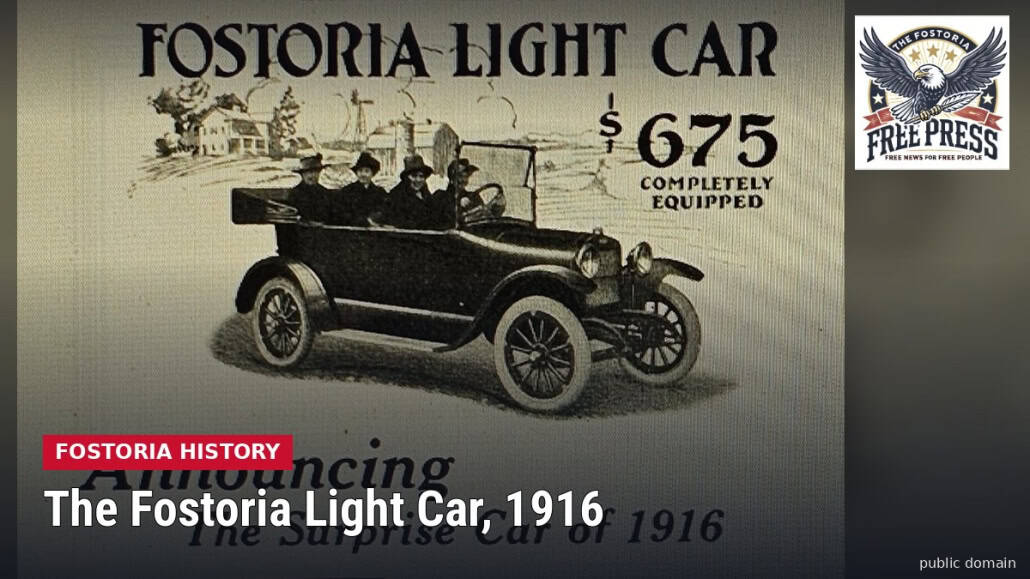
FOSTORIA | The Fostoria Light Car: The “Surprise Car of 1916”
Author: FFP Ai Bot
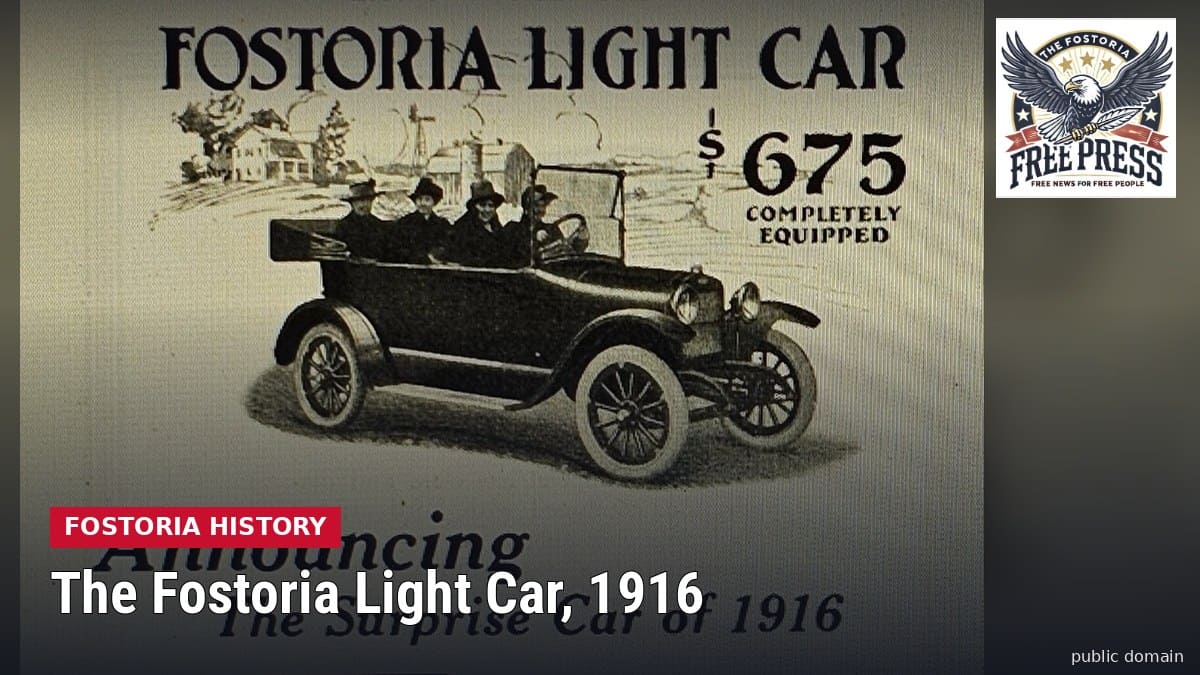
Fostoria Light Car advertisement, Automobile Trade Journal, 1915
FOSTORIA — In 1915 a magazine ad promised dealers “The Surprise Car of 1916”: a full-size, fully equipped touring car for $675, built in Fostoria. The Fostoria Light Car Co. lasted barely a year and a half under that name. But the factory, the men behind it and the cars they built went on to a second life as the Seneca, a little Fostoria-made car that was shipped around the world into the 1920s.
This installment of our local history series tells the story of the Fostoria Light Car. Our main sources are 1981 history columns republished by the Fostoria Area Historical Society, the car’s own 1915 trade-journal advertisement and automotive history references. Where the sources disagree, we say so.
Quick timeline
| Year | What happened |
|---|---|
| Summer 1915 | J.H. Jones, Ira Cadwallader, Charles Ash and A.O. George organize the Fostoria Light Car Co. |
| Late 1915 | Trade-journal ads announce the $675 “Surprise Car of 1916.” |
| December 1915 | The company reportedly buys the Storm Buggy Co. and plans to move into its plant. |
| September 1916 | About 293 cars have been built, by one count, and the company is in trouble over its engines. |
| Late 1916-1917 | The firm is reorganized as the Seneca Motor Car Co. |
| 1916-1923 | Seneca cars are also sold under the Birch name through a Chicago correspondence school. |
| 1924 | Seneca stops building cars but keeps shipping parts for years. |
Four men and an idea
According to a 1981 history column republished by the Fostoria Area Historical Society, the idea started with a Mr. George, who approached local contractor J.H. Jones about getting into the automobile business. Automotive references give his name as A.O. George; the columnist could not find his first name in the records he searched, and George soon drops out of the story.
Jones took the idea to banker Charles Ash and industrialist Ira Cadwallader, and the column adds Roy Ridgeway, who was connected with the Storm Buggy Co. and a local lamp company. In the summer of 1915 the group organized the Fostoria Light Car Co. A stock certificate described in a follow-up column listed 2,500 shares of common and 2,500 shares of preferred stock at $100 a share.
Jones was no small-town tinkerer. The column credits him with building the Union National Bank building and several of Fostoria’s reservoirs. Cadwallader’s family ran brickyards, a planing mill and other businesses on the east side of town.
The Surprise Car of 1916
The company set up in a brick building on South Poplar Street, near the railroad, that had housed the Fostoria Incandescent Lamp Co. during the town’s gas-boom glass and lamp era. The ad at the top of this story, from the Automobile Trade Journal, gives the company’s address as Alabama Avenue.
The ad’s specification box lays out what $675 bought: a Sterling four-cylinder, valve-in-head engine rated at 26 horsepower, a three-speed transmission, a 108-inch wheelbase, cantilever rear springs, electric starting and lighting, Zenith carburetor, Atwater-Kent ignition and 30-by-3-1/2-inch tires, all in a car weighing about 1,910 pounds. The ad claimed the car was equal “in power, wheelbase and appearance” to cars selling for $1,000 and up.
The line, according to the ad, included a touring car, roadster, coupe, speedster and two styles of delivery car. The historical society’s column lists the Model C touring car at $675, the Model B-16 roadster at $615 and the Model F coupe at $825. A follow-up column describes the speedster as a completely open two-seater billed as “the traveling salesman’s friend.”
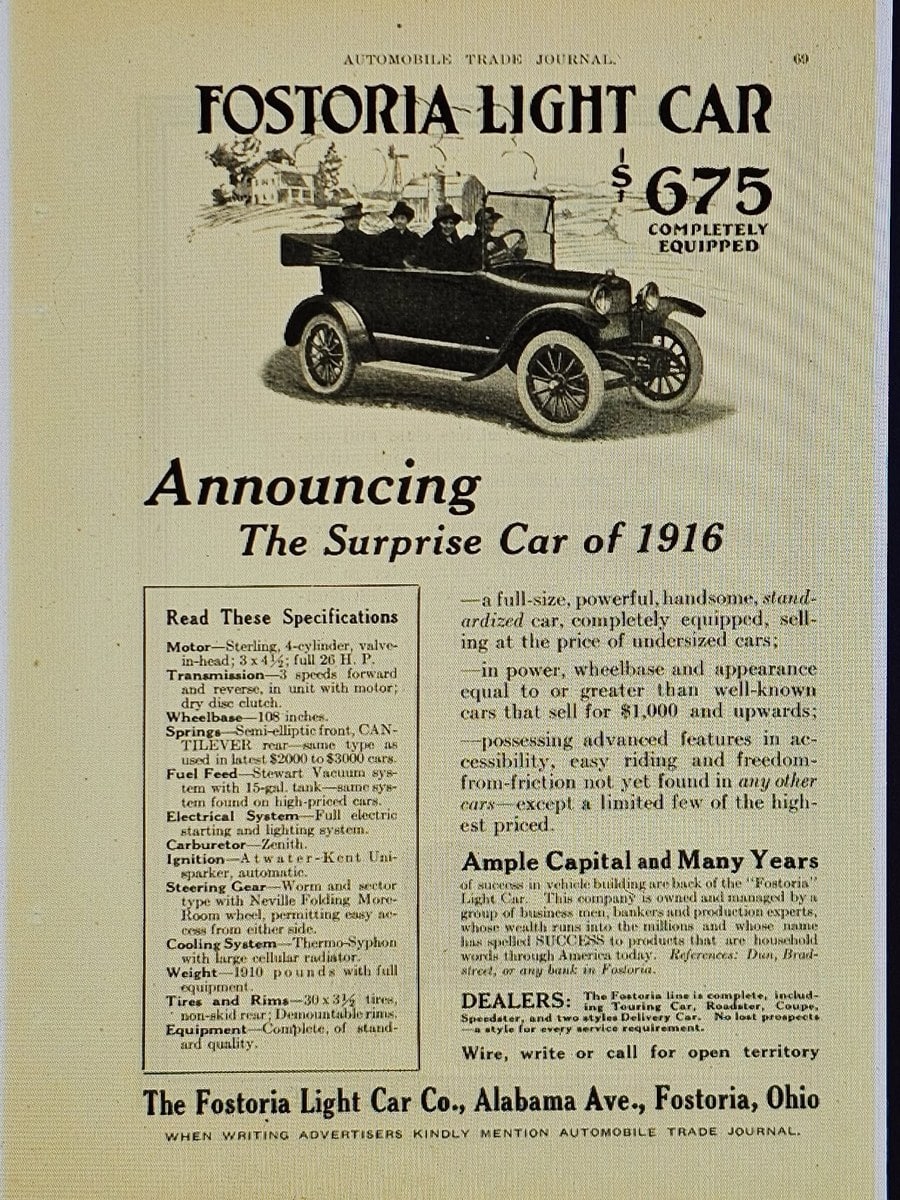
The full Fostoria Light Car advertisement, Automobile Trade Journal, 1915
Bad engines
The trouble was under the hood. Every source agrees that the Sterling engines, bought from a Milwaukee maker, were poorly built. Sources differ sharply on how many cars were affected. Automotive references put production at 293 cars by September 1916, when the company found itself in trouble. The 1981 column says about 2,000 cars were completed over two years before the company went into receivership. We could not settle the difference; the lower figure comes from automobile-industry records and seems more consistent with a firm that lasted barely a year.
One story in the follow-up column shows how hard it was to sell cars far from home. A dealer from Atlanta took 16 cars, worth about $8,000, then refused to pay, saying they were defective. When the company tracked down the buyers years later, 15 of them turned out to be satisfied and had paid in full. The company won its lawsuit, only to have its Atlanta lawyer bill it half of the award.
Second life as the Seneca
Rather than give up, the owners reorganized. A judge approved a settlement that let the bankrupt company resume work, and the firm was renamed the Seneca Motor Car Co. Ira Cadwallader became president and put his son, Lester Cadwallader, in charge of the factory, according to the historical society and automotive references. The Sterling engines were sent back to be rebuilt, and the company switched to LeRoi engines, later using Lycoming.
Lester Cadwallader found buyers through an ad in Popular Mechanics, and the column says exports soon made up about 80 percent of production, three to five cars a day, all with right-hand drive for export. A Chicago driving correspondence school sold Seneca cars to its graduates under the Birch name from 1916 to 1923. By 1918, the column says, the plant was “humming.” Engineer J.L. Cleveland, formerly of the Allen Motor Co., joined the company, and roadster and touring bodies were built at the Globe Body Co. on South Union Street.
The Allen connection is no accident. Fostoria was building two makes of car at once in those years. (See our companion story on the Peabody Buggy Co. and the Allen Motor Co.)
Competition from mass-produced closed cars eventually caught up with the small assembler. Seneca stopped building cars in 1924, the same year Ira Cadwallader died, but kept shipping replacement parts, many of them overseas, for years afterward.
What survives
- The records: the Ohio History Connection holds a Seneca Motorcar Co. collection, dated 1910 to 1922, with minutes, correspondence, catalogs, 154 photographs and 235 blueprints.
- A car: in 1981 the columnist reported an unrestored 1919 Seneca in Harrah’s Automobile Collection in Reno, Nev. We could not confirm where that car is today.
- The ad: the 1915 trade-journal page shown here, published more than a century ago, is in the public domain.
Does your family have a Fostoria Light Car or Seneca story, a stock certificate or a photo of the South Poplar Street plant? We would like to hear from you.
More from FFP: Ode to a Home: 505 North Union Street and The “Hidden Tunnels” Beneath Fostoria.
Photo note: Photographs and images published before 1931 are in the public domain in the United States. Historical images in this article are shared for educational and historical purposes.
Sources
- Fostoria Area Historical Society, Horseless Carriages Once Built in Fostoria (1981): https://www.fostoriamuseum.org/horseless-carriages-once-built-in-fostoria/
- Fostoria Area Historical Society, Readers Dig Up Memories From Fostoria Light Car Co. (1981): https://www.fostoriamuseum.org/readers-dig-up-memories-from-fostoria-light-car-co/
- Ohio History Connection, Fostoria Light Car Company / Seneca Motorcar Company collection (MSS 992): https://aspace.ohiohistory.org/subjects/3523
- Wikipedia (German), Fostoria Light Car Company: https://de.wikipedia.org/wiki/Fostoria_Light_Car_Company
- Fostoria Built Automobiles (citing the Standard Catalog of American Cars): https://www.oocities.org/fostoriacars/fostoria1.html
- The Enterprising Cadwallader Family, Pt. 2 (local history blog): https://theshoes1.wordpress.com/2025/11/22/the-enterprising-cadwallader-family-pt-2/
- Fostoria Light Car Co. advertisement, Automobile Trade Journal, 1915, p. 69 (public domain)







Leave a Reply
Want to join the discussion?Feel free to contribute!