
FOSTORIA | The LE&W Depot, the Iron Triangle and the Union Stock Yards: How Railroads Built Fostoria
Author: FFP Ai Bot
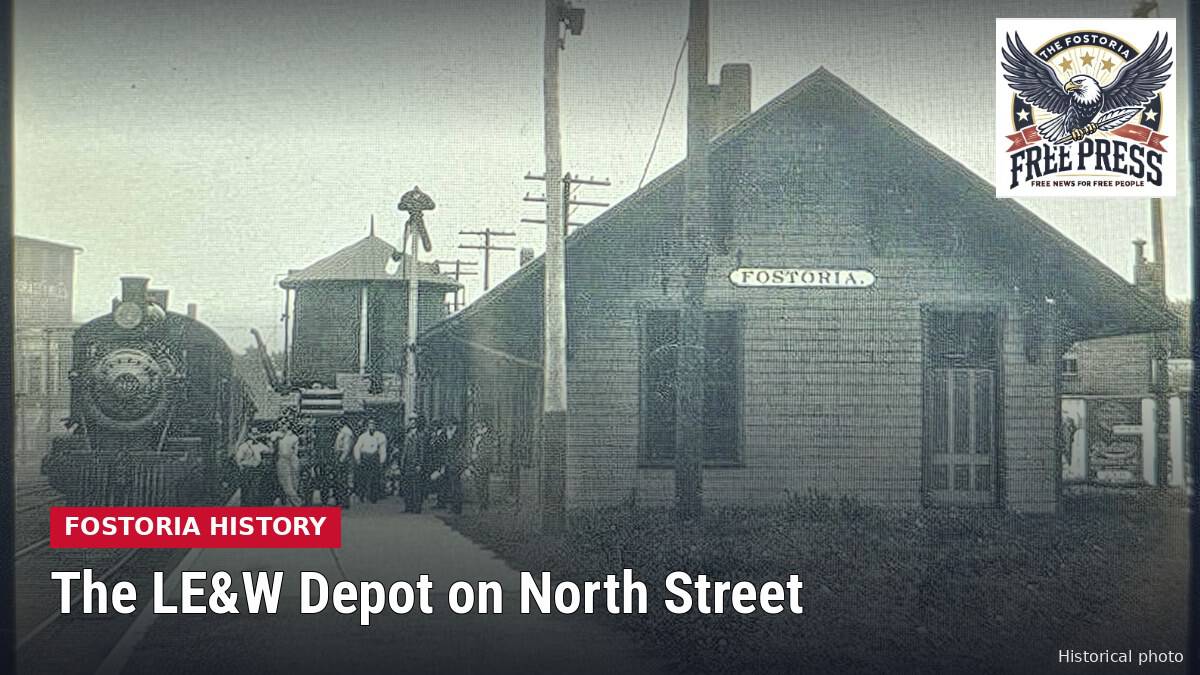
Lake Erie & Western depot, North Street, 1900s
FOSTORIA — Long before anyone called it “Train City,” Fostoria was a town that grew up at a crossing of rails. Steam trains, interurban cars and freight lines turned a pair of 1830s crossroads villages into a manufacturing city, and a little wooden depot on West North Street has watched almost all of it.
In this installment of our local history series we look at the Lake Erie & Western depot, the rail lines that formed the famous “Iron Triangle,” and the Union Stock Yards that once shipped livestock from the south end of town. Facts come from the Fostoria Area Historical Society’s archive, Destination Seneca County, the Fostoria Rail Preservation Society, Library of Congress fire insurance maps and news reports. Where a detail rests only on local memory, we say so.
Quick timeline: Fostoria and the railroads
| Year | What happened |
|---|---|
| 1854 | The villages of Rome and Risdon unite as Fostoria, named for Charles W. Foster. |
| 1850s | The Fremont & Indiana line, later part of the Lake Erie & Western, becomes the first railroad in town. |
| 1872-1873 | The Columbus & Toledo (later Hocking Valley and C&O) and the Baltimore & Ohio arrive. |
| 1878 | The LE&W builds its passenger depot at 128 W. North St., reportedly for $850. |
| 1880s | The Nickel Plate line adds another crossing. |
| 1898-1932 | Electric interurban lines connect Fostoria with Toledo, Findlay, Fremont and beyond. |
| 1909 | A postcard of the Union Stock Yards shows livestock pens and rail sidings on the south side. |
| Aug. 31, 1929 | The last LE&W passenger train from Sandusky runs through Fostoria. |
| 2007 | The Fostoria Rail Preservation Society acquires the LE&W depot. |
| Nov. 15, 2013 | The Iron Triangle Rail Park opens on South Poplar Street. |
From Rome and Risdon to the rails
Fostoria began as two settlements: Rome, laid out along the Tiffin road, and Risdon, platted along what became Main Street. In 1854 they joined under a new name honoring Charles W. Foster, the merchant whose son, Charles Foster, would later serve as Ohio governor and U.S. treasury secretary. The railroads arrived almost as soon as the town did. According to Destination Seneca County, the first line was the Fremont & Indiana, a route that later became part of the Lake Erie & Western.
A 1978 history column republished by the Fostoria Area Historical Society says the town’s first depot stood on the land later occupied by the Candyland restaurant, near Sandusky and Main streets. When the line became LE&W property, a new depot and freight station were built on the south side of the tracks between Main and North streets.
More lines followed, and each one crossed the others. By the 1870s and 1880s, the Columbus & Toledo (later the Hocking Valley and then the Chesapeake & Ohio), the Baltimore & Ohio and the Nickel Plate all ran through town. Those crossings put Fostoria on the map for shippers and, a century later, for train watchers. Three major routes, today operated by CSX and Norfolk Southern, still form the triangle of tracks that gives the “Iron Triangle” its name, with dozens of trains passing in a typical day.
The LE&W depot on North Street
The modest depot at 128 W. North St. was built in 1878 by the Lake Erie & Western for a reported $850, according to Destination Seneca County and the Fostoria Rail Preservation Society. The photo at the top of this story shows it in its working years, with a steam locomotive at the platform and passengers and crew gathered by the baggage carts.
The 1896 Sanborn fire insurance map of Fostoria, held by the Library of Congress, shows the LE&W passenger and freight depots along the tracks just a block from St. Wendelin’s Church and school, which explains why the parish and the depot so often appear in the same old photographs.
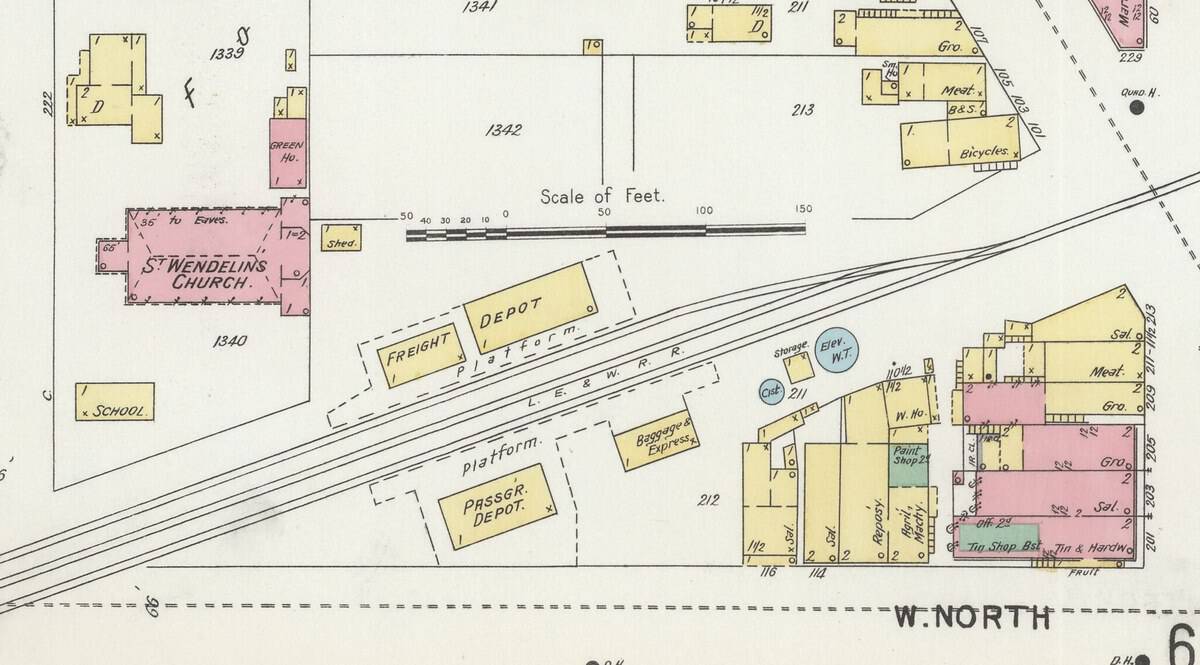
Sanborn fire insurance map detail, LE&W depots and St. Wendelin, 1896
The LE&W, later absorbed into the Nickel Plate system, carried passengers between Sandusky and Indiana. The historical society’s archive records the last passenger run on Aug. 31, 1929, when train No. 21 left Sandusky for Bloomington, Ind., with eight passengers aboard. Older residents of the time remembered summer excursion trains on the line to Cedar Point. By 1978 the rails and ties on the old roadbed through town had been pulled up.
The depot itself survived. A local column from 1978 notes it was then serving as headquarters for Camp Fire. The Fostoria Rail Preservation Society acquired it in 2007 with help from a grant from the Henry H. Geary Jr. Memorial Foundation and has worked to restore it.
The Union Stock Yards
All those crossing rail lines made Fostoria a natural place to gather livestock for shipment. A postcard marked 1909 shows the “Union Stock Yards, Fostoria, Ohio,” with long pens, a frame office and several sidings. A circa-1921 national list of stockyards includes the Fostoria Union Stock Yards, and old local maps place it near the tracks east of South Poplar Street.
Local accounts describe the yards as a place where farmers from Seneca, Hancock and Wood counties brought cattle and hogs to be fed, watered and loaded onto rail cars bound for big terminal markets. As trucking took over livestock hauling in the decades before World War II, rail stockyards across Ohio faded, and Fostoria’s did too. We could not find a firm closing date.
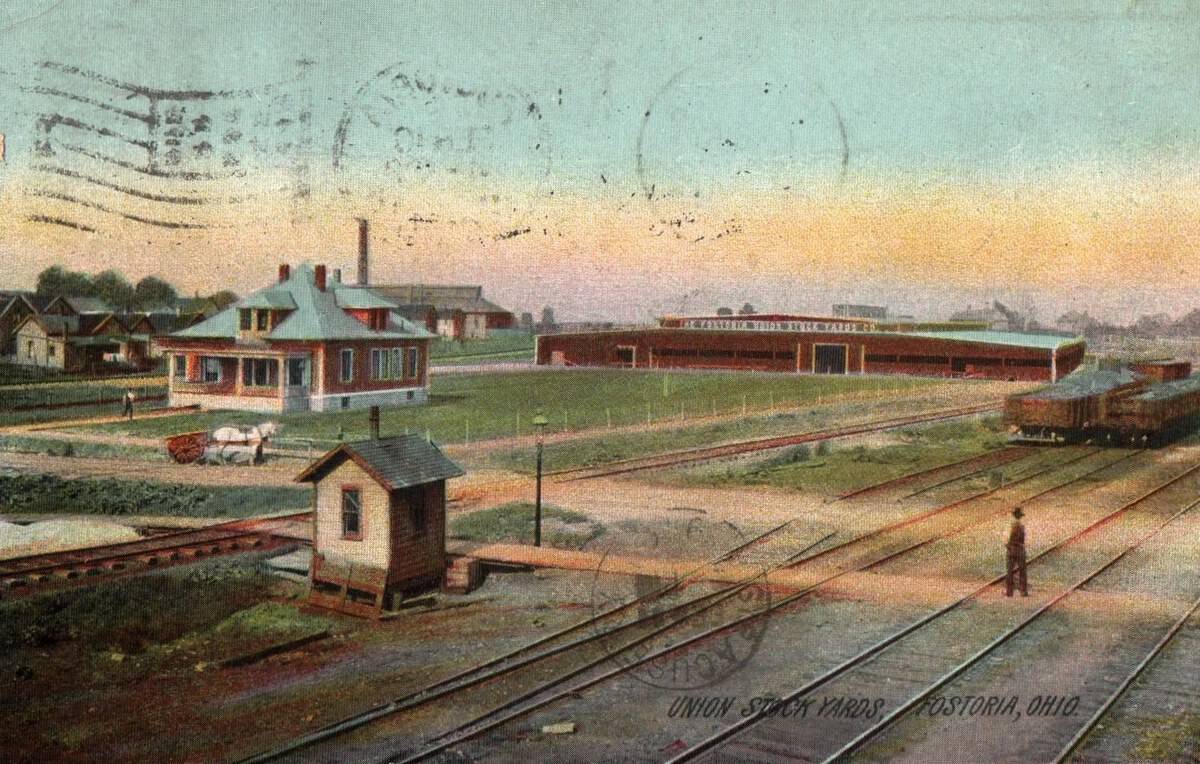
Union Stock Yards postcard, 1909
Then and now
The depot: the LE&W depot still stands at 128 W. North St. and is owned by the Fostoria Rail Preservation Society. It sits about a block from St. Wendelin’s church grounds, as it did on the 1896 map above.
The stockyards: the pens are long gone. In 2013 Fostoria opened the Iron Triangle Rail Park at 499 S. Poplar St. A 2013 Toledo Blade report said the park was built on the cleared site of a former pork-packing plant, next to the former stockyards site, which was also being cleared for redevelopment. The park, built with state transportation funds, has a pavilion, viewing platforms and a front-row seat to the CSX and Norfolk Southern main lines. It officially opened Nov. 15, 2013.
That means the same patch of ground where drovers once loaded cattle is now where visitors from around the country come to watch trains, a fitting full circle for a town built by the railroad.
More from FFP: Fostoria: Time for a Train Drop on New Year’s Eve? and The “Hidden Tunnels” Beneath Fostoria.
Photo note: Photographs and images published before 1931 are in the public domain in the United States. Historical images in this article are shared for educational and historical purposes.
Sources
- Destination Seneca County, From Risdon and Rome to the Rails: https://www.destinationsenecacounty.org/blog/from-risdon-and-rome-to-the-rails-the-birth-of-fostoria-and-its-railroad-legacy/
- Destination Seneca County, LE&W Depot: https://www.destinationsenecacounty.org/place/lew-depot/
- Fostoria Rail Preservation Society, Fostoria Depots and Buildings: https://www.fostoriairontriangle.com/buildings.htm
- Fostoria Rail Preservation Society, Rail Park opens Nov. 15: http://fostoriairontriangle.com/focus.htm
- The Blade (via FRPS), Fostoria to start construction soon on train-watching park: http://www.fostoriairontriangle.com/pdf/bladearticle.pdf
- Ohio.org, Iron Triangle Rail Park: https://ohio.org/wps/portal/gov/tourism/things-to-do/destinations/iron-triangle-rail-park-2
- Fostoria Area Historical Society, Remnants of Steam Rail Removed (1978): https://www.fostoriamuseum.org/remenants-of-steam-rail-removed/
- Fostoria Area Historical Society, Postcards – Train Depots: https://www.fostoriamuseum.org/postcards-train-depots/
- Library of Congress, Sanborn Fire Insurance Map, Fostoria, 1896: https://www.loc.gov/item/sanborn06698_003/
- Railway Bull Shippers Group, Stockyard list circa 1921: https://groups.io/g/RailwayBullShippersGroup/message/5500



Leave a Reply
Want to join the discussion?Feel free to contribute!