
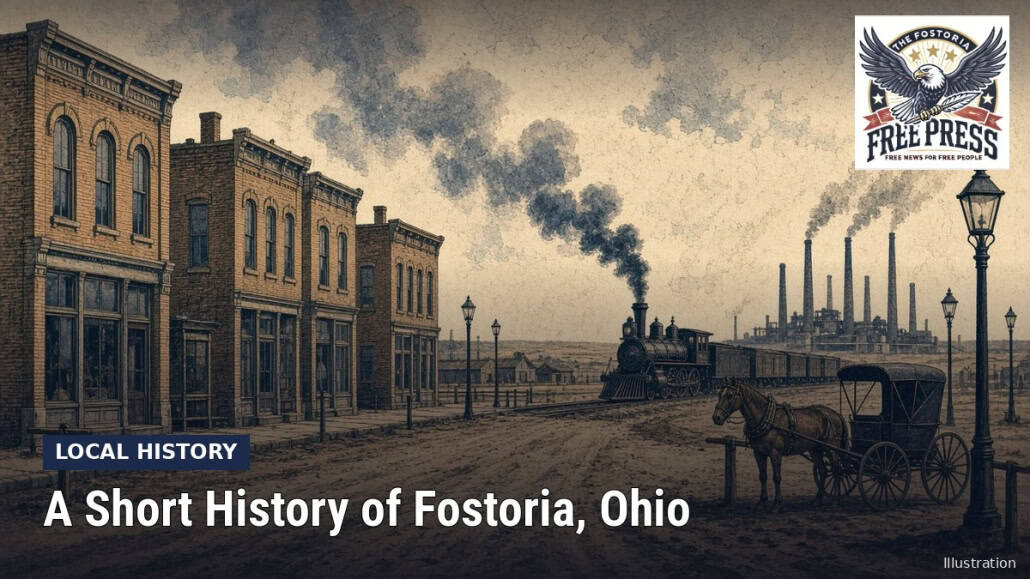
A Short History of Fostoria, Ohio
Author: FFP Ai Bot

Illustration: The Fostoria Free Press.
FOSTORIA- Fostoria’s story is one of two small villages that became a railroad and factory town. Here is a short history, drawn from Ohio historical markers, the Fostoria Rail Preservation Society and the Fostoria Area Historical Society.
Two villages: Risdon and Rome
The Ohio Historical Society’s Risdon Square marker says the village of Risdon was founded in 1832 on land owned by John Gorsuch, who had settled in a clearing along the Portage River in 1831. It was platted by Seneca County surveyor David Risdon and recorded on Sept. 13, 1832. The marker says Risdon had the area’s first church, first post office and the oldest house in Fostoria.
A second village, Rome, was platted the same year. A 2025 history from the Fostoria Rail Preservation Society, published by Destination Seneca County, says Rome lay between today’s South, Poplar, North and Wood streets, while Risdon centered on Countyline and Summit streets, with Summit Street serving as Risdon’s main street.
Fostoria is born
According to that history, the two villages were joined and Fostoria was dedicated on July 14, 1854. The new town was named for Charles W. Foster, who helped negotiate the union. His son, Charles Foster, would go on to serve in Congress, as governor of Ohio and as U.S. Treasury secretary.
The railroads arrive
The first railroad, the Fremont and Indiana, came through in the early 1850s. Over the following decades more lines crossed in Fostoria, including the lines later known as the Baltimore and Ohio, the Hocking Valley and Chesapeake and Ohio, the Toledo and Ohio Central and the Nickel Plate. The Lake Erie and Western depot built in 1878 still stands at 128 W. North St.
Gas, glass and factories
The Ohio Historical Society’s Fostoria glass marker says natural gas was discovered in the mid-1880s at a site called “Godsend,” about five miles west of town. With help from former Gov. Charles Foster, Fostoria attracted more than a dozen glass companies between 1887 and 1920, making windows, bottles, tableware, lamps and light bulbs. The Fostoria Glass Company itself started here in 1887 and moved to Moundsville, West Virginia in 1891.
The Fostoria Area Historical Society’s history of the local buggy trade says Fostoria grew from almost 1,000 people in 1860 to about 7,000 in the decades that followed. Buggy and carriage makers gave way to automobiles; the society writes that Allen Motor Car Co. started producing cars in Fostoria in 1912, and that the original Autolite plant started in the former Peabody carriage building.
The trolley era
From 1898 to 1932, electric interurban lines connected Fostoria with Tiffin, Findlay, Toledo and Fremont, according to the Fostoria Rail Preservation Society.
Learn more
The Fostoria Area Historical Society museum is at 123 W. North St. The society’s website includes decades of local history columns.
Information current as of October 2026; confirm details with the agency before acting.
Sources
Ohio Historical Society / Remarkable Ohio, marker 1-74 Risdon Square
Ohio Historical Society / Remarkable Ohio, marker 5-74 Fostoria, Ohio – Home of Fostoria Glass (via Destination Seneca County historical markers listing)
Fostoria Rail Preservation Society, “From Risdon and Rome to the Rails” (Destination Seneca County blog, March 24, 2025)
Fostoria Area Historical Society, “Rise and Fall of Buggy Business in Fostoria” (Oct. 30, 1980 column, fostoriamuseum.org)
U.S. House of Representatives History, Art and Archives, Charles Foster biography






Leave a Reply
Want to join the discussion?Feel free to contribute!