
FOSTORIA | “Replace With Fostoria”: The Pressed Steel Company That Put Fostoria Fenders on America’s Cars
Author: FFP Ai Bot
Fostoria Fenders ad, Motor Age, September 1925
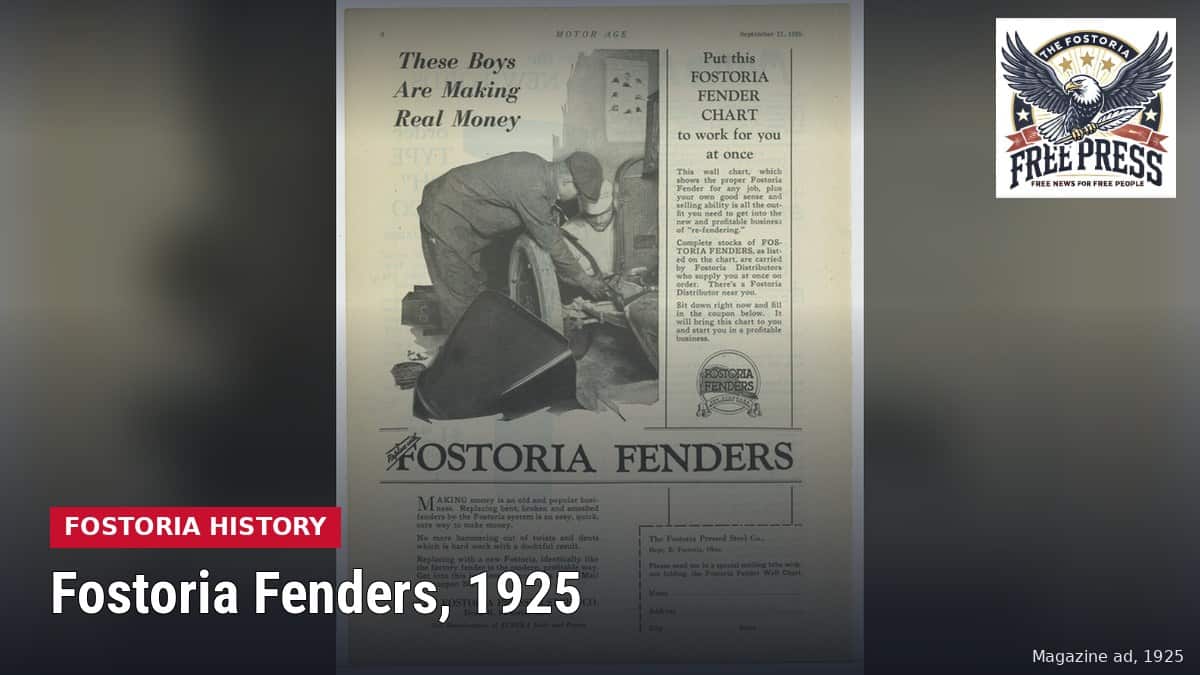
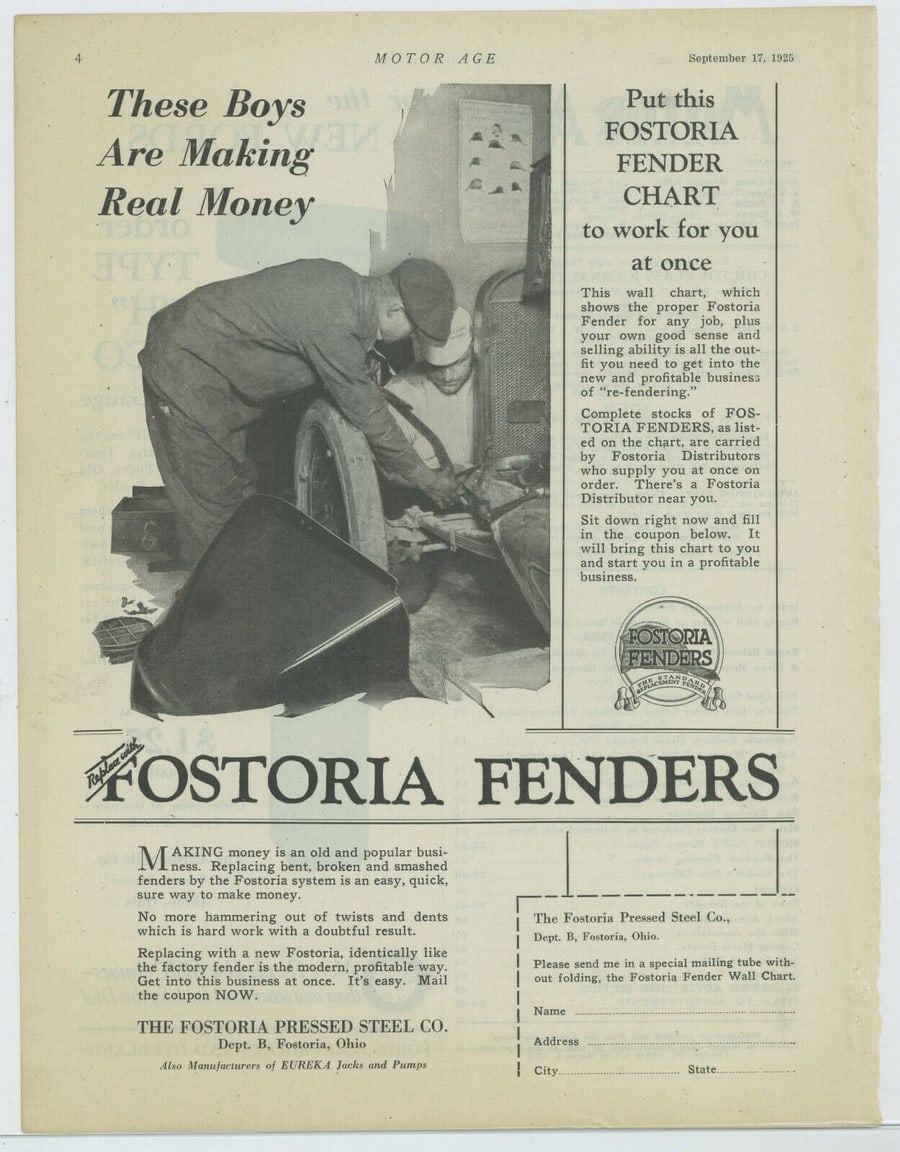
FOSTORIA — “These Boys Are Making Real Money,” the headline promises. In the photo, two mechanics wrestle a new fender onto a battered car. “Replacing bent, broken and smashed fenders by the Fostoria system is an easy, quick, sure way to make money,” the ad copy says. “No more hammering out of twists and dents.”
The ad ran in Motor Age magazine in September 1925, placed by The Fostoria Pressed Steel Co. of Fostoria, Ohio. This installment of our local history series looks at the company behind Fostoria Fenders, which started as a supplier to the city’s own car makers and grew into one of its longest-lived industries.
Quick timeline
| Year | What happened |
|---|---|
| April 2, 1917 | Articles of incorporation for The Fostoria Pressed Steel Co. are signed; the state charter follows April 23. |
| 1918 | Allen Motor Co., its main early customer, moves to Columbus. |
| 1925 | Fostoria Fenders ads run in Motor Age magazine. |
| 1934 | The company offers 339 fender models for a dozen makes of car. |
| 1935 | It develops “Localite” industrial lighting fixtures. |
| 1939 | It develops infrared equipment for paint drying and industrial heating. |
| 1942 | Its 25th anniversary; the fender business is phased out during World War II. |
| 1977 | Now known as Fostoria Industries, it marks its 60th year. |
Built for the Allen car
According to a 1977 Fostoria Area Historical Society column, written by a man who had joined the company’s sales staff in 1941, the company traces its start to April 2, 1917, when articles of incorporation were signed by W. O. Allen, C. D. Pifer, Henry Rothrock, E. C. Wolfe and George E. Schroth. The state of Ohio issued the charter on April 23, 1917. Ohio business filings can be searched through the Ohio Secretary of State.
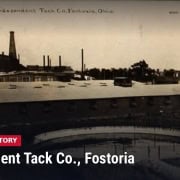
The new firm was promoted mainly by people tied to the Allen Motor Co., the subject of our story on Peabody buggies and Allen motor cars. Its job was to stamp sheet metal parts for the Allen car: fenders, engine hoods, gas tanks and dust shields. It started in a building that had belonged to the Seneca White Lime Co.
When Allen moved to Columbus in 1918, the young company lost its biggest customer almost overnight. New investors bought stock to keep it afloat, and it went on to make sheet metal parts for other regional car builders, including Maibohn Motor Car Co. of Sandusky, the Economy (later Vogue) Motor Car Co. of Tiffin and the Seneca Motor Car Co. of Fostoria, which grew out of the Fostoria Light Car Co.
The early years were hard. The 1977 column says short-term loans were sometimes needed to meet the payroll, and at one point everyone took a pay cut. Products came and went, including a sealant called Titeseal, camp stoves and luggage carriers for cars.
Re-fendering America
Fostoria Fenders ad, Motor Age, Sept. 17, 1925
Replacement fenders turned out to be the winner. Cars were multiplying fast, fenders were easily crumpled, and automakers could not keep up with the demand for spare parts. The 1925 ads pitched garage owners on a “new and profitable business of re-fendering.” A wall chart showed the proper Fostoria fender for any job, and stocks were carried by Fostoria distributors around the country. A coupon invited readers to send to “Dept. B, Fostoria, Ohio” for the chart. The ad also notes that the company made Eureka jacks and pumps.
Fostoria Fenders ad, Motor Age, Nov. 12, 1925
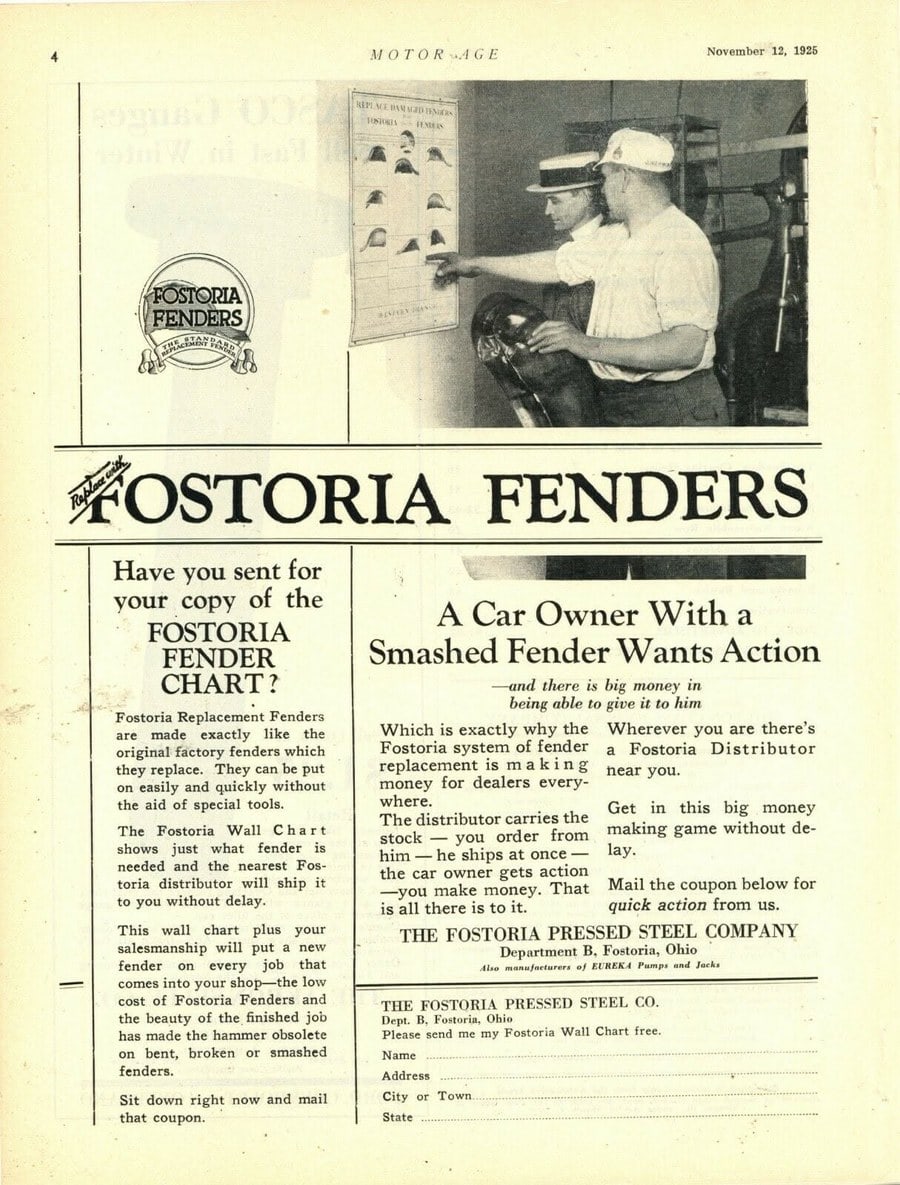
A second ad, from November 1925, turned to the customer’s side of the counter: “A Car Owner With a Smashed Fender Wants Action.” By 1934, according to the historical society, the company offered 339 fender models for Buick, Chrysler, Chevrolet, DeSoto, Oakland, Oldsmobile, Plymouth, Pontiac, Studebaker and Whippet-Willys cars. In their day, the column says, fenders made Fostoria as well known as Fostoria glassware.
From fenders to infrared
The company kept reinventing itself. It developed “Localite” lighting fixtures for factory machines in 1935 and infrared equipment for paint drying and other industrial heating in 1939, just in time for war production. Fenders faded out during World War II, because dies were expensive and steel was restricted to essential uses. A 1944 U.S. patent for radiant heat treating equipment was issued to Fostoria Pressed Steel Corp.
By its 60th year, in 1977, the company was known as Fostoria Industries and had moved into a new plant. The column describes it then as a subsidiary of TPI Corp. of Johnson City, Tenn., with infrared ovens and localized lighting leading its sales.
Magazines like Motor Age are a rich source for Fostoria’s industrial past. Many early trade journals can be found through the Library of Congress and online libraries. For more Fostoria makers, see our look at Fostoria factories on early postcards.
Did you or a relative work at Fostoria Pressed Steel or Fostoria Industries? We would like to hear from you.
Photo note: Photographs and images published before 1931 are in the public domain in the United States. Historical images in this article are shared for educational and historical purposes.
Sources
- Motor Age, Fostoria Fenders advertisements, Sept. 17, 1925, and Nov. 12, 1925 (photo collection)
- Fostoria Area Historical Society, Fostoria Industries Has Diamond Jubilee (Dec. 13, 1977): https://www.fostoriamuseum.org/fostoria-industries-has-diamond-jubilee/
- Fostoria Pressed Steel Corp., U.S. Patent 2,354,658, Radiant heat treating and apparatus therefor (1944): https://www.freepatentsonline.com/2354658.html
- Fostoria Industries, “The Infrared Specialist,” Sweet’s catalog (1979): http://sweets.construction.com/swts_content_files/29864/1979_238200-FOS_08.pdf
- Ohio Secretary of State, business search: https://businesssearch.ohiosos.gov/








Leave a Reply
Want to join the discussion?Feel free to contribute!