
FOSTORIA | Tower, Reservoirs and a Fountain: The Old Fostoria Water Works on Early Postcards
Author: FFP Ai Bot
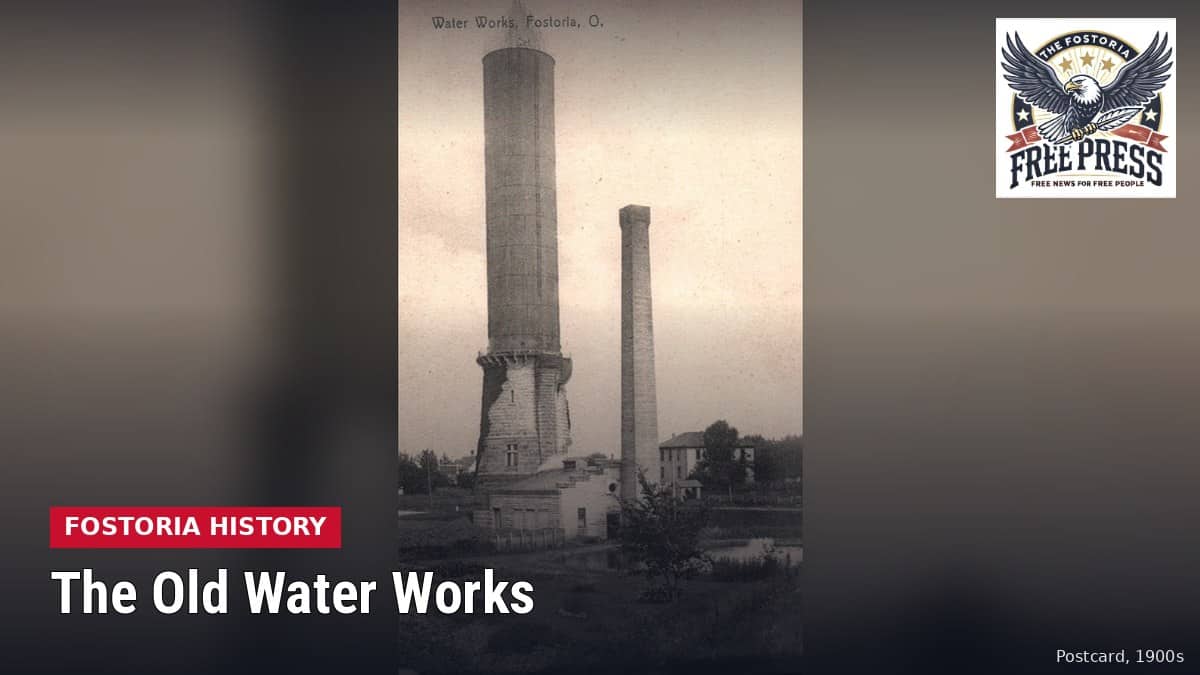
“Water Works, Fostoria, O.,” postcard, 1900s
FOSTORIA — A tall brick tower rises over a pumping station. In another view, a fountain throws a jet of water high above a quiet pond ringed with trees.
Both are early postcards of the Fostoria water works. This installment of our local history series looks at how the city stored and cleaned its drinking water, cut ice from its reservoirs and even turned its water works grounds into a park. It is a companion to our recent story on the 1928 sewage treatment plant, which covered where the water went after it was used.
Quick timeline
| Year | What happened |
|---|---|
| Late 1800s-early 1900s | Ice is harvested each winter from Reservoir No. 2 and stored in ice houses nearby. |
| About 1913 | The last ice harvest from the reservoir, as one worker later recalled. |
| May 1928 | A national water works journal publishes an article on water softening and pumping station improvements at Fostoria. |
| Today | Six reservoirs supply raw water to the treatment plant at 744 W. Fremont St. |
The tower and the pumps
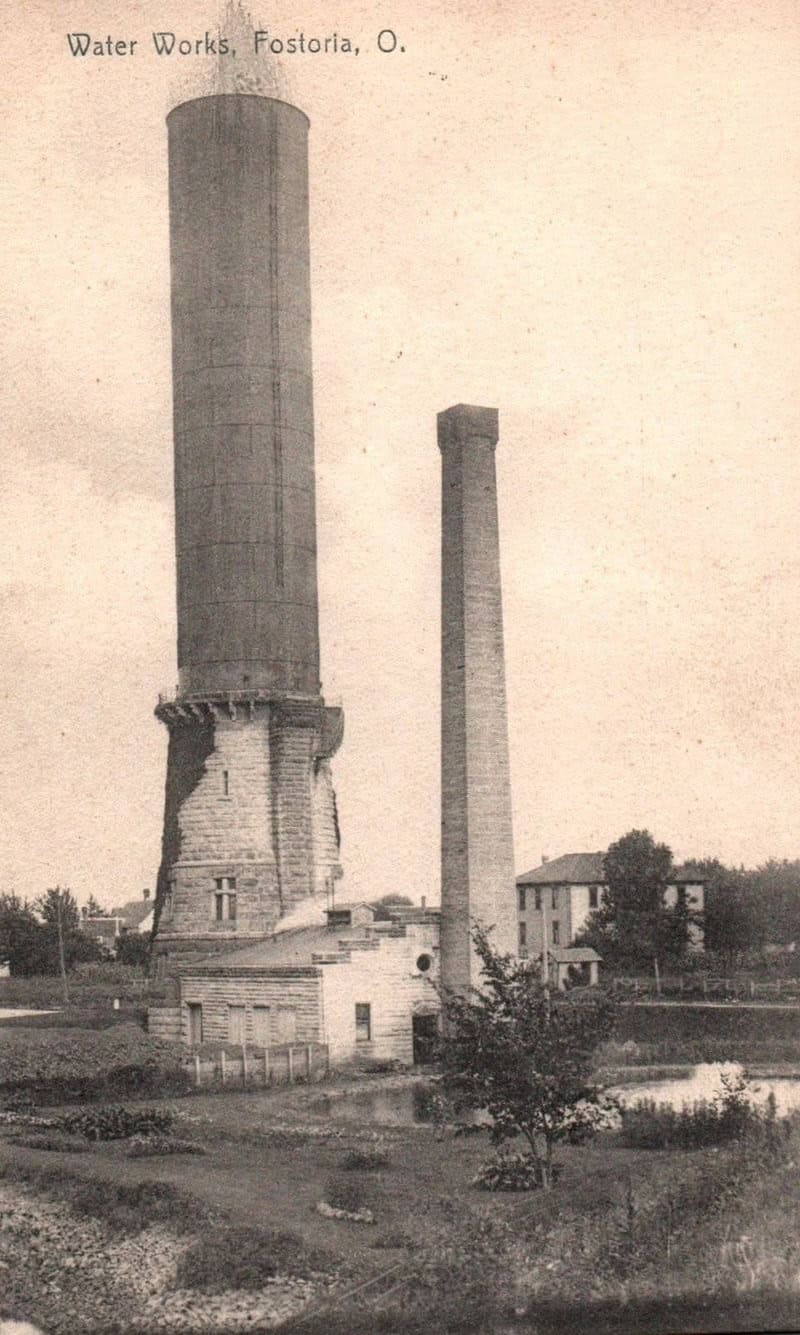
“Water Works, Fostoria, O.,” postcard, 1900s
The card shown at the top of this page and again here carries the simple caption “Water Works, Fostoria, O.” over a striking view: a tall, round brick water tower on a stone base, a slimmer smokestack beside it and a low pumping house between them. Steam pumps, fired by the boiler under that stack, would have pushed water from the reservoirs up into the tower and out into the city’s mains.
A Fostoria Area Historical Society column about ice harvesting describes an early photo with “the water works and tower” on one side of Reservoir No. 2 and the old Fostoria Academy on the other, which helps place the scene. We were not able to confirm when the tower was built or when it came down.
Cleaning the water
Pumping was only part of the job. Over the years the city also had to clean and soften its water before it reached homes. In May 1928, the Journal of the American Water Works Association published an article on “Water Softening Plant and Pumping Station Improvements at Fostoria, Ohio,” a sign that the city kept investing in the plant.
Ice from Reservoir No. 2
The reservoirs did double duty in winter. According to the historical society, ice was cut from Reservoir No. 2 in the late 1800s and early 1900s, floated through an open channel with pike poles and carried by a steam-powered conveyor into double-walled ice houses insulated with a foot of sawdust. A man who ran the boiler house for that conveyor later recalled that the crews could store at least 60,000 pounds an hour.
He believed 1913 was the last year ice was harvested from the reservoir. By then, the Fostoria Ice & Coal Co. was making ice in a plant on East North Street.
A park with a fountain
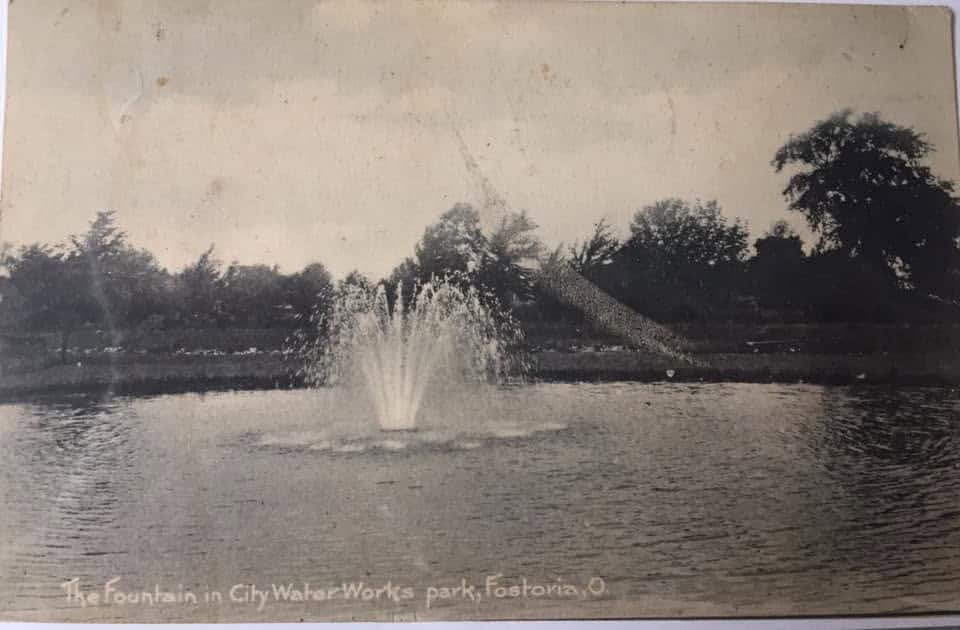
“The Fountain in City Water-Works park, Fostoria, O.,” real-photo postcard, early 1900s
The second card shows what its caption calls “The Fountain in City Water-Works park.” A single tall jet rises from the middle of a pond, with a broad lawn and mature trees behind it. Many cities of the era landscaped their water works grounds as public parks, and this card suggests Fostoria did the same. We have not found records of when the park and fountain were built or how long they lasted.
Still the city’s water supply
According to the City of Fostoria, raw water today is stored in six reservoirs around the city. Most is pumped from the East Branch of the Portage River into Reservoirs No. 5 and No. 6, then flows by gravity to the water treatment plant at 744 W. Fremont St. There it is treated, filtered and disinfected and pumped through about 100 miles of pipe, with the Culbertson and Zeller Road towers holding treated water for fire protection.
One of those reservoirs carries a name with a story. A historical society column notes that Lake Mottram was named for Charles Mottram, a Fostoria man killed in action in World War II, whose grandfather and uncle had run the waterworks for many years.
Firefighters once had other water sources, too: the same society has documented underground cisterns beneath some uptown streets, filled by roof runoff, that crews could pump from in a fire. Our story on the horse-drawn fire department has more on firefighting in that era.
Do you have photos of the old water tower, the ice houses or the Water Works park fountain? We would like to hear from you.
Photo note: Photographs and images published before 1931 are in the public domain in the United States. Historical images in this article are shared for educational and historical purposes.
Sources
- City of Fostoria, Water Treatment: https://www.fostoriaohio.gov/1221/Water-Treatment
- Fostoria Area Historical Society, Ice Cutting Here Long Ago: https://www.fostoriamuseum.org/ice-cutting-here-long-ago/
- Fostoria Area Historical Society, Readers Dig Up Memories From Fostoria Light Car Co. (Mottram family, Lake Mottram): https://www.fostoriamuseum.org/
- Fostoria Area Historical Society, Underground Reservoir Service on West Center Street: https://www.fostoriamuseum.org/underground-reservoir-service-on-west-center-street/
- J. F. Laboon, “Water Softening Plant and Pumping Station Improvements at Fostoria, Ohio,” Journal AWWA, May 1928: https://doi.org/10.1002/j.1551-8833.1928.tb13576.x







Leave a Reply
Want to join the discussion?Feel free to contribute!