
FOSTORIA | Clean Water, 1928: How Fostoria Built the Sewage Plant That Still Serves the City
Author: FFP Ai Bot
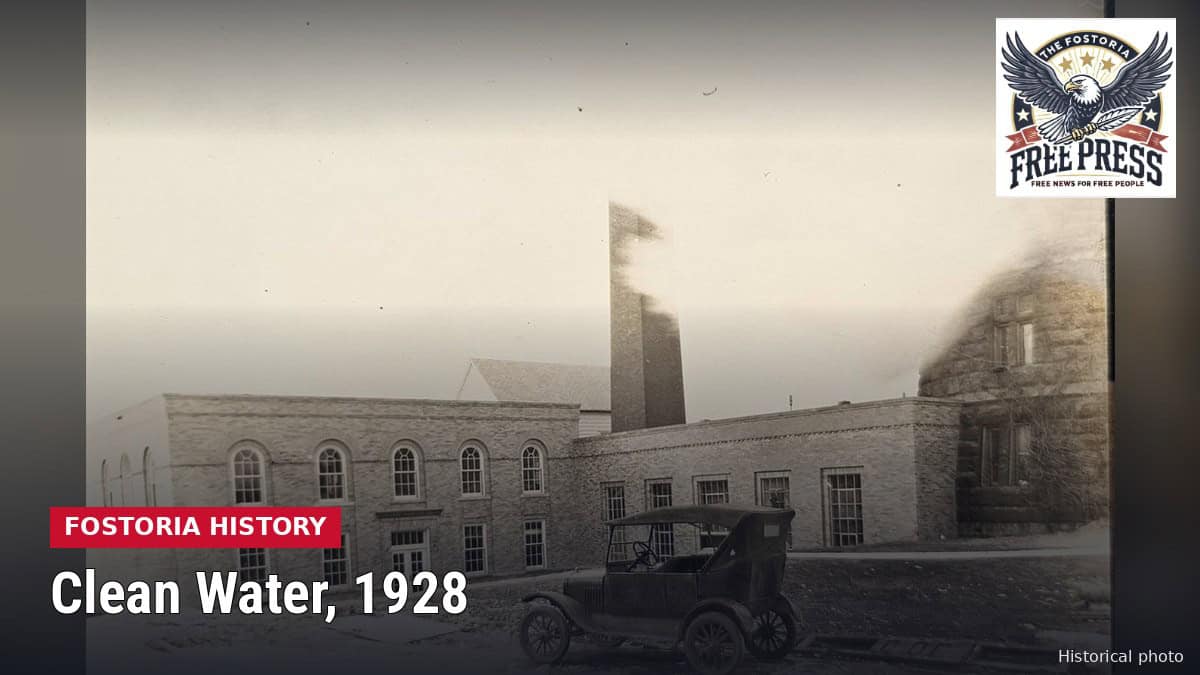
A Fostoria municipal plant building with a Model T out front, 1920s
FOSTORIA — It is not the kind of history that makes postcards. There are no parades or ribbon-cuttings in these pictures, just a typed page headed “SEWERAGE DISPOSAL” and a photo of a long brick building with a Model T parked in the mud out front.
But the work those pages describe changed daily life in Fostoria as much as any factory. This installment of our local history series looks at how the city came to build a modern sewage treatment plant in 1928, a plant that, much expanded, still cleans the city’s wastewater today.
Quick timeline
| Year | What happened |
|---|---|
| 1926 | In Fostoria v. Elder, the Ohio Supreme Court declines to take up the city’s appeal in a case over sewage being dumped into a stream. |
| May 1928 | A national water works journal publishes an article on water softening plant and pumping station improvements at Fostoria. |
| 1928 | The sewage treatment plant is rebuilt and expanded, according to a typed city report, and Ohio EPA lists 1928 as the plant’s construction year. |
| 2021 | The plant receives its latest major upgrade. |
| Today | The plant at 1301 Perrysburg Road has a design flow of 8.25 million gallons a day and serves nearly 20,000 people. |
A problem downstream
Like many Ohio towns that grew fast during the gas boom of the 1880s and the factory years that followed, Fostoria piped its sewage away from homes and businesses and let the streams carry it off. By the 1920s, that was no longer acceptable to the state or to neighbors downstream.
Court records show the dispute reached the Ohio Supreme Court. In Fostoria v. Elder, decided in August 1926, the city argued that a court could not order it to stop dumping sewage into a stream, because state health authorities had already taken jurisdiction and had ordered Fostoria to install proper facilities by a set date. The Supreme Court overruled the city’s motion to hear the appeal. The case summaries we found do not give the full background, so we do not know the details of the complaint or who Elder was.
What the case does show is that by 1926 the state had ordered Fostoria to build proper sewage treatment, and the clock was running.
“The present Sewage Treatment Plant is new”
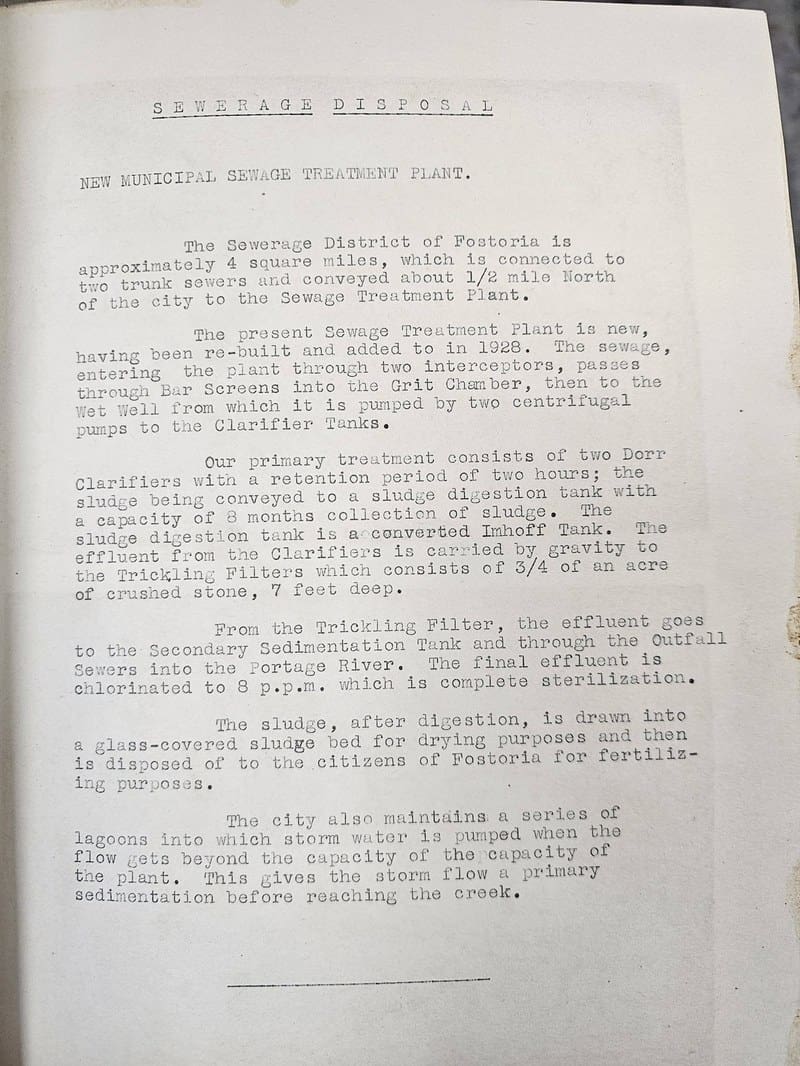
“Sewerage Disposal,” a typed page describing the new municipal plant, late 1920s or 1930s
A typed page, apparently from a city report or booklet, describes the result. “The present Sewage Treatment Plant is new, having been re-built and added to in 1928,” it says. The sewerage district covered about four square miles, connected to two trunk sewers that carried wastewater about half a mile north of the city to the plant.
The page walks through each step. Sewage entered through two interceptors and passed through bar screens and a grit chamber to a wet well, where two centrifugal pumps lifted it to the clarifier tanks. Primary treatment used two Dorr clarifiers with a two-hour retention period. Sludge went to a digestion tank, described as a converted Imhoff tank, that could hold eight months of sludge.
From the clarifiers, the water flowed by gravity to trickling filters made of three-quarters of an acre of crushed stone, seven feet deep. It then passed through a secondary settling tank and out to the Portage River, chlorinated before release. Digested sludge was dried in a glass-covered bed and then, the report says, “disposed of to the citizens of Fostoria for fertilizing purposes.” The city also kept storm-water lagoons to give overflow a first settling before it reached the creek.
We do not know exactly when the page was typed. Its description of the 1928 plant as new suggests the late 1920s or 1930s.
Water in, water out
The sewage plant was only half of the story. In May 1928, the Journal of the American Water Works Association published an article by J. F. Laboon of the Chester Engineers of Pittsburgh titled “Water Softening Plant and Pumping Station Improvements at Fostoria, Ohio.” We were able to confirm the article’s title, author and date, but not read its full text, so we cannot say what the improvements included.
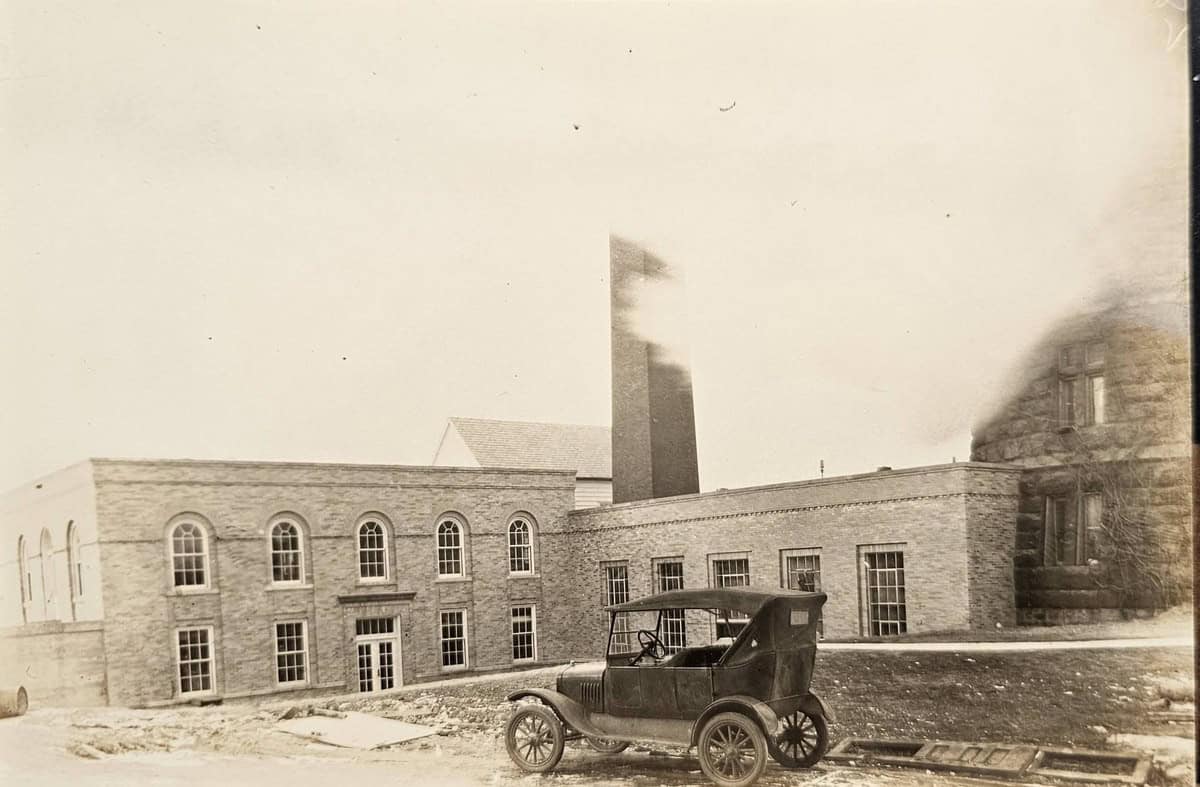
A municipal plant building with a Model T touring car, 1920s
The photograph shown here was kept with the typed sewage plant page. It shows a long, two-story brick building with round-arched upper windows, a lower wing and a tall square chimney, with a Ford Model T touring car parked on rough, unfinished ground. The car and the raw construction site point to the 1920s. We have not been able to confirm which city plant the building housed, so we describe it only as a municipal plant building.
Still at work
According to a 2025 permit fact sheet from the Ohio Environmental Protection Agency, the Fostoria Wastewater Treatment Plant was constructed in 1928 and last upgraded in 2021. It has an average design flow of 8.25 million gallons a day and a peak capacity of 12.7 million gallons. It serves Fostoria, parts of the Northwestern Water and Sewer District, the village of New Riegel and Loudon and Jackson townships in Seneca County and Washington Township in Hancock County, nearly 20,000 people in all. Treated water still goes to the East Branch of the Portage River.
Information on today’s plant is available from the City of Fostoria.
Do you have photos of Fostoria’s water works, sewage plant or reservoirs from the early days? We would like to hear from you.
More from FFP: The “Hidden Tunnels” Beneath Fostoria and Main, Perry and Sandusky at the Turn of the Century.
Photo note: Photographs and images published before 1931 are in the public domain in the United States. Historical images in this article are shared for educational and historical purposes.
Sources
- “Sewerage Disposal: New Municipal Sewage Treatment Plant,” typed page, late 1920s-1930s (photo collection)
- Ohio EPA, NPDES permit modification fact sheet, Fostoria WWTP, permit 2PD00031 (public notice May 8, 2025): https://dam.assets.ohio.gov/image/upload/epa.ohio.gov/Portals/35/permits/doc/2PD00031.fs.pdf
- Fostoria v. Elder, Ohio Supreme Court, No. 20074 (Aug. 1926), 4 Ohio Law Abs. 868: https://app.midpage.ai/document/fostoria-v-elder-6734804
- J. F. Laboon, “Water Softening Plant and Pumping Station Improvements at Fostoria, Ohio,” Journal AWWA, May 1928: https://doi.org/10.1002/j.1551-8833.1928.tb13576.x
- City of Fostoria: https://fostoriaohio.gov/







Leave a Reply
Want to join the discussion?Feel free to contribute!