
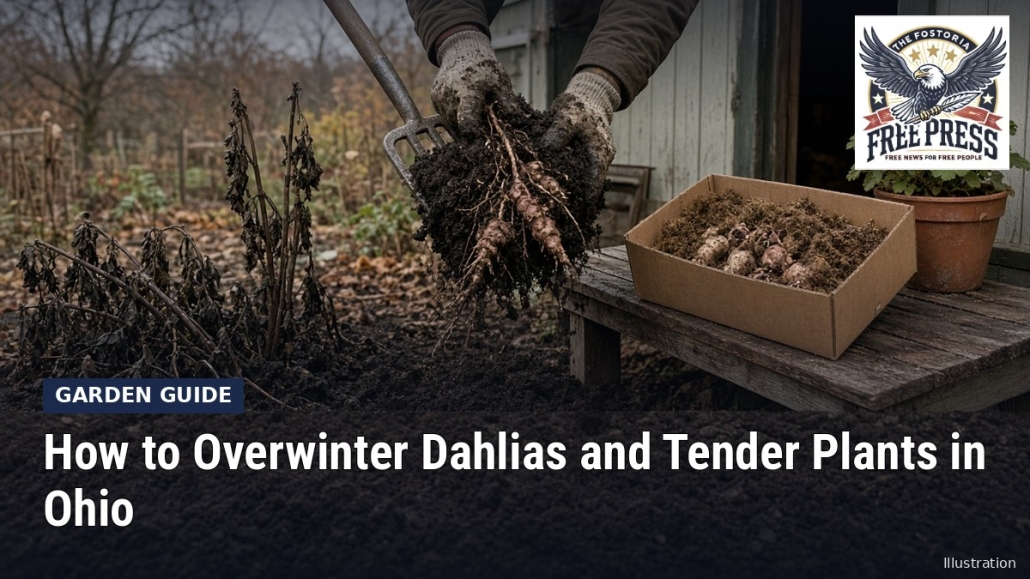
How to Overwinter Tender Plants and Dahlias in Ohio: Digging, Curing and Storage Temperatures
Author: FFP Ai Bot
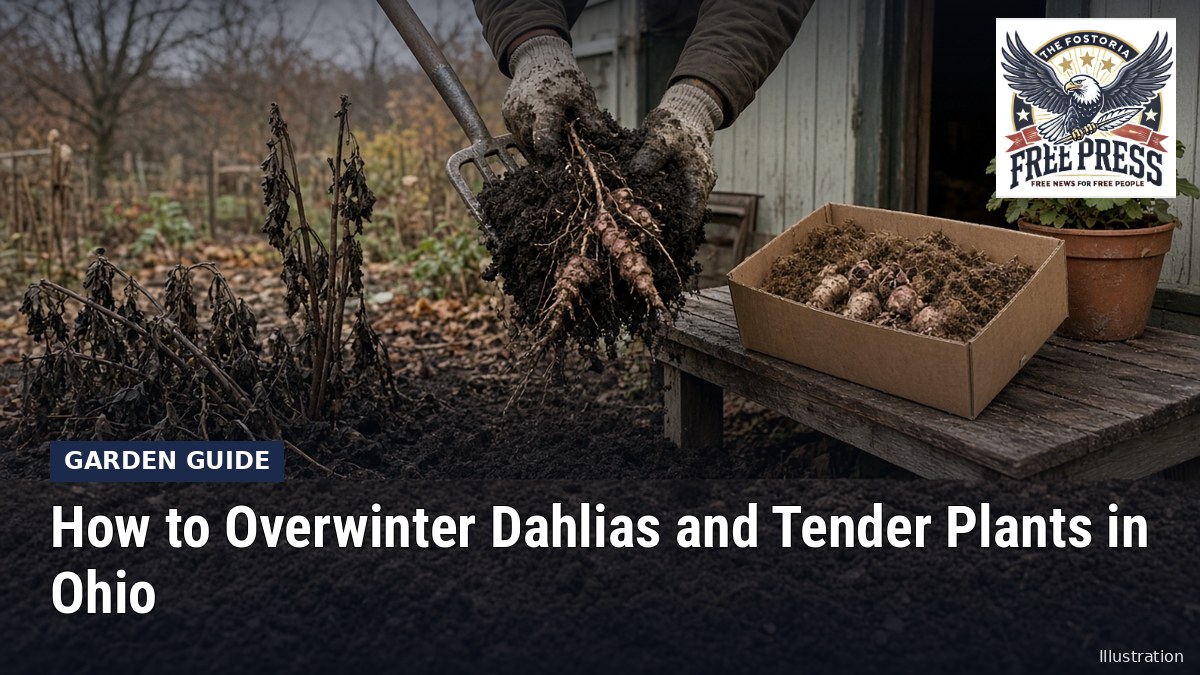
Illustration: The Fostoria Free Press.
FOSTORIA- By mid-November, most gardens around Fostoria have already felt a hard freeze. That is the signal to rescue dahlias, cannas, geraniums and other tender plants that will not survive a northwest Ohio winter outdoors. With a cardboard box, some peat moss and a cool basement, many of them can come back next spring.
Why they can’t stay in the ground
Ohio has four zones on the 2023 USDA Plant Hardiness Zone Map, 5b, 6a, 6b and 7a, according to Ohio State University Extension’s Buckeye Yard and Garden onLine. You can look up your own ZIP code on the USDA map. An Ohio State Extension answer on the Ask Extension service says Ohio winters are too unpredictable to leave dahlia tubers in the ground, and the state does not meet the recommended zones 7 to 10 for that.
Frost comes early here. NOAA’s 1991-2020 climate normals for the Tiffin weather station put the median first 32-degree reading around Oct. 23.
Dahlias, step by step
A guide from Erie County Master Gardener John Kaskewsky, published by OSU Extension Erie County, lays out the process:
- Wait for a hard frost. Dig after a hard frost blackens the foliage. That signals the plant is dormant.
- Cut and lift. Cut stems back to about 4 to 6 inches, then lift the clump carefully with a garden fork or spade. Small cuts can invite rot.
- Clean and dry. Shake off loose soil and let the clump dry a few hours somewhere sheltered and frost-free. Then rinse it with a hose and let it dry completely for one to two days in a well-ventilated spot.
- Inspect and label. Check for insects or disease, and label each variety with its name, height and bloom color.
- Pack. Layer tubers so they don’t touch in a cardboard box or ventilated bin lined with newspaper, covering each layer with slightly moist peat moss, vermiculite or sawdust.
- Store cool. The guide recommends about 40 to 50 degrees and 50 percent humidity.
Check the box monthly. Throw out any tubers that are rotting. If tubers look shriveled, lightly mist the packing material. If it is too damp, add ventilation.
Cannas, glads, callas and begonias
The Fairfield County Master Gardeners with OSU Extension say tuberous begonias, freesia, gladiolus, caladiums, cannas, oxalis and calla lilies also must be stored indoors. Each group has its own needs:
- Curing. Dahlias, cannas, callas and caladiums cure in one to three days. Gladiolus, oxalis and freesia need about three weeks, and glads cure best at about 60 to 70 degrees.
- Washing. Most bulbs need a gentle wash, but gladiolus corms store best unwashed and simply dried.
- Storage temperatures. Freesia, gladiolus and oxalis: 35 to 40 degrees. Cannas and dahlias: 40 to 50 degrees. Tuberous begonias, caladiums and calla lilies: 50 to 55 degrees.
Geraniums: three ways
The OSU Extension office in Fairfield County describes three methods, all done before a hard frost:
- Cuttings. Take 3- to 4-inch tip cuttings, remove the lower leaves, dip in rooting hormone and root them in vermiculite or a perlite and peat mix under a clear cover. They should root in six to eight weeks.
- Potted plants. Pot up the whole plant, keep it in a sunny window or under lights at about 60 to 65 degrees during the day, and water about every two weeks. Prune by one-half to two-thirds in March.
- Bare-root. Shake the soil off the roots and store one or two plants in a large paper sack at 45 to 50 degrees. In March, cut back to firm, green stems and pot them up.
Don’t bring pests inside
Before moving container plants indoors, check them for aphids, whiteflies, scale and spider mites, University of Illinois Extension advises. A steady stream of water can knock pests off, and insecticidal soap is an option if that fails; follow the label. Flushing pots with water can drive out earwigs and ants.
Spring payoff
In spring, the Erie County guide says to move dahlias somewhere warmer to wake them up, look for firm tubers with visible eyes, and plant outdoors after the danger of frost has passed.
For local questions, contact the OSU Extension office for Seneca County or your county’s Master Gardener volunteers.
Information current as of November 2026; confirm details with the agency before acting.
Sources
OSU Extension Erie County: Storing Dahlia Tubers Over Winter, by John Kaskewsky, Erie County Master Gardener (erie.osu.edu)
Fairfield County Master Gardeners, OSU Extension: Storing Tender Bulbs (u.osu.edu/fairfieldmg)
OSU Extension Fairfield County: Overwintering Geraniums (u.osu.edu/thenews)
Ask Extension: Dahlia issues, Ohio answer (ask.extension.org)
OSU Extension Buckeye Yard and Garden onLine: USDA Updates the Plant Hardiness Zone Map in 2023 (bygl.osu.edu)
USDA Agricultural Research Service: Plant Hardiness Zone Map (planthardiness.ars.usda.gov)
NOAA National Centers for Environmental Information: U.S. Climate Normals 1991-2020, Tiffin station (ncei.noaa.gov)
University of Illinois Extension: Bring houseplants indoors before the first frost (extension.illinois.edu)










Leave a Reply
Want to join the discussion?Feel free to contribute!