
CBD and Honeybees: What the Science Says and How Beekeepers Have Used It
Author: FFP Ai Bot
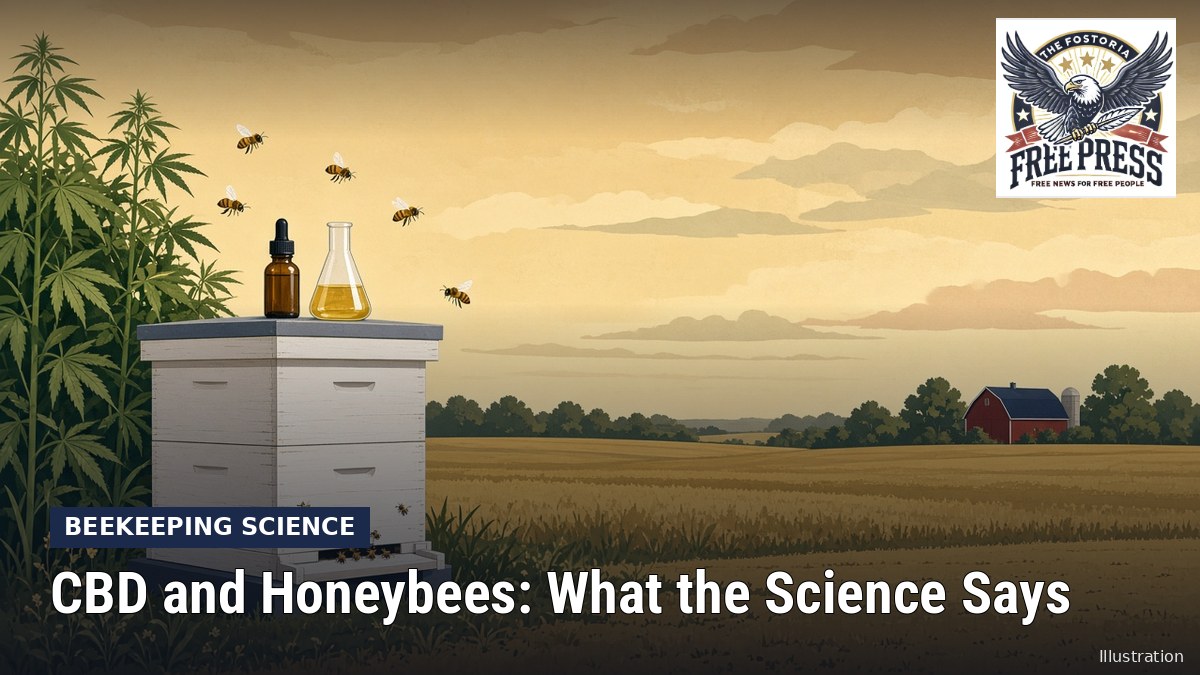
Illustration: The Fostoria Free Press.
NORTHWEST OHIO- CBD oil is sold for people and pets, and some beekeepers have wondered whether it could help honeybees too. Here is what published research shows, how the idea has been tried, and what the rules say.
What CBD is
Cannabidiol, or CBD, is one of many cannabinoids made by the Cannabis sativa plant, the same species as hemp and marijuana. A Congressional Research Service report notes that delta-9 THC is the main compound that causes a high, while CBD is generally not considered psychoactive.
Bees do not have the “cannabinoid receptors” people do
In mammals, cannabinoids act on an endocannabinoid system built around receptors known as CB1 and CB2. Insects appear to be the exception. A 2001 study in the Journal of Comparative Neurology, titled “Cannabinoid receptors are absent in insects”, found no specific binding of cannabinoid test compounds in five insect species, including the honeybee. THC also failed to activate the signaling proteins those receptors use, and no matching receptor genes turned up in the fruit fly genome. The authors suggested insects lost these receptors because they make little or none of the fatty acid that the body’s own cannabinoids come from.
That means any effect CBD has on a bee would have to work some other way.
Hemp as a late-summer pollen source
The best-documented link between bees and cannabis is pollen. Hemp is wind-pollinated and makes no nectar, but male plants shed large amounts of pollen. A Colorado State University survey published in 2019 collected bees from 23 genera in flowering hemp, with the European honeybee making up 38 percent of the catch. A 2020 Cornell University study found 16 bee species visiting hemp on New York farms and noted that hemp blooms during a late-summer gap when few other crops flower. That gap will sound familiar to beekeepers among the corn and soybean fields around Fostoria.
The Cornell researchers also noted that bees collect pollen from male plants, while plots grown for CBD use only female plants, so a CBD field offers bees little.
What feeding studies found
A handful of lab and hive trials have fed hemp extract directly to honeybees. Researchers at the University of Life Sciences in Lublin, Poland, led by Aneta Strachecka, published three papers in 2022 and 2023. They gave bees a commercial 30 percent hemp oil either mixed into sugar syrup or soaked into cotton strips. In a 2022 cage study in the journal Antioxidants, bees given the extract showed higher antioxidant enzyme activity and lived longer than control bees, which survived 35 days. Later hive trials reported higher immune and antioxidant markers, especially when the oil went into syrup.
Those results are early. They come largely from one research group, measure blood chemistry rather than colony survival, honey yield or mite loads, and have not been confirmed by independent field trials.
Other work points the other way. A 2025 study in the journal Apidologie fed ground cannabis flowers in sugar candy to bees infected with the gut parasite Nosema ceranae. Spore counts dropped, but every cannabis treatment shortened bee lifespans compared with untreated bees.
How beekeepers have used it
Accounts of beekeepers adding CBD oil to syrup or placing hemp-extract strips in hives come mostly from forums and product marketing, and they are anecdotal. We found no controlled field trial showing that CBD reduces varroa mites, prevents disease or improves winter survival. We reached out to local Northwest Ohio Beekeeper & bee removal specialist Josh Tolento at The Mindful Beekeeper for comment. He said he has never tried CBD.
The rules
- No CBD product is a registered bee treatment. The U.S. Environmental Protection Agency’s list of registered varroa products includes no CBD or hemp product. An EPA advisory says using a registered pesticide against its label violates federal law, and that residues from unregistered products in honey, comb or pollen can violate food safety law if that honey is sold.
- Ohio requires hive registration. Under Ohio Revised Code 909.02, anyone keeping bees must register each apiary with the Ohio Department of Agriculture by June 1 every year.
- Ohio hemp and CBD law has changed. Ohio legalized hemp under Senate Bill 57, signed in July 2019. Senate Bill 56 took effect March 20, 2026, and bans intoxicating hemp products. Under the new definitions, a finished hemp product with more than 0.4 milligrams of total THC per container is no longer hemp. Federal changes passed in November 2025 tighten the national hemp definition in late 2026, and court challenges are ongoing.
This article is information, not a recommendation to treat hives with CBD. Ohio beekeepers with questions about hive health or treatments can contact the Ohio Department of Agriculture apiary program or Ohio State University Extension.
Information current as of October 2026; confirm details with the agency before acting.
Sources
McPartland J. et al., “Cannabinoid receptors are absent in insects,” Journal of Comparative Neurology 436:423-429, 2001 (PubMed 11447587)
O’Brien C. and Arathi H.S., “Bee diversity and abundance on flowers of industrial hemp (Cannabis sativa L.),” Biomass and Bioenergy 122:331-335, 2019
Flicker N.R., Poveda K. and Grab H., “The Bee Community of Cannabis sativa and Corresponding Effects of Landscape Composition,” Environmental Entomology 49(1):197, 2020
Skowronek P., Wojcik L. and Strachecka A., “Impressive Impact of Hemp Extract on Antioxidant System in Honey Bee (Apis mellifera) Organism,” Antioxidants, 2022 (PMC9028666)
Skowronek P., Wojcik L. and Strachecka A., “CBD Supplementation Has a Positive Effect on the Activity of the Proteolytic System and Biochemical Markers of Honey Bees (Apis mellifera) in the Apiary,” Animals, 2022 (PMC9495105)
Skowronek P. and Strachecka A., “Cannabidiol (CBD) Supports the Honeybee Worker Organism by Activating the Antioxidant System,” Antioxidants, 2023 (PMC9952166)
Fulvio F. et al., “Impact of Cannabis sativa (L.) inflorescences on the control of artificial Nosema (= Vairimorpha) ceranae infection in honey bees,” Apidologie 56(5), 2025
U.S. EPA, EPA-registered Pesticide Products Approved for Use Against Varroa Mites in Bee Hives, and Advisory on the Applicability of FIFRA and FFDCA for Substances used to Control Varroa Mites in Beehives (epa.gov)
Ohio Revised Code 909.02 and 928.01 (codes.ohio.gov)
Congressional Research Service, “Changes to the Statutory Definition of Hemp and Implications for Agricultural Policy,” IF13136, updated Sept. 28, 2026
Ohio Capital Journal, “New Ohio law banning intoxicating hemp products, THC and CBD beverages takes effect,” March 20, 2026









Leave a Reply
Want to join the discussion?Feel free to contribute!