
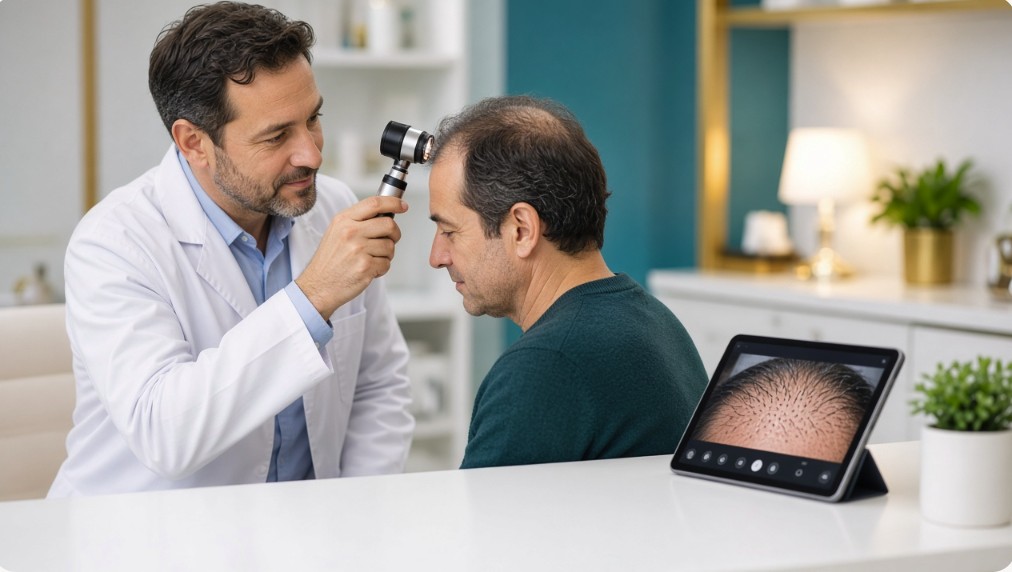
Who Is a Good Candidate for Stem Cell Hair Restoration?
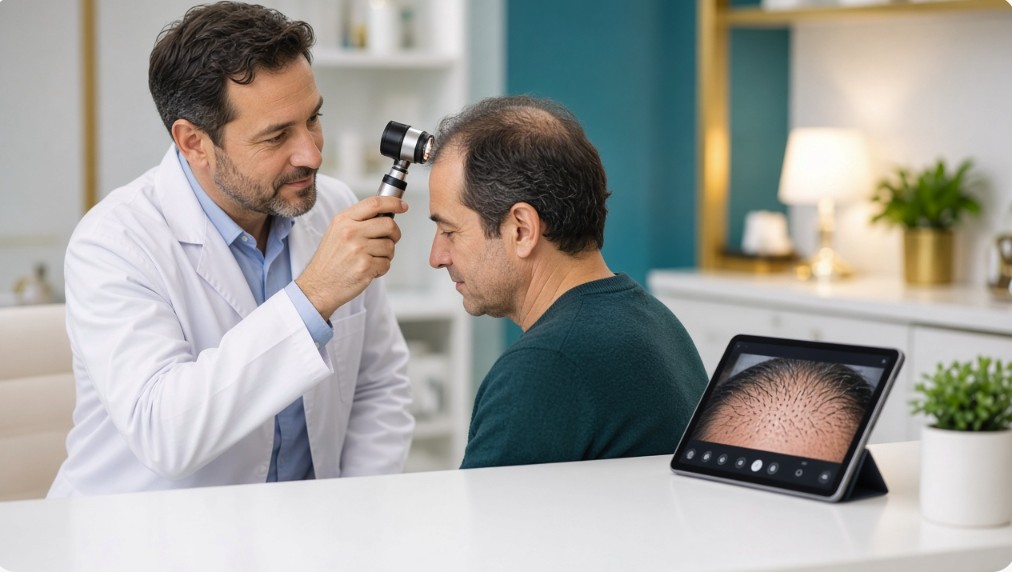
Stem cell hair restoration gets a lot of attention, but it is not the right fit for everyone with thinning hair. Whether it makes sense depends less on how much hair you have lost and more on what kind of hair is left.
Here is how physicians generally think about candidacy, and when another option may serve you better.
Key takeaways
- Regenerative treatments work on existing follicles. You need hair in the area, even if it is thin.
- Early to moderate pattern hair loss is the most common reason people consider it.
- Areas that have been smooth and bald for years usually need an FUE hair transplant instead.
- A proper diagnosis comes first, because not all hair loss is pattern hair loss.
Why Candidacy Depends on the Follicles You Still Have
In androgenetic alopecia, the most common cause of thinning, follicles shrink over time under the influence of the hormone DHT. Thick hairs are gradually replaced by fine, short ones.
Research published in the Journal of Clinical Investigation in 2011 (Garza and colleagues) found that hair follicle stem cells are still present even in bald scalp of men with pattern hair loss. What breaks down is the signaling that turns those cells into growing hair. Regenerative treatments aim to restore that signaling. For a deeper look, see our explainer on the science behind stem cell hair transplants.
That is why the presence of fine, miniaturized hairs matters. They are a sign the follicle is shrinking, not gone.
Signs You May Be a Stem Cell Hair Transplant Candidate
People who are often evaluated for stem cell hair restoration or another regenerative hair loss treatment include those with:
- Early to moderate thinning at the crown or top of the scalp.
- A widening part or diffuse thinning, common in women with female pattern hair loss.
- Fine, short hairs in thinning areas, a sign of miniaturization.
- Gradual loss over a few years rather than a long-standing bald patch.
- Interest in a nonsurgical first step, with the option of adding a transplant later.
- An upcoming or recent FUE transplant, where the goal is to support surrounding native hair.
When Stem Cell Hair Restoration Is Probably Not the Answer
Some situations call for a different plan:
- Smooth, shiny bald areas that have had no hair for years. Without follicles to work with, regenerative treatment has little to act on. Grafts are usually needed.
- A receded hairline you want lowered. Injections do not create a new hairline. An FUE hair transplant moves permanent donor hair to rebuild it.
- Hair loss from another cause. Thyroid disease, iron deficiency, certain medications, autoimmune conditions like alopecia areata, and scarring alopecias need their own diagnosis and treatment.
- Unrealistic expectations. Regenerative treatments aim to thicken and stabilize hair. Results vary and usually need maintenance.
Androgenetic Alopecia Treatment Options at a Glance
Candidacy is easier to understand when you see the full menu:
- Medications: Minoxidil and finasteride are long-standing, evidence-backed treatments for pattern hair loss, though finasteride is not appropriate for everyone.
- PRP: Platelet-rich plasma from your own blood. More published trials than stem cell treatments, with results that vary by protocol. See stem cell therapy vs PRP for hair loss.
- Stem cell hair restoration: Cells or cell products such as SVF or exosomes. Promising early research, mostly small studies, and not FDA-approved for hair loss.
- FUE or FUT hair transplant: Moves DHT-resistant donor hair into thinning or bald areas. The American Academy of Dermatology describes transplants as capable of permanent, natural-looking results.
Many patients end up with a combination, for example grafts for the hairline and regenerative or medical treatment for a thinning crown.
What the Evidence Says About Who Responds
Studies of regenerative hair treatments mostly enroll people with pattern hair loss who still have hair in the treated area. A 2023 systematic review in Cells (Krefft-Trzciniecka and colleagues) of 14 stem cell studies found no major side effects and called the approach promising, but urged caution until larger studies confirm results.
For PRP, a 2022 network meta-analysis in the Journal of Drugs in Dermatology (Gupta and Bamimore) found that younger patients and women tended to respond better, and that the number and timing of sessions mattered.
The bottom line is that research supports careful patient selection. Clinics should be willing to tell you when a treatment is unlikely to help.
Questions That Help Determine Candidacy
A physician will usually ask about:
- When your hair loss started and how fast it is progressing.
- Family history of hair loss.
- Medications, health conditions and recent illness or stress.
- Treatments you have already tried and how they worked.
- Your goals: thicker existing hair, a lower hairline, or both.
Find Out If You Are a Candidate
The surest way to know is a scalp evaluation. You can explore hair restoration options for men and women at cendanthair.com, read about Cendant’s stem cell hair restoration candidacy criteria, or send photos for a quick quote and consultation. Before you go, review what to expect at a hair restoration consultation.
This article is general information, not medical advice. Talk with a qualified, licensed physician about your hair loss.
Frequently Asked Questions
Can stem cell hair restoration regrow a bald spot?
Areas that have been smooth and bald for years usually do not respond, because few working follicles remain. Those areas typically need an FUE hair transplant.
Is stem cell hair restoration good for women?
It is often considered for female pattern hair loss, such as a widening part or diffuse thinning, because follicles are usually still present. A medical evaluation should rule out other causes first.
Am I too young or too old for stem cell hair treatment?
There is no single age cutoff. Physicians look at your pattern and pace of loss, overall health and goals. Some PRP research suggests younger patients respond better.
Do I need a hair transplant or stem cells?
If you want to restore a receded hairline or cover bald areas, a hair transplant clinic is usually needed. If you are thinning but still have hair, a regenerative option may be discussed. Many people combine both.
Sources
- Garza LA, et al. Bald scalp in men with androgenetic alopecia retains hair follicle stem cells but lacks CD200-rich and CD34-positive hair follicle progenitor cells. Journal of Clinical Investigation. 2011. https://doi.org/10.1172/JCI44478
- Krefft-Trzciniecka K, et al. Human stem cell use in androgenetic alopecia: a systematic review. Cells. 2023. https://doi.org/10.3390/cells12060951
- Gupta AK, Bamimore M. Platelet-rich plasma monotherapies for androgenetic alopecia: a network meta-analysis and meta-regression study. Journal of Drugs in Dermatology. 2022. https://doi.org/10.36849/JDD.6948
- American Academy of Dermatology. Hair transplants. https://www.aad.org/public/diseases/hair-loss/treatment/transplant
- U.S. Food and Drug Administration. Consumer Alert on Regenerative Medicine Products Including Stem Cells and Exosomes. https://www.fda.gov/vaccines-blood-biologics/consumers-biologics/consumer-alert-regenerative-medicine-products-including-stem-cells-and-exosomes



Leave a Reply
Want to join the discussion?Feel free to contribute!