“Stem cell hair transplant” is one of the most searched phrases in hair loss, and people with thinning hair want to know one thing: does it work?
The biology behind stem cell hair restoration is real and well studied. The treatments sold under that name are newer, and the clinical evidence is still catching up. Here is a plain-language look at the science, the studies, and how these options compare with a proven FUE hair transplant.
Key takeaways
- Hair growth depends on two groups of cells: hair follicle stem cells in the “bulge” and dermal papilla cells at the base of each follicle.
- In pattern hair loss, follicles shrink, but research suggests the stem cells often survive.
- “Stem cell” hair treatments usually mean injections of fat-derived cells (SVF), exosomes, conditioned media, or platelet-rich plasma (PRP), sometimes combined with a transplant.
- Early studies are encouraging but mostly small and short. The FDA has not approved any stem cell or exosome product for hair loss.
- An FUE or FUT hair transplant moves your own permanent hair and remains the established option. Regenerative treatments are possible add-ons for thinning hair that is still there.
How Hair Grows: Hair Follicle Stem Cells and Dermal Papilla Cells
Every hair grows from a follicle, a tiny organ that cycles through growth (anagen), transition (catagen) and rest (telogen). Two cell populations run that cycle.
Hair follicle stem cells live in a region of the follicle called the bulge. Researchers identified this region as the home of slow-dividing follicle stem cells in a landmark 1990 paper in the journal Cell (Cotsarelis and colleagues). They supply the building blocks for each new hair.
Dermal papilla cells sit at the base of the follicle. Think of them as the control center. They signal the stem cells when to wake up and how thick a hair to make.
What Goes Wrong in Androgenetic Alopecia
Androgenetic alopecia, or male and female pattern hair loss, is the most common cause of thinning hair. It is driven by genetics and dihydrotestosterone (DHT), a hormone made from testosterone. In DHT-sensitive follicles, three things happen over years:
- The growth phase gets shorter, so hairs do not grow as long.
- The follicles shrink, a process called miniaturization.
- Thick, pigmented hairs are slowly replaced by fine, short, almost invisible hairs.
A 2011 study in the Journal of Clinical Investigation (Garza and colleagues) compared bald and non-bald scalp from men with pattern hair loss. The researchers found that hair follicle stem cells were still present in bald scalp. What was missing were the progenitor cells that normally turn stem cell activity into a growing hair.
In other words, the “seed” is often still there, but the signaling that activates it has broken down. That is why scientists are interested in treatments that try to restore those signals. It also explains a limit: a scalp that has been smooth and bare for years may not have enough working follicles left to respond.
How Stem Cell Hair Restoration Is Claimed to Work
“Stem cell hair transplant” is a marketing term more than a medical one. In most clinics, it does not mean growing new hair follicles in a lab. It usually means injecting one or more biologic products into thinning areas of the scalp, sometimes alongside a standard transplant. The most common are:
Adipose-derived cells and SVF
Fat tissue contains a mix of cells called the stromal vascular fraction (SVF), which includes adipose-derived stem cells. A small amount of fat is drawn, processed and injected into the scalp; some clinics also use bone marrow cells. The theory is that these cells release growth factors that improve blood supply and nudge struggling follicles back into growth.
Exosomes for hair loss
Exosomes are tiny particles cells release to send messages, carrying proteins and genetic material. Exosome products are usually made from donor stem cells grown in a lab and contain no living cells.
Stem cell-derived conditioned media
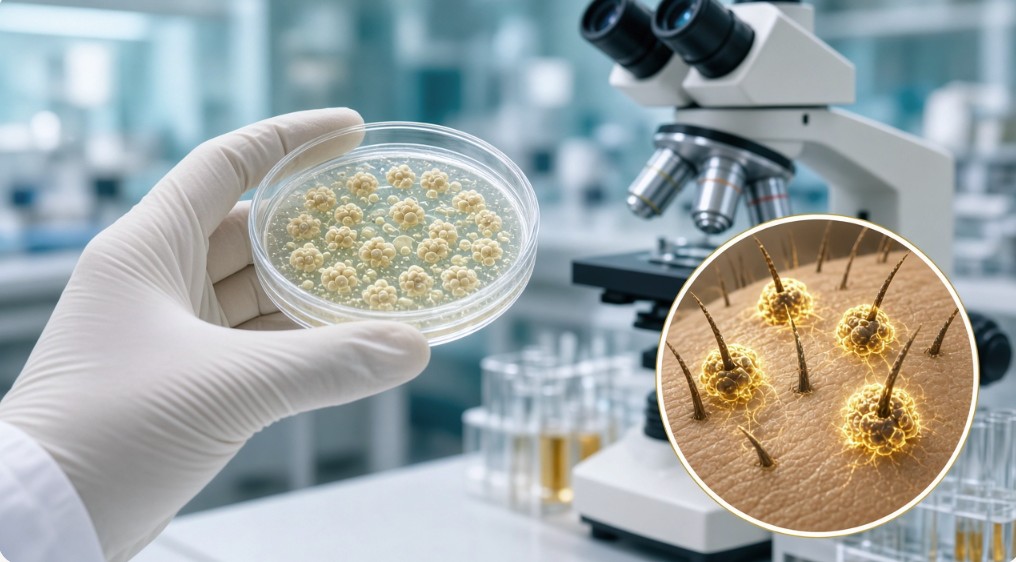
Stem cells grown in a lab release growth factors into the liquid around them. That liquid, called conditioned media, can be applied to the scalp or injected.
PRP and PRF
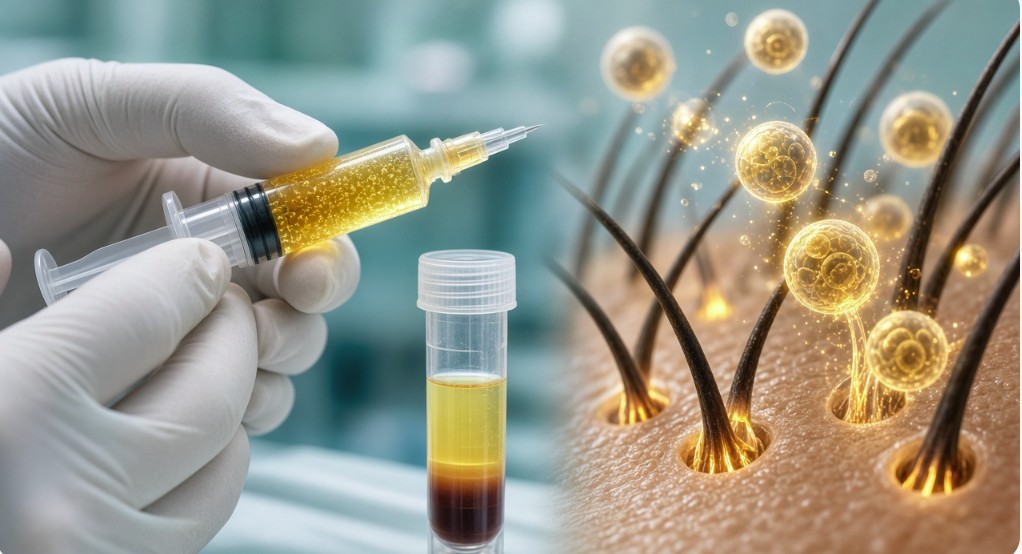
Platelet-rich plasma (PRP) is not a stem cell treatment, but it is often part of the package. The patient’s blood is spun to concentrate platelets, which release growth factors. Platelet-rich fibrin (PRF) is a related preparation.
The common thread is signaling: all aim to restore the conversation between dermal papilla cells and hair follicle stem cells.
What the Research and Clinical Evidence Actually Shows
Promising lab science does not automatically equal proven results on a human scalp.
The encouraging studies
- Adipose stem cell extract: A 2020 randomized, double-blind, placebo-controlled trial in Stem Cells Translational Medicine (Tak and colleagues) gave 38 people a topical adipose stem cell extract or placebo. After 16 weeks, hair count rose 28.1% versus 7.1%, and thickness improved.
- Conditioned media: A 2015 study in Eplasty (Fukuoka and Suga) injected adipose stem cell-conditioned medium into 22 patients and reported higher hair counts; a 10-patient half-head comparison favored the treated side.
- SVF-enhanced fat grafting: A 2017 patient series in Stem Cells and Cloning (Perez-Meza and colleagues) reported safety and hair changes after scalp injections of SVF-enriched fat. It was not randomized, and one author disclosed ties to the device maker.
- Systematic reviews: A 2023 review in the journal Cells (Krefft-Trzciniecka and colleagues) looked at 14 studies of stem cell use in androgenetic alopecia. It found no major side effects and called the approach promising, but said results “should be interpreted with caution” until they are reproduced in larger groups.
Exosomes: early and uneven evidence
A 2023 review in the Journal of Cosmetic Dermatology (Gupta and colleagues) found 16 exosome studies for hair, only one in people. A 2025 review in Clinical, Cosmetic and Investigational Dermatology (Al Ameer and colleagues) found 11 clinical studies, just two randomized, with small samples and inconsistent methods.
PRP: the most studied option
A 2015 randomized, placebo-controlled half-head study in Stem Cells Translational Medicine (Gentile and colleagues) found higher hair density on the PRP side in 20 patients, though some began losing hair again 12 to 16 months later. A 2022 network meta-analysis in the Journal of Drugs in Dermatology (Gupta and Bamimore) pooled 25 trials and found results depended heavily on how PRP was prepared and how often it was given.
“Cloning” hair: still in the lab and early trials
What most people picture when they hear “stem cell hair transplant” is growing brand-new follicles from a few of your own cells. That work is real, but experimental.
A 2013 study in Proceedings of the National Academy of Sciences (Higgins and colleagues) showed that human dermal papilla cells grown in three-dimensional clusters could trigger new hair follicle growth in human skin grafted onto mice. A 2020 randomized, placebo-controlled trial in Japan, published in the Journal of the American Academy of Dermatology (Tsuboi and colleagues), injected 65 men and women with cultured cells from their own follicles’ dermal sheath cup. Density improved at one dose versus placebo, but the effect was temporary, lasting until about nine months. Neither is an approved U.S. treatment.
What regulators say
The U.S. Food and Drug Administration has approved stem cell products only for certain blood disorders and has not approved any exosome product. It has warned the public about unapproved stem cell, SVF and exosome products, citing reports of serious harm. The International Society for Stem Cell Research (ISSCR) runs a patient site, AboutStemCells.org, that urges people to ask hard questions before paying for unproven stem cell treatments. That does not make every regenerative hair treatment unsafe or useless, but patients deserve clear answers about what is injected, where it comes from and what evidence supports it.
Limitations and Open Questions
Several basic questions remain open:
- Small, short studies. Many trials enroll fewer than 50 people and follow them for months, not years.
- No standard recipe. Cell sources, processing and number of sessions vary widely between clinics.
- Few placebo controls. Without a control group, real effects are hard to separate from normal shedding swings.
- Durability. It is unclear how long gains last or how often to repeat treatment.
- Who benefits most. Evidence points toward early to moderate thinning, not long-standing bald areas.
Stem Cell Hair Restoration vs. FUE and FUT Hair Transplants
A traditional hair transplant does not try to revive weak follicles. It moves healthy ones.
Hair on the back and sides of the scalp usually resists DHT. In a follicular unit extraction (FUE) hair transplant, a surgeon removes individual follicle groups from that donor area and places them where hair is thin or gone. Follicular unit transplantation (FUT) removes a thin strip of donor skin and divides it into grafts. The American Academy of Dermatology describes transplants as able to deliver permanent, natural-looking results, with most patients seeing results six to nine months after surgery.
- What it treats: FUE/FUT adds hair where it has been lost, including a receded hairline. Stem cell hair restoration and PRP aim to thicken hair that is still present.
- Evidence: Transplant surgery has decades of clinical use. Regenerative treatments have promising but limited data.
- Permanence: Transplanted follicles tend to keep growing. Regenerative effects may fade and need repeat sessions.
- Limits: A transplant is limited by donor supply and does not stop future thinning of the hair around it.
That is why many physicians combine approaches: grafts restore the hairline, while medical or regenerative treatment tries to protect the native hair around it.
When PRP or regenerative treatment may be a reasonable add-on
PRP or another regenerative hair loss treatment may make sense as an adjunct for:
- Early or diffuse thinning where follicles are miniaturized but still visible.
- People who want a nonsurgical option before considering a transplant.
- Transplant patients protecting surrounding native hair, alongside proven medications such as minoxidil or finasteride when appropriate.
It is generally not a substitute for grafts in areas that are completely bald. For more, see our guides on stem cell therapy vs PRP for hair loss and who is a good candidate for stem cell hair restoration.
Hair Transplant Clinic | Denver,CO
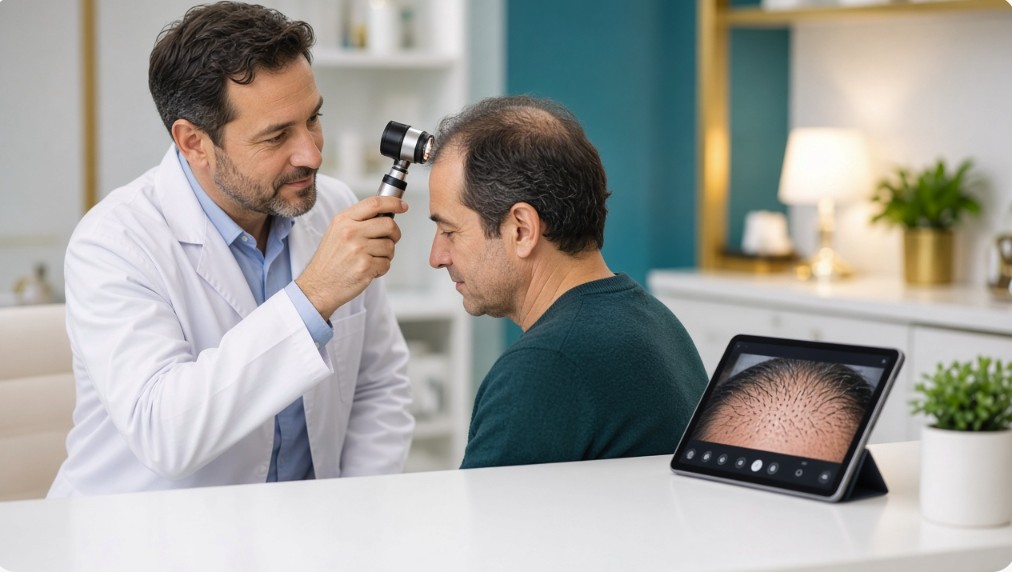
If you are weighing a stem cell hair transplant against an FUE procedure, start with a professional scalp assessment (here is what to expect at a hair restoration consultation). You can learn more about hair restoration options at cendanthair.com, read how Cendant’s Denver Hair Transplant Clinics approaches stem cell hair restoration, and compare it with an FUE hair transplant.
Ready for a personal answer? Request a hair restoration consultation and quick quote with Cendant Hair, or contact a Cendant clinic in Denver, Houston, Dallas or Scottsdale.
This article is general information, not medical advice. Hair loss has many causes, including thyroid disease and medications. Talk with a qualified, licensed physician before starting any treatment.
Frequently Asked Questions
What is a stem cell hair transplant?
It is a common name for injecting regenerative products such as fat-derived cells (SVF), exosomes, conditioned media or PRP into thinning areas of the scalp, sometimes alongside an FUE hair transplant. It does not mean transplanting lab-grown follicles.
Does stem cell hair restoration really work?
Early studies show gains in hair count and thickness for some people with pattern hair loss, but most are small and short. Results vary, and no stem cell product is FDA-approved for hair loss.
Is stem cell hair restoration better than an FUE hair transplant?
They do different jobs. FUE moves permanent donor hair into thinning or bald areas and has a long track record. Regenerative treatments aim to strengthen existing hair, alone or alongside a transplant.
What is the difference between PRP and stem cell hair treatment?
PRP uses concentrated platelets from your own blood. Stem cell treatments use cells or cell products from fat, bone marrow or donor tissue. PRP has more published trials.
How long do results from regenerative hair loss treatment last?
That is not well established. Some studies show gains fading within a year, so many protocols include maintenance sessions.
Sources
- Cotsarelis G, Sun TT, Lavker RM. Label-retaining cells reside in the bulge area of pilosebaceous unit. Cell. 1990. https://doi.org/10.1016/0092-8674(90)90696-c
- Garza LA, et al. Bald scalp in men with androgenetic alopecia retains hair follicle stem cells but lacks CD200-rich and CD34-positive hair follicle progenitor cells. Journal of Clinical Investigation. 2011. https://doi.org/10.1172/JCI44478
- Higgins CA, et al. Microenvironmental reprogramming by three-dimensional culture enables dermal papilla cells to induce de novo human hair-follicle growth. PNAS. 2013. https://doi.org/10.1073/pnas.1309970110
- Tsuboi R, et al. Autologous cell-based therapy for male and female pattern hair loss using dermal sheath cup cells. Journal of the American Academy of Dermatology. 2020. https://doi.org/10.1016/j.jaad.2020.02.033
- Tak YJ, et al. A randomized, double-blind, vehicle-controlled clinical study of hair regeneration using adipose-derived stem cell constituent extract in androgenetic alopecia. Stem Cells Translational Medicine. 2020. https://doi.org/10.1002/sctm.19-0410