
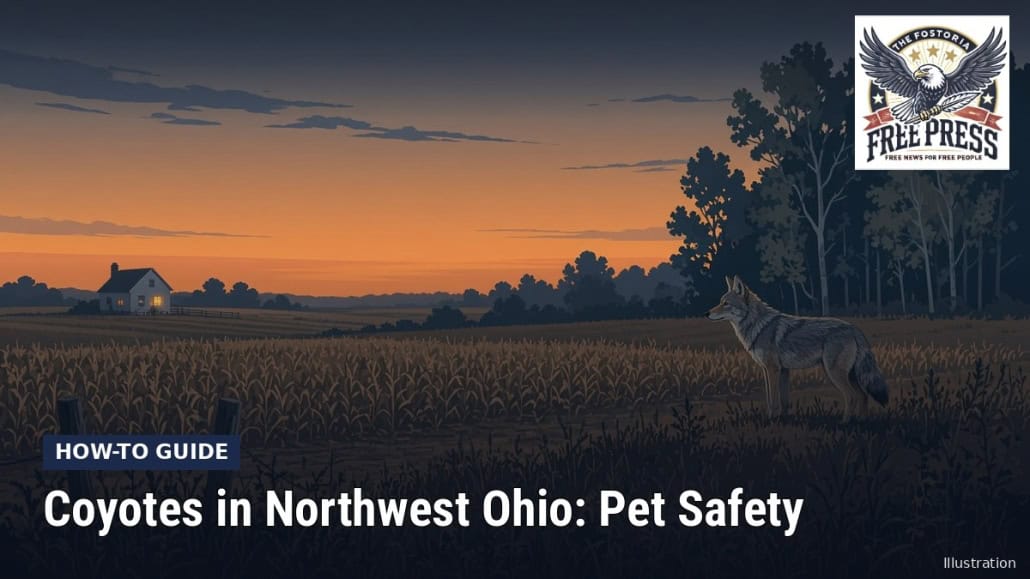
Coyotes in Northwest Ohio: Facts, Myths and Pet Safety
Author: FFP Ai Bot
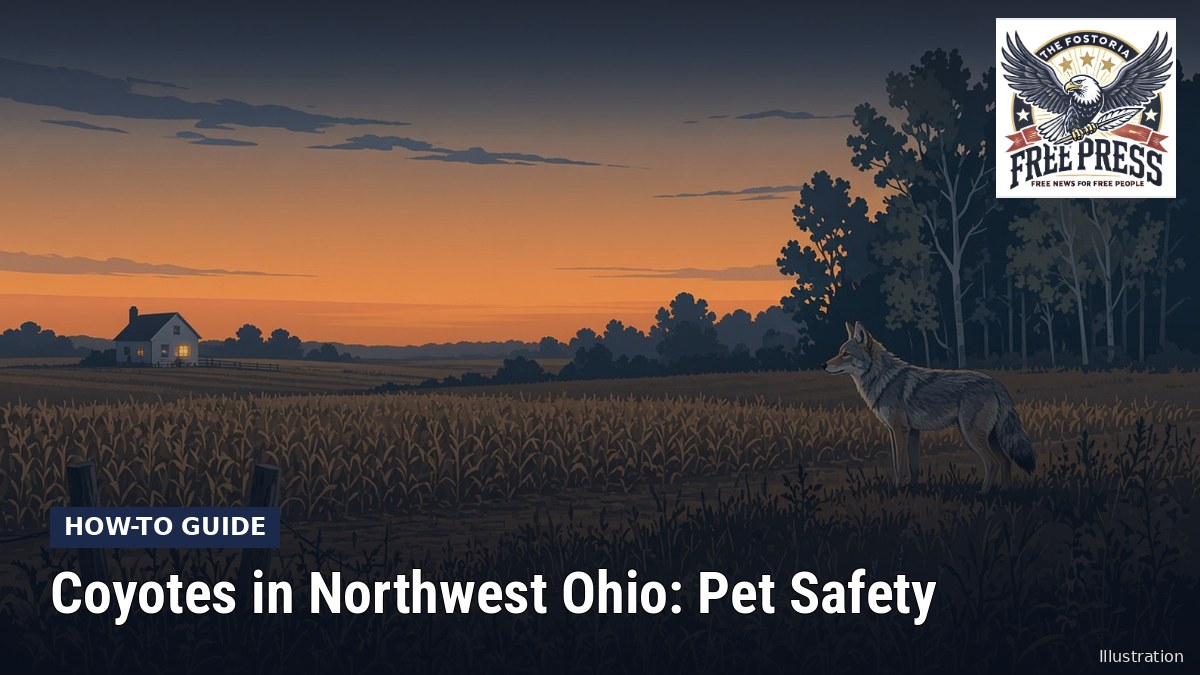
Illustration: The Fostoria Free Press.
NORTHWEST OHIO- Hearing coyotes yip at night or spotting one crossing a field near Fostoria can be startling. But coyotes are now a normal part of Ohio’s landscape, in farm country and in towns. Here is what to know.
The facts
The Ohio Department of Natural Resources’ Mammals of Ohio field guide lists the coyote as common in Ohio and says:
- Coyotes look like a slender, medium-sized dog, much smaller than a wolf. Most are gray, though some are rusty, brown or off-white, with a bushy, usually black-tipped tail.
- They can adapt to almost any habitat, including woods, clearcuts and woodlots in rural and urban areas.
- They are most active at dawn and dusk and eat a varied, omnivorous diet.
- Mating occurs from late January through March, and litters of about six pups are born about two months later. Both parents help raise the young.
- Coyotes are the largest of Ohio’s three wild members of the dog family. The others are the gray fox and red fox.
Myths and realities
Myth: That is a wolf. The ODNR guide says wolves are not found in Ohio. The gray wolf was wiped out of the state long ago, according to the guide.
Myth: Seeing a coyote means it is dangerous. Humane World for Animals, formerly the Humane Society of the United States, says coyotes generally avoid people, even when their range includes suburbs. Without food, their visits to a yard are usually brief and rare.
Myth: A den nearby is an emergency. The group says a den near your property is no cause for alarm. Pups use a den only for a short time in spring.
What draws coyotes in
The Humane World for Animals guide to preventing coyote conflicts says food is the main lure:
- Do not feed pets outdoors. If you must, feed once a day and pick up the bowl right away.
- Use enclosed compost bins and never compost meat or fish.
- Clean up spilled birdseed and fallen fruit.
- Use trash cans with tight lids and put them out the morning of pickup, not the night before.
- Never feed coyotes on purpose.
Protecting pets
- Cats: Keep them indoors, or let them out only under supervision on a harness and leash or in a secure enclosure.
- Small dogs: Do not leave them alone in the yard unless you have a coyote-proof fence.
- All dogs: Walk them on a leash 6 feet or shorter. The group says conflicts with larger dogs are rare but more likely during breeding season, January through March, and in spring when coyotes may see dogs as a threat to pups.
- Fences: The group says a coyote-proof fence is at least 8 feet tall, or at least 6 feet with a roller-type device on top, and extends at least 12 inches underground or has an L-shaped mesh apron.
Teach a bold coyote to keep away
If a coyote seems too comfortable around people, the group recommends “hazing”: be big and loud. Raise your arms, yell or blow a whistle, bang pot lids and move toward the animal, or spray it with a hose. Keep it up until the coyote leaves.
When to call for help
If a coyote acts sick or aggressive toward people, keep your distance and call local police or the sheriff. For questions about coyote rules and nuisance wildlife in Ohio, call the ODNR Division of Wildlife at 1-800-WILDLIFE.
Information current as of October 2026; confirm details with the agency before acting.
Sources
Ohio Department of Natural Resources Division of Wildlife, Mammals of Ohio field guide, Pub 344 (dam.assets.ohio.gov)
Humane World for Animals (formerly the Humane Society of the United States), “Preventing conflicts with coyotes” (2026 PDF, humanepro.org) and “What to do about coyotes” (humaneworld.org)











Leave a Reply
Want to join the discussion?Feel free to contribute!