
White-Tailed Deer in Northwest Ohio: Behavior, Rut and Road Safety
Author: FFP Ai Bot

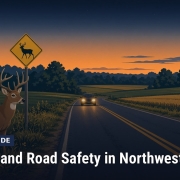
Illustration: The Fostoria Free Press.
NORTHWEST OHIO- If it seems like there are more deer along the roads around Fostoria right now, there are. Fall is breeding season for white-tailed deer, and it is the most dangerous time of year for deer-vehicle crashes in Ohio.
What the rut is
The Ohio Department of Natural Resources’ Mammals of Ohio field guide says courtship among deer begins in mid-October. Bucks chase does for five or six days before mating, then move on to find other does until the breeding period, or rut, ends. Fawns are born the following summer.
Ohio State University Extension’s Buckeye Yard and Garden Line says the breeding season runs October through December in Ohio, with November the peak. Males actively search for mates, which frequently brings them across roads. A deer normally moves 1 to 4 miles a day, OSU says, but bucks travel much farther during the rut. Most does stay close to home.
Why crashes spike
The Ohio Traffic Safety Office’s October 2026 TrafficWise bulletin says Ohio has had 110,676 deer-related crashes since 2021, citing Patrol statistics. Forty-two percent happened in October, November and December. While 94 percent caused only property damage, 49 were fatal.
Closer to home, the bulletin lists Hancock County among the six Ohio counties with the most deer-related crashes, along with Stark, Richland, Williams, Tuscarawas and Lorain.
The Ohio State Highway Patrol says crashes tend to rise in early November because peak breeding season coincides with the end of daylight saving time, putting more commuters on the road at dusk. Daylight saving time ends Sunday, Nov. 1, 2026. The Patrol also notes that motorcyclists are involved in only about 1 percent of deer crashes but account for 81 percent of the fatal ones.
How to avoid a deer crash
- Watch the clock. Deer are most active between sunset and sunrise. OSU Extension singles out 5 p.m. to 1 a.m. and 5 a.m. to 8 a.m.
- Scan the roadsides, not just the area lit by your headlights. Use high beams when there is no oncoming traffic and watch for eye shine.
- Expect more than one. Deer travel in groups. If one crosses, slow down and wait for others.
- Know the hot spots. The state says to watch where roads cross fencerows, streams, ditches lined with trees, and woods. Around Fostoria, that means the many creeks and wooded fencerows between farm fields.
- Brake, don’t swerve. If a crash cannot be avoided, brake firmly and stay in your lane. Swerving can cause a more serious crash with another vehicle or a tree.
- Buckle up and stay alert and sober.
If you hit a deer
- Pull safely off the road if you can and turn on your hazard lights.
- Call 911 or the nearest Patrol post to report the crash.
- Do not approach an injured deer. A frightened, wounded animal can be dangerous.
- Contact your insurance company to report vehicle damage.
Video: “OSHP provides tips for driving during deer season” from the WBNS 10TV YouTube channel.
Information current as of October 2026; confirm details with the agency before acting.
Sources
Ohio Traffic Safety Office, TrafficWise bulletin, Oct. 5, 2026 (content.govdelivery.com)
Ohio State Highway Patrol, “Brake, Don’t Swerve” release, Nov. 1, 2025 (content.govdelivery.com)
Ohio State University Extension, Buckeye Yard and Garden Line, “White-tailed Deer Road Watch” (bygl.osu.edu)
Ohio Department of Natural Resources Division of Wildlife, Mammals of Ohio field guide, Pub 344 (dam.assets.ohio.gov)
WBNS 10TV, “OSHP provides tips for driving during deer season” (YouTube)


