
OHIO | From Turnips to Porches: Why the Pumpkin Became Halloween’s Lantern

Author: FFP Ai Bot
From Turnips to Porches: Why the Pumpkin Became Halloween’s Lantern
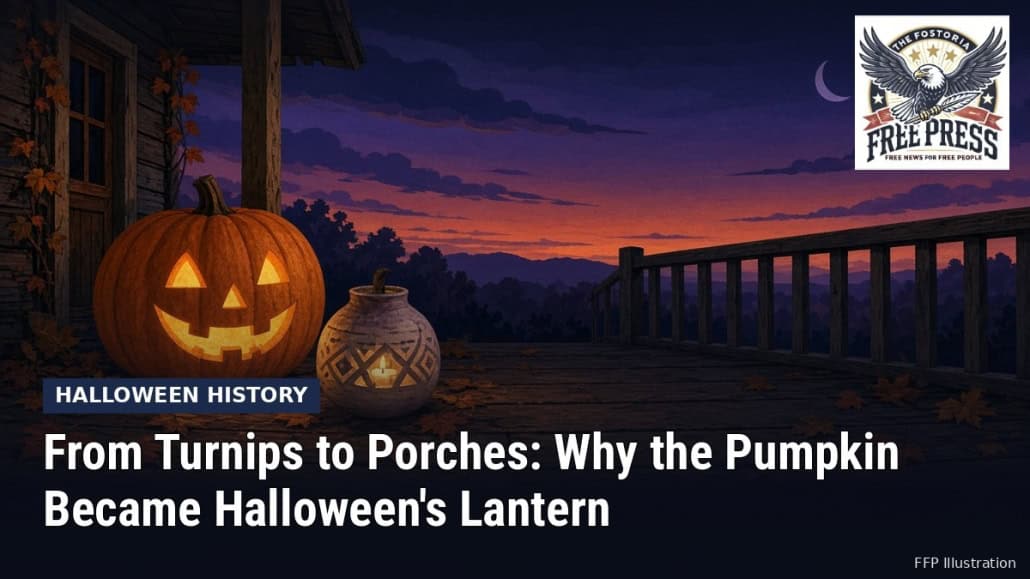
OHIO — Every Oct. 31, porches across Ohio glow orange. The carved pumpkin feels like it has always been part of Halloween, but the jack-o’-lantern is really a story of Old World folklore, an immigrant’s practical swap and a famous American ghost story.
It started with a turnip
Long before pumpkins, people in Ireland and Scotland carved faces into turnips, potatoes and beets around Samhain, the Celtic festival marking the end of the harvest, when spirits of the dead were believed to roam. A candle or ember inside the hollowed vegetable was meant to keep wandering spirits away, according to Smithsonian Magazine and National Geographic.
The name is tied to an Irish folktale about Stingy Jack, a trickster who fooled the Devil twice. In most versions, Jack was barred from heaven when he died, and the Devil, bound by his promise, would not take him either. Jack was left to wander the dark with a single burning coal, which he carried inside a hollowed-out turnip. He became “Jack of the Lantern.”
Historians note the legend was layered onto a custom that already existed. The carving came first; the story gave it a name.
The word is older than the pumpkin
The Oxford English Dictionary traces “jack-o’-lantern” in Britain to the late 1650s and 1660s, when it described the eerie will-o’-the-wisp lights over bogs and, later, a night watchman carrying a lantern. The earliest recorded use of the term for a lantern carved from a turnip or pumpkin comes from 1837.
The Atlantic crossing
When large numbers of Irish immigrants came to North America in the 19th century, they brought the custom with them and found a better vegetable. The pumpkin, native to the Americas, was bigger, softer and far easier to carve than a turnip, and it ripened right at harvest time in October.
A ghost story did the rest
Washington Irving’s “The Legend of Sleepy Hollow,” first published in 1820, ends with the Headless Horseman hurling a pumpkin at Ichabod Crane. In Irving’s story the pumpkin is not carved, but later illustrations showed the Horseman holding a fiery jack-o’-lantern, and that image stuck.
Nathaniel Hawthorne mentioned a jack-o’-lantern in his 1835 story “The Great Carbuncle” and wrote about a scarecrow with a carved pumpkin head in “Feathertop” in 1852. The Nov. 1, 1866, Daily News of Kingston, Ontario, described Halloween youngsters making “transparent heads and face” from a “great sacrifice of pumpkins,” lit by tallow candles. The Nov. 23, 1867, issue of Harper’s Weekly carried what historians consider one of the earliest images of a carved pumpkin in a major American publication.
Why it stuck
Pumpkins are harvested in autumn, right on Halloween’s doorstep. They were plentiful in America just as immigrants needed a turnip substitute. And their size made them the perfect canvas for a face.
The crop is big business today. U.S. farmers grew 1.47 billion pounds of pumpkins valued at $286 million in 2025, according to the U.S. Department of Agriculture’s Vegetables 2025 Summary. Illinois led the nation, and Ohio ranks among the other top pumpkin-producing states.
So when you carve a pumpkin this Halloween, you are keeping alive a piece of Irish folklore, an immigrant’s clever substitution and a ghost story’s most famous prop: a turnip’s old job, done by a bigger, friendlier pumpkin.
Sources:
U.S. Department of Agriculture, National Agricultural Statistics Service, Vegetables 2025 Summary – https://esmis.nal.usda.gov/sites/default/release-files/795772/vegean26.pdf
Smithsonian Magazine, When People Carved Turnips Instead of Pumpkins for Halloween – https://www.smithsonianmag.com/smart-news/when-people-carved-turnips-instead-of-pumpkins-for-halloween-180978922/
National Geographic, The history of American jack-o’-lanterns – https://www.nationalgeographic.com/history/article/the-twisted-transatlantic-tale-of-american-jack-o-lanterns
University of Notre Dame Rare Books and Special Collections, An Irish Story Produces a Halloween Icon – https://sites.nd.edu/rbsc/halloween-2024/
Successful Farming, Which State Dominates Pumpkin Production? – https://www.agriculture.com/which-state-dominates-pumpkin-production-5-charts-tell-the-story-12196481




Leave a Reply
Want to join the discussion?Feel free to contribute!