
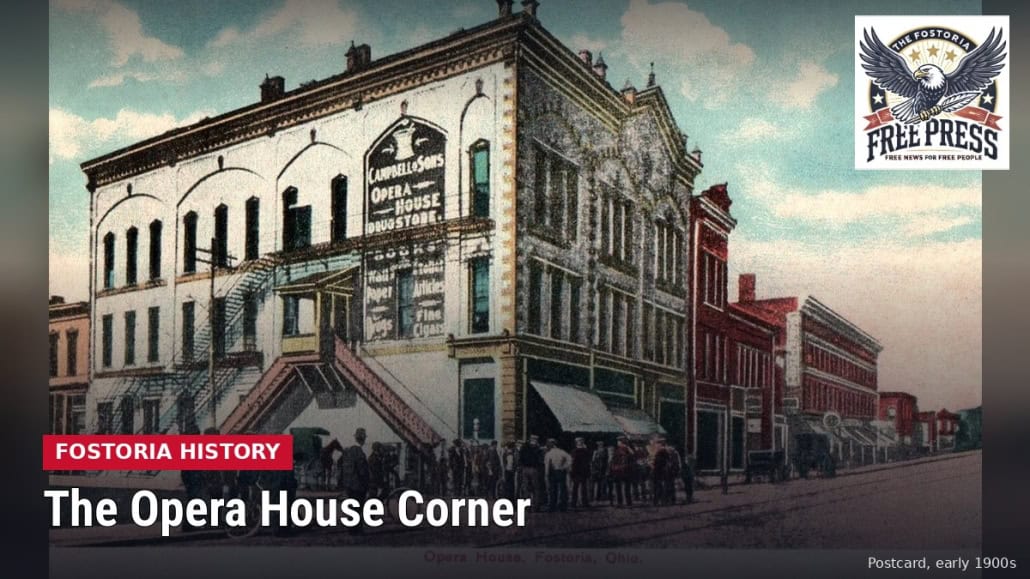
FOSTORIA | The Opera House Corner to North Street: A Postcard Walk Along Main Street
Author: FFP Ai Bot
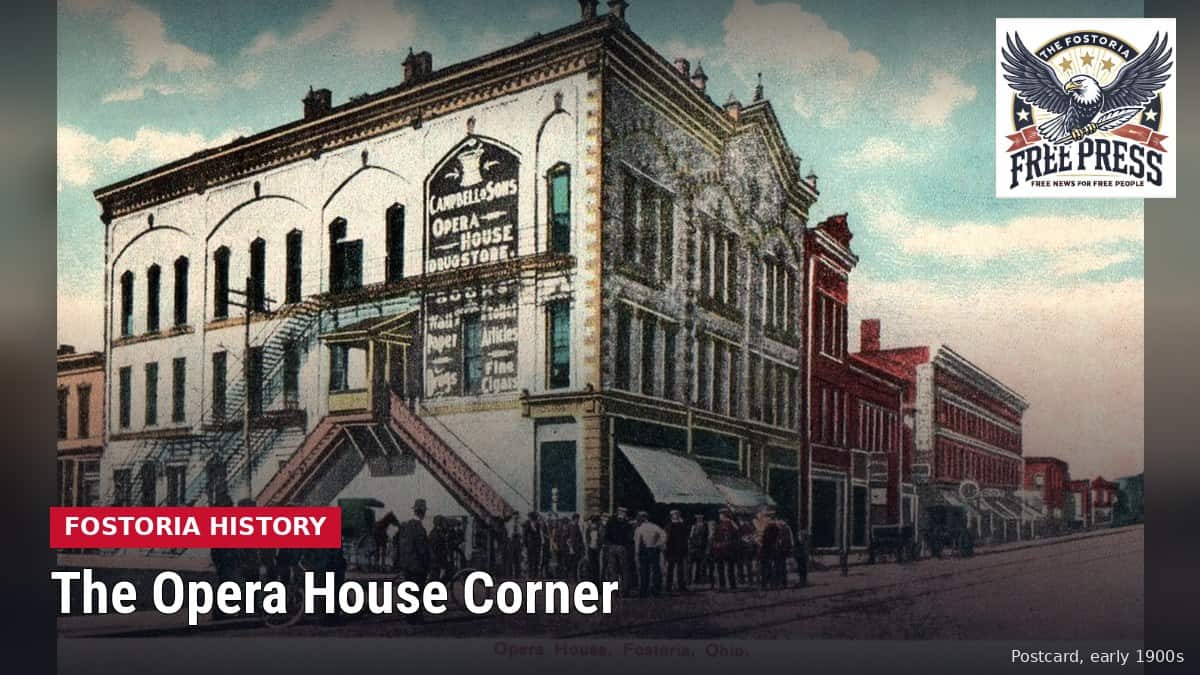
“Opera House, Fostoria, Ohio,” postcard, early 1900s
FOSTORIA — A crowd of men in hats and caps gathers on the sidewalk outside the Opera House drugstore. A block or two away, a sign high on a brick wall invites young people to “day and evening sessions” at a business college. Farther north, a tea store holds down a busy corner while early automobiles share the street with a trolley.
This installment of our local history series takes a postcard walk along Main Street in the early 1900s, using three cards that show the Opera House corner, a view titled “Main St. So.” and a scene looking south from North Street. Earlier stories looked at Main Street merchants and downtown landmarks such as the Alcott Block and the Hays House.
Quick timeline
| Year | What happened |
|---|---|
| 1860 | Blacksmith John Andes, born in Bavaria in 1836, comes to Fostoria. |
| 1875 | A catalog lists a Fostoria Business College as a branch of the Northwestern Normal and Training School, with 508 students in the combined schools. |
| 1878 | The Andes Block is completed at Main and Center, and the Andes Opera House opens on its top floor. |
| 1908 | The May 1908 Sanborn fire insurance map shows the Andes Opera House, with its stage along the West Center Street side and a drugstore in the corner room. |
| 1910 | The Andes Opera House closes because it cannot meet state fire regulations. |
| 1910s | The A. Beesch Tea Co. occupies the ground floor at the southwest corner of North and Main. |
| 1948 | The Ohio Savings & Loan Association buys the North and Main corner building. |
| 2001 | The Fostoria Downtown Historic District is listed on the National Register of Historic Places. |
The Opera House corner
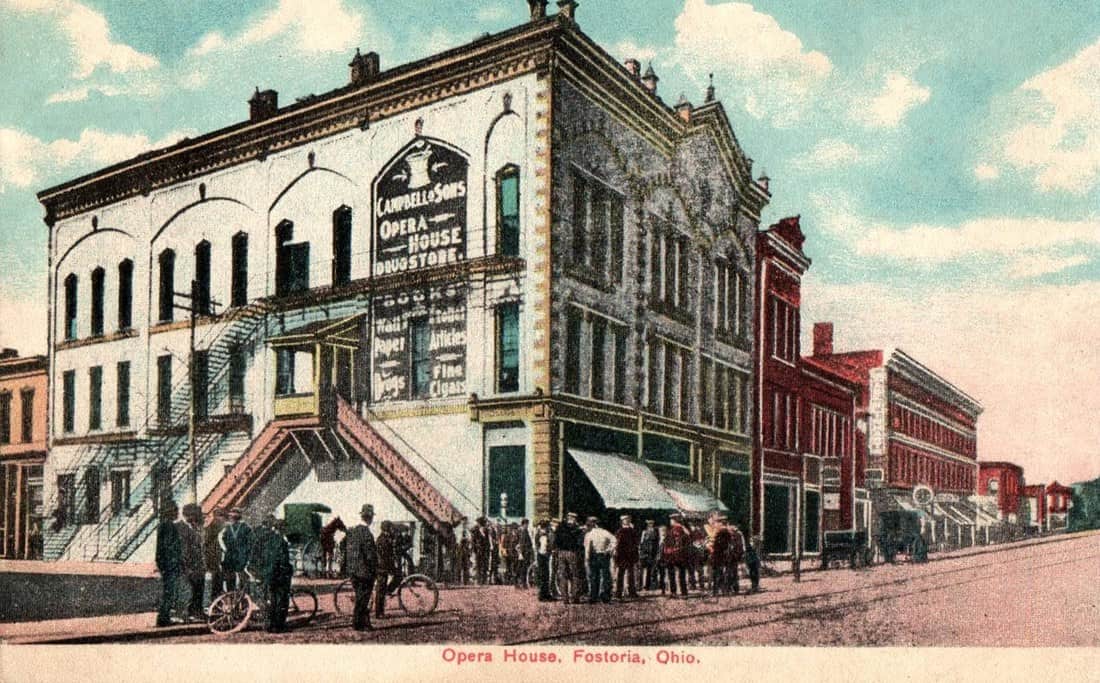
“Opera House, Fostoria, Ohio,” postcard, early 1900s
The card at the top of this page carries the title “Opera House, Fostoria, Ohio.” It shows a three-story corner building painted a pale color, with a big arched sign on its side reading “Campbell & Sons Opera House Drug Store.” Below it, a second painted sign lists books, wall paper, toilet articles and fine cigars. A wooden double stairway climbs the outside wall to a landing, and a fire escape zigzags up the back corner. Out front, a crowd of men, several bicycles and a horse and buggy fill the sidewalk and street. Next door on Main Street stands a taller building with an ornate stone front, followed by a row of red brick blocks.
The Andes Opera House filled the entire top floor of the Andes Block, which John Andes built in 1878 at the northwest corner of Main and Center streets. According to the Fostoria Area Historical Society, the opera house seated 800 and brought in professional companies from New York and Chicago as they toured towns along the railroads. One reader told the society’s columnist in 1982 that as a little girl she saw “Uncle Tom’s Cabin” there from the first row of the balcony, while her father worked as a stagehand.
The ground-floor corner room was home to a long line of drugstores, according to the historical society, including Campbell and Godfrey, Bev. Campbell, Hoffman Bros. and Al Bohrer. The May 1908 Sanborn fire insurance map of Fostoria, held by the Library of Congress, labels the building “Andes Opera Ho.,” marks “Drugs” in the corner room and shows the stage along the West Center Street side.
That outside stairway and fire escape are worth a second look. The historical society reported that the opera house closed in 1910 because it could not meet state fire regulations. We do not know when the stairs on this card were added, but they show how a top-floor theater had to get its audience down to the street. The Andes Block still stands today, refaced in 1982 during the downtown Streetscape program, and is part of the Fostoria Downtown Historic District.
“Day and evening sessions”
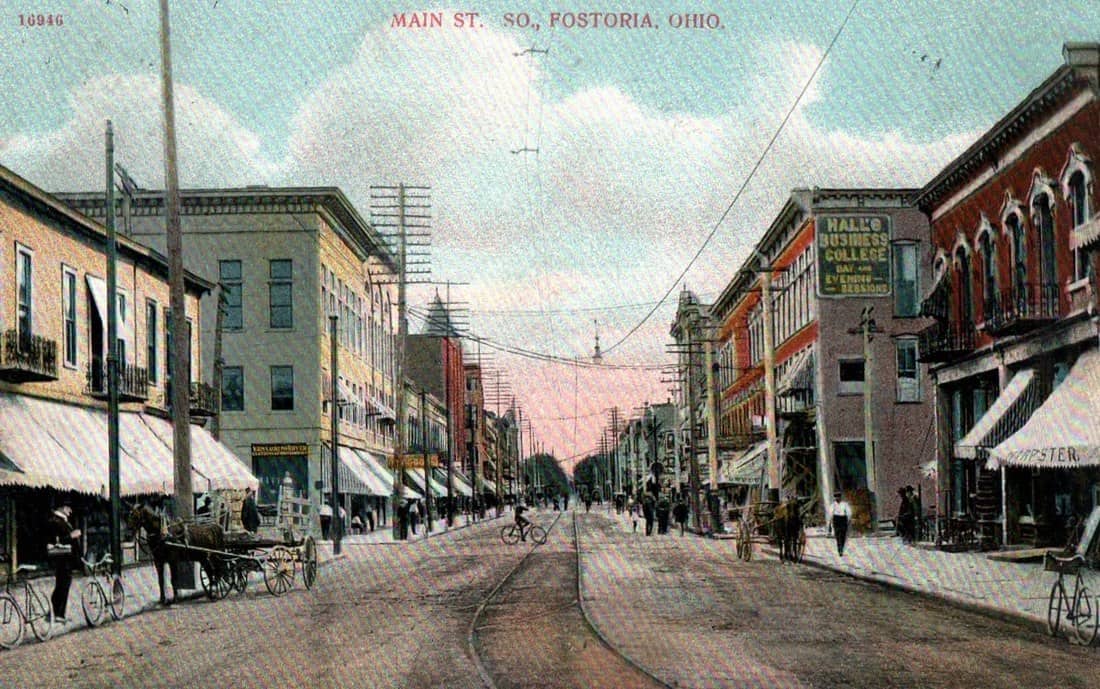
“Main St. So., Fostoria, Ohio,” postcard no. 16946, early 1900s
The second card, numbered 16946, is titled “Main St. So., Fostoria, Ohio.” It looks down a long business street lined with three-story blocks, striped awnings, wooden utility poles and a single set of streetcar tracks down the middle. A man stands beside a horse and buggy at the left curb, bicycles lean against the poles, and a lone cyclist rides down the middle of the street. There is not an automobile in sight.
High on a building at the right, a painted sign reads “Hall’s Business College, Day and Evening Sessions.” We have not found a record of when Hall’s operated in Fostoria or exactly where its rooms were. Fostoria had a business school as early as 1875. A 1978 historical society column found a catalog from that year listing a Fostoria Business College as a branch of the Northwestern Normal and Training School, which had moved to town from Republic in 1874. The columnist also remembered a sign reading “Fostoria Business College” painted on the North Street side of the building at the southwest corner of Main and North.
Looking south from North Street
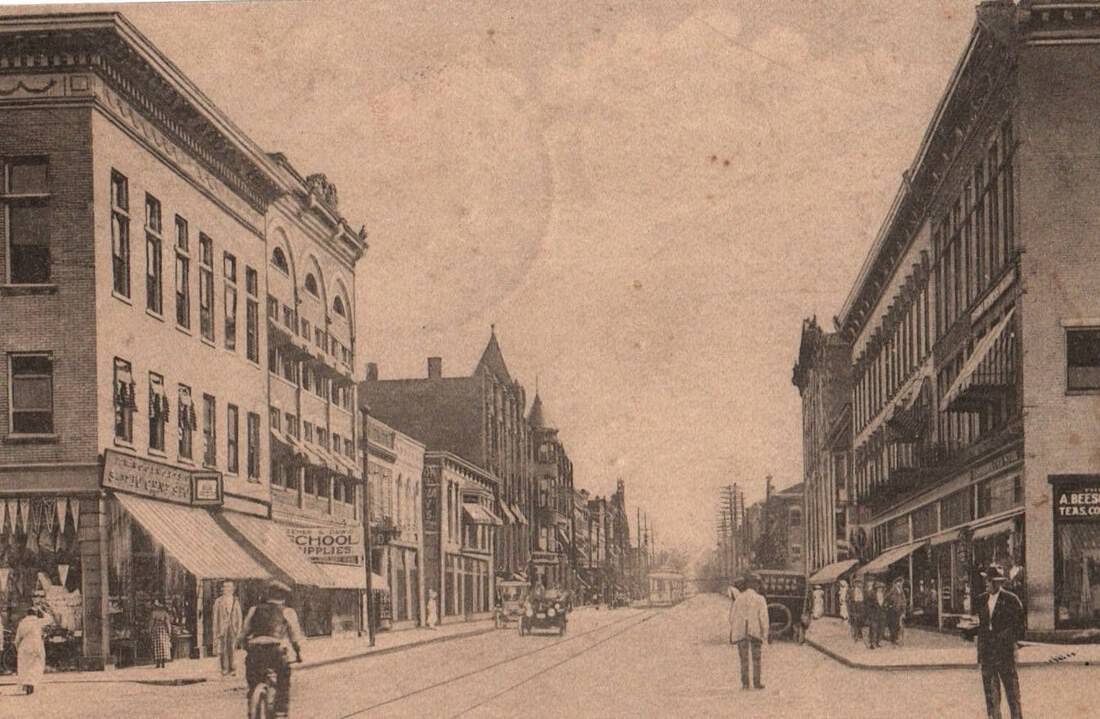
Looking south on Main Street from North Street, 1910s
The third view, a sepia card from the 1910s, looks south down Main Street. On the right, a corner store has a sign reading “A. Beesch Teas Co.” On the left, awnings shade a store with a “School Supplies” sign. Early automobiles are parked along the street, a man rides a bicycle, a streetcar heads up the tracks in the distance, and a steep pointed tower rises above the rooftops farther down the street.
That tea store sign helps place the scene. According to a 1981 historical society column, the building at the southwest corner of North and Main had “the A. Beesch Tea Co. on the ground floor,” and “in earlier days, there was a business college above.” The Ohio Savings & Loan Association bought that building in 1948. So this photographer was most likely standing at North Street, looking south toward the Opera House corner and Center Street.
That column also raises a possibility about the “Hall’s” card. The building on its right side may be the same North and Main corner seen from a little farther north, with a business college upstairs, but the two views do not show enough of the same storefronts for us to say so with confidence.
The streetcar tracks in both cards carried the interurban lines that tied Fostoria to Findlay, Tiffin, Fremont and Toledo from 1898 until about 1932. More of those tracks appear in our story on Perry Street in the early 1900s.
Do you know when Hall’s Business College was in Fostoria, or do you have a program from the Andes Opera House? We would like to hear from you.
Photo note: Photographs and images published before 1931 are in the public domain in the United States. Historical images in this article are shared for educational and historical purposes.
Sources
- Library of Congress, Sanborn Fire Insurance Map, Fostoria, Ohio, May 1908 (sheet 12): https://www.loc.gov/item/sanborn06698_005/
- National Park Service, NRHP, Fostoria Downtown Historic District: https://npgallery.nps.gov/AssetDetail/NRIS/01001065
- Fostoria Area Historical Society, W. Center From Early Days to Now (Sept. 23, 1982): https://www.fostoriamuseum.org/w-center-from-early-days-to-now/
- Fostoria Area Historical Society, Underground Reservoir Service on West Center Street (Sept. 30, 1982): https://www.fostoriamuseum.org/underground-reservoir-service-on-west-center-street/
- Fostoria Area Historical Society, She Saw Uncle Tom’s Cabin at Opera House (Oct. 28, 1982): https://www.fostoriamuseum.org/she-saw-uncle-toms-cabin-at-opera-house/
- Fostoria Area Historical Society, Did You Know Fostoria Used to Have a College? (June 15, 1978): https://www.fostoriamuseum.org/did-you-know-fostoria-used-to-have-a-college/
- Fostoria Area Historical Society, Ohio Savings Has Operated 66 Years (May 14, 1981): https://www.fostoriamuseum.org/ohio-savings-has-operated-66-years/
- Fostoria Area Historical Society, Electric Trolley Era Still Pleasant Memory for Some (May 4, 1977): https://www.fostoriamuseum.org/electric-trolley-era-still-pleasant-memory-for-some/





Leave a Reply
Want to join the discussion?Feel free to contribute!