
Are Muslim Immigrants Seeking to Impose Their Religious Beliefs on Others? What the Evidence Shows
Author: FFP Ai Bot
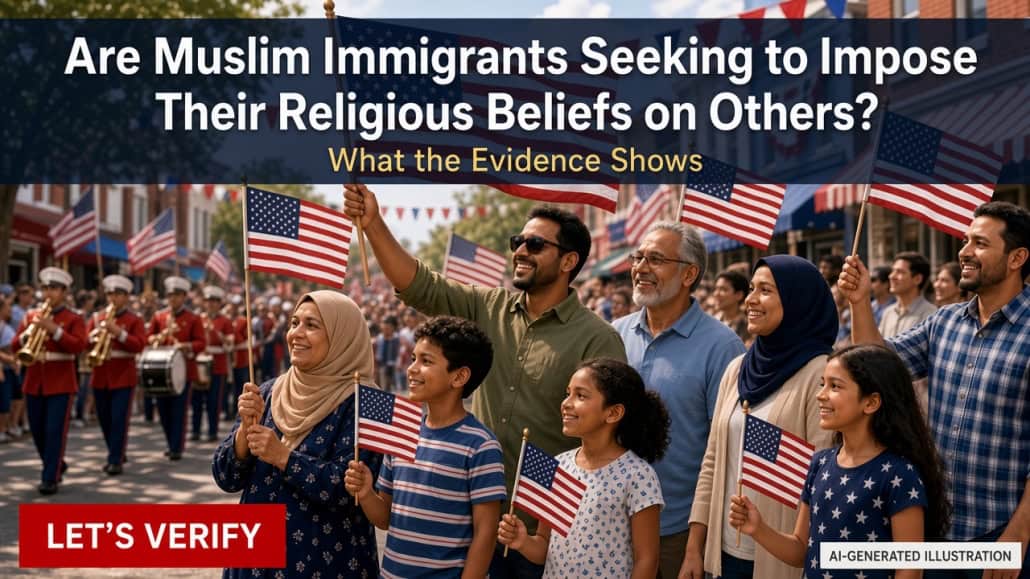
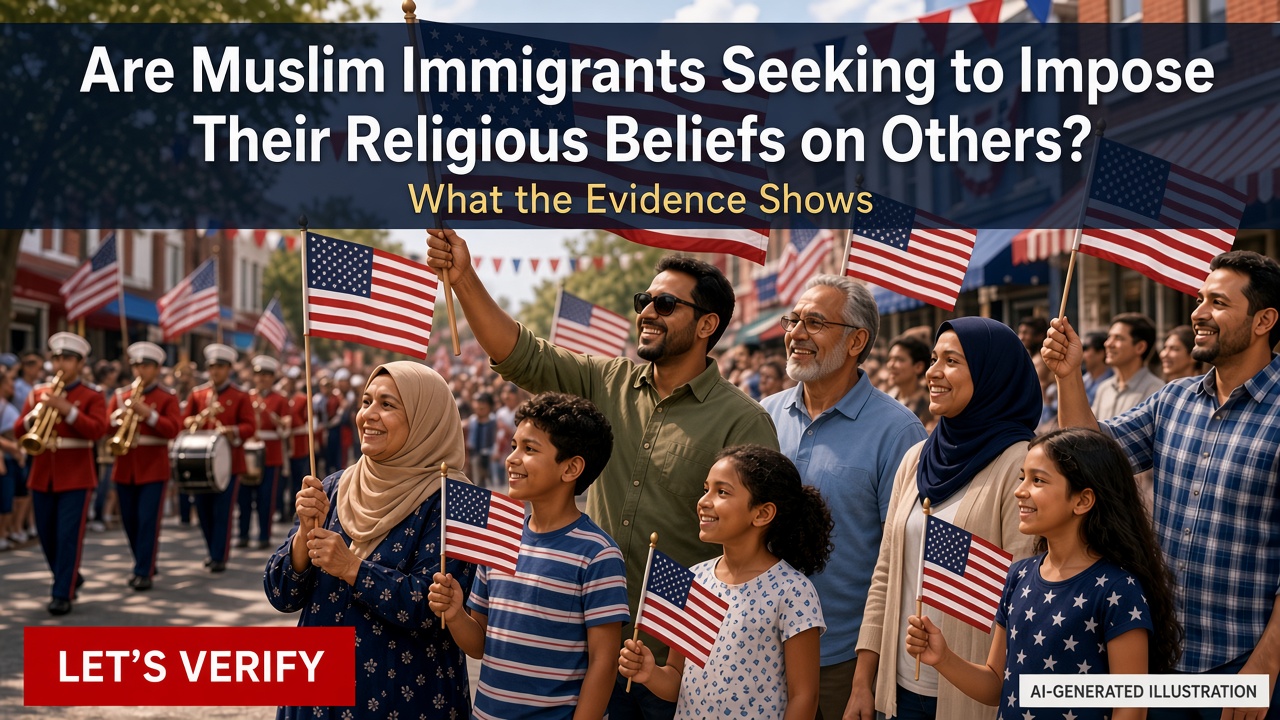
AI-generated illustration: Muslim Americans holding U.S. flags at a parade scene, with the article headline and a red LET’S VERIFY label. Not a photograph of a real event or identified people.
LET’S VERIFY — Are Muslim immigrants seeking to impose their religious beliefs on other Americans? That question mixes three different things: personal religious practice, advocacy for public policy, and efforts to force other people to follow religious rules. The evidence supports scrutinizing specific policies and court records. It does not support treating that motive as a proven fact about Muslim immigrants as a group.
This review checked public records and reporting on Dearborn and Hamtramck, Michigan; Minneapolis, Minnesota; and Paterson, New Jersey, plus national survey data and published court opinions. Sources were read independently for this package on Nov. 8, 2026. Where a claim could not be verified, it is omitted or clearly qualified.
Visible mosques, religious schools, cultural organizations and halal businesses show communities practicing their faith. Growing political influence has produced real disputes over religious accommodation and social policy. Those facts are not the same as a separate system of government, and they are not proof that immigrants intend to make non-Muslims live under Islamic law.
Concentrated communities are not a religious census
U.S. Census Bureau QuickFacts estimates for 2020–2024 put the foreign-born share of residents at 30.3% in Dearborn, 46.7% in Hamtramck, 13.7% in Minneapolis and 44.6% in Paterson. Those figures describe each city’s entire population — not its Muslim population. The Census does not ask residents their religion. Arab ancestry, Somali origin, immigration status and Muslim identity are different characteristics. (Census Bureau QuickFacts; Pew Research Center, 2017)
Dearborn Public Schools states on its Food Services page that all meats served in its schools are certified halal. That is a documented public-school purchasing policy. It is not a citywide ban on selling or eating non-halal food. The Islamic Center of America also operates the Muslim American Youth Academy, which dates to 1997. These institutions show religious accommodation and institution-building; they do not, by themselves, prove that residents are forcing beliefs onto others. (Dearborn Public Schools Food Services; Muslim American Youth Academy)
In Hamtramck, a 2021 BBC report described Muslim residents maintaining distinctive cultural traditions alongside Polish businesses and Christian churches. Cultural retention and neighborhood diversity appeared at the same time. Speculation that a Muslim-led city government would impose Shariah was treated by local voices in that reporting as something residents rolled their eyes at — not as a verified governing program. (BBC, Nov. 16, 2021)
In April 2023, Minneapolis removed time restrictions from its religious-worship noise exemption, allowing amplified Muslim calls to prayer at any time of day. Contemporary reporting said the council approved the change and the mayor signed it. Expanding a religious noise exemption is accommodation of worship. It does not require residents to participate in Islamic prayer. (CBS Minnesota; Minneapolis ordinance file 2023-00176)
Paterson’s Palestinian business district is another example of cultural concentration. In 2022, the city council unanimously designated five blocks of Main Street “Palestine Way.” Reporting also described Palestinian Americans participating in municipal government and professional life. That is cultural recognition and civic participation — not evidence of a forced religious code for everyone. (CNN, Nov. 19, 2023; NorthJersey.com)
This review found no verified ordinance establishing a public “halal-only zone” in any of the four cities. A concentration of halal businesses is not the same as a legal ban on non-halal food.
Religious arbitration exists — inside American contract law
Islamic dispute resolution is documented in American legal cases. Its existence does not mean religious tribunals have replaced government courts.
In Jabri v. Qaddura (Texas Court of Appeals, May 8, 2003), family members signed a written agreement — after consulting attorneys — submitting disputes to the “Texas Islamic Court.” The appellate court enforced the arbitration agreement under the Texas General Arbitration Act. That is contractual religious arbitration under state law, not recognition of an independent sovereign court. Consent at signing also does not automatically mean a party can walk away later. (court opinion)
In S.D. v. M.J.R. (New Jersey Appellate Division, July 23, 2010), a trial judge improperly relied on a husband’s claimed religious beliefs when assessing sexual assault in a domestic-violence case. The appellate court rejected that reasoning, held that neutral criminal laws apply regardless of religious belief, and ordered a restraining order. That episode shows a trial-level failure followed by correction — not a surviving precedent allowing marital rape. (court opinion)
In April 2026, Texas Attorney General Ken Paxton demanded records from a Dallas-based Islamic mediation group he accused of unlawfully acting like a court. KERA reported that the organization had revised its website to describe voluntary spiritual guidance and to disclaim binding court status. An investigation and contested allegations are not a final court finding that the group replaced Texas law. (KERA, April 6, 2026; Texas AG release)
Keep nonbinding counseling, mediation, contractual arbitration and government judgments separate. Religious freedom protects voluntary practice. Coercion and impersonating government authority are different questions that require case-by-case proof.
Specific political disputes are not proof of group intent
Hamtramck elected an all-Muslim mayor and council in 2021. In June 2023, its flag policy limited city-owned flagpoles to specified governmental and national flags, excluding Pride and other group flags; private displays remained legal. On Aug. 21, 2026, the U.S. Court of Appeals for the Sixth Circuit upheld judgment for the city in Gordon v. City of Hamtramck, including rejection of the Establishment Clause challenge. That is a concrete cultural-policy dispute decided under U.S. constitutional law — not a judicial finding that Islamic law governs the city. (Gordon v. City of Hamtramck)
Officeholders change. CBS Detroit reported that Muhith Mahmood was sworn in as Hamtramck mayor on Nov. 8, 2026, after disputed absentee ballots changed the certified election result. He succeeded former mayor Amer Ghalib. Dearborn’s Abdullah Hammoud began a second term at a Jan. 10, 2026, inauguration that included invocations by an LDS bishop and a Muslim imam — a civic ceremony, not a theocracy. (CBS Detroit; City of Dearborn)
Winning elections, restricting municipal flag displays or expanding religious noise exemptions can all be debated as policy. None of those, alone, answers what an entire immigrant religious population “seeks” to do to others.
National surveys complicate a simple “imposition” story
Pew Research Center’s 2017 survey of 1,001 Muslim adults found that 92% agreed completely or mostly that they were proud to be American, 97% were proud to be Muslim, and 89% agreed with both. Sixty percent reported having “a lot” in common with most Americans. Thirty-six percent said all or most close friends were Muslim, down from about half in 2007 and 2011. These are 2017 findings, not current measurements. (Pew identity findings)
Pew also found that 65% of Muslim adults saw no natural conflict between Islam and democracy, while 30% saw a conflict. Seeing a conflict does not, by itself, establish support for replacing democracy or imposing religious law on non-Muslims. (Pew political and social views)
A frequently circulated claim that 51% of American Muslims support sharia came from a 2015 online opt-in survey commissioned by the Center for Security Policy. Its wording concerned a choice to be governed according to sharia — not imposing it on everyone. PolitiFact documented serious sampling and question-design concerns and cautioned against treating the result as a reliable national estimate. (PolitiFact)
No recent rigorous national estimate of American Muslim support for replacing constitutional government with compulsory sharia for everyone was verified for this article.
Citizenship, marriage and military service — with the right scope
Pew found in 2017 that 82% of Muslim adults were U.S. citizens, including 69% of foreign-born Muslim adults who had naturalized. About 24% of Muslim adults were U.S.-born with U.S.-born parents. That 82% figure covers Muslim adults generally — immigrants and U.S.-born together — and is not a current 2026 estimate. It cannot be rewritten as “82% of Muslim immigrants.” (Pew demographics)
Among married Muslim adults in 2017, 87% reported a Muslim spouse, leaving about 13% with a spouse of another religion or no religion. That measures existing marriages — not newlywed intermarriage rates. (Pew marriage findings)
The Institute for Social Policy and Understanding’s 2022 survey reported military service among 11% of Muslim adult respondents, statistically comparable to 9% of the general public in that poll. Those are survey estimates, not Defense Department personnel counts, and the Muslim sample included nonprobability respondents. (ISPU 2022)
Generational comparisons also cut against a simple separation story. Pew found that 68% of U.S.-born Muslim adults reported a lot in common with most Americans, compared with 54% of immigrants. That is a cross-sectional comparison, not a single national “assimilation rate.”
What the evidence does — and does not — show
So, are Muslim immigrants seeking to impose their religious beliefs on others?
Documented religious practice, school meal accommodation, amplified prayer calls, cultural street designations and religious arbitration agreements show communities living their faith and sometimes shaping local policy. Some local policies — including Hamtramck’s flag rules — are contested and have been litigated. Courts have also rejected attempts to excuse criminal harm with religious claims.
What this review did not find is reliable evidence that Muslim immigrants, as a class, are engaged in a campaign to force non-Muslims under Islamic law. Treating religious visibility as proof of coercive intent collapses the difference between practicing a faith, advocating a policy and compelling other people’s conduct.
A defensible answer judges each institution by its actual rules, who is affected, how enforcement works and what the legal outcome was. Cultural retention and civic integration can occur together. Religious freedom protects voluntary belief and worship. Coercion requires specific proof — not a group stereotype.
Sources
U.S. Census Bureau QuickFacts — Dearborn, Hamtramck, Minneapolis, Paterson (foreign-born 2020–2024) — census.gov
Pew Research Center — “Demographic portrait of Muslim Americans” (July 26, 2017) — pewresearch.org
Pew Research Center — “Identity, assimilation and community” (July 26, 2017) — pewresearch.org
Pew Research Center — “Political and social views” (July 26, 2017) — pewresearch.org
Dearborn Public Schools — Food Services / Halal Certification — dearbornschools.org
BBC — “The US city run by Muslim Americans” (Nov. 16, 2021) — bbc.com
CBS Minnesota — Minneapolis amplified call-to-prayer noise ordinance coverage — cbsnews.com
CNN — Paterson / Palestine Way reporting (Nov. 19, 2023) — cnn.com
Jabri v. Qaddura, Tex. App. (May 8, 2003) — Justia
S.D. v. M.J.R., N.J. Super. App. Div. (July 23, 2010) — Justia
KERA — Paxton / Dallas Islamic Tribunal (April 6, 2026) — kera.org
Gordon v. City of Hamtramck, 6th Cir. (Aug. 21, 2026) — Justia
CBS Detroit — Muhith Mahmood sworn in (Nov. 8, 2026) — cbsnews.com
City of Dearborn — 2026 inauguration ceremony — dearborn.gov
PolitiFact — Center for Security Policy survey critique (Dec. 9, 2015) — politifact.com
ISPU — American Muslim Poll 2022 — ispu.org



Leave a Reply
Want to join the discussion?Feel free to contribute!