



FOSTORIA | Randy King, winner of a $10k lottery ticket in Fostoria. Ohio looses control in road rage confrontation. Facebook friends reported that the money was spent on the purchase of his white truck.


https://tiffinfostoriamunicipalcourt.org/
TIFFIN | A veteran detective with the Tiffin Police Department is facing misdemeanor OVI charges following a traffic stop in March 2026. According to public court records and officer employment documents, Shawn D. Vallery was arrested on March 16, 2026, and charged with Operating a Vehicle Under the Influence (OVI) under Ohio Revised Code 4511.19(A)(1)(A). The charge is a first-degree misdemeanor that carries six points on a driver’s license.
Court filings list Vallery’s blood-alcohol concentration at .153 — well above the legal limit of .08. The Ohio State Highway Patrol, not the Tiffin Police Department, conducted the investigation. Trooper A. Albright of the OSP issued the citation. Dispatch logs from the night of the incident reportedly confirm that OSP was called to the scene, raising questions about a potential conflict of interest given Vallery’s senior role inside the department he serves.
The primary case, docketed as TRC2600710A in Seneca County Municipal Court, was filed on March 20, 2026. Related citations (TRC2600710B and TRC2600710C) list additional traffic violations: OVI/breath (low) and failure to control. A fourth older case (TRD2302749) involving a different Vallery (Thomas D.) appears unrelated.
Judge Rhonda L. Best recused herself from the case pursuant to Canon 1 of the Ohio Code of Judicial Conduct. Retired Judge Robert G. Hart was assigned to preside. To avoid any appearance of impropriety, Seneca County Prosecutor’s Office appointed James F. Melle — Director of Law for the City of Fremont — as special assistant director of law to handle the prosecution.
Vallery is represented by Tiffin attorney Dean Henry of Behm & Henry, L.L.C. Henry has filed an appeal of the Administrative License Suspension (ALS) and a petition for limited driving privileges. A pretrial hearing is currently scheduled for April 24, 2026, at 1:00 p.m. in Seneca County Municipal Court.
Public officer records confirm Vallery has served full-time with the Tiffin Police Department since October 1, 2000. Prior to that, he worked full-time at the Crawford County Sheriff’s Office (February 1997–September 2000) and the Bloomville Police Department (starting August 1996). He completed basic academy training at Wayne County Sheriff’s Academy in March 1997.
Vallery rose to the rank of detective and has been a visible, decorated member of the department. In 2024, he was named Officer of the Year. In October 2025, the department and local media celebrated his 25 years of service. He has testified in numerous criminal cases as a lead investigator and has represented the department at events such as National Police Week.
Court records list Vallery’s address as 51 E. Market Street in Tiffin — the location of Tiffin City Hall and the Police Department.
All details above come directly from publicly available documents:
No statements have been released yet by the Tiffin Police Department, Chief David Pauly, or Vallery himself regarding the charges. As with any criminal case, Vallery is presumed innocent until proven guilty in a court of law.
This matter is ongoing. The Advertiser-Tribune and other local outlets have not yet published reports on the arrest as of April 2, 2026, suggesting the case remains in its early procedural stages.
Context for the Community Tiffin, a small city in Seneca County, has long taken pride in its police department. Vallery’s decades of service, recent Officer of the Year honor, and frequent public appearances made him a recognizable figure in local law enforcement. The fact that the Ohio State Highway Patrol — an outside agency — handled the stop and investigation underscores standard protocol when an internal officer is involved, designed to maintain impartiality.
Residents and local officials will be watching how the case proceeds, particularly given the department’s emphasis on integrity and community trust. A pretrial hearing next month will likely provide the next public update.
This article is based exclusively on verified public records, officer employment history, and court filings. No confidential information was used.



FINDLAY, Ohio | Two Fostoria residents were killed and a third person was seriously injured Tuesday afternoon when the car they were riding in crashed after the driver suffered a medical emergency.
Devante McBeth, 30, and Breanna Garvey, 31, were pronounced dead at the scene. A 38-year-old man, also from Fostoria, was transported to a local hospital with serious injuries.
According to Findlay police, the crash occurred around 2:18 p.m. as McBeth was driving south on Blanchard Avenue toward the intersection with Crystal Avenue. Police say McBeth experienced a medical emergency, causing the sedan to accelerate uncontrollably. One of the passengers attempted to steer the vehicle but was unable to regain control.
The car left the roadway and struck a parked vehicle, a utility pole, and a tree. Garvey was in the rear seat at the time of the crash, while the injured 38-year-old was in the front passenger seat.
The incident remains under investigation by Findlay police.


FINDLAY, Ohio | Findlay YMCA’s standout swimmer Tillie Abbott is set to compete this week at the YMCA National Swimming Championships in Greensboro, North Carolina.
The prestigious five-day event brings together 1,284 athletes representing 180 YMCAs from across the country.
Abbott is scheduled to compete in three freestyle events:
– 200 Freestyle – Wednesday, April 1 at 9:25 AM
– 50 Freestyle – Thursday, April 2 at 9:30 AM
– 100 Freestyle – Friday, April 3 at 9:00 AM
Fans can watch the competition live for free at: [takeitlive.tv/events/26tl010-hm7n9](https://takeitlive.tv/events/26tl010-hm7n9)
The Findlay YMCA community is rallying behind Tillie as she represents northwest Ohio on the national stage. Best wishes for strong races and an unforgettable experience!

Fostoria Woman Files Federal Civil Rights Lawsuit Against City, Judge, Prosecutor, Police Officers, and Ohio Attorney General
A Fostoria woman has filed a federal civil rights lawsuit in the United States District Court for the Northern District of Ohio, alleging a series of constitutional violations arising from a series of municipal traffic cases handled in the Tiffin-Fostoria Municipal Court in 2025.
Rebecca Cook, a Fostoria resident appearing pro se — meaning she is representing herself without an attorney — filed the complaint under 42 U.S.C. § 1983, the federal law that allows individuals to sue government officials for violations of their constitutional rights.
The defendants named in the complaint are a broad list of Fostoria-area officials, including:
City of Fostoria
Judge Rhonda Lynn Best of the Tiffin-Fostoria Municipal Court
Prosecutor Barbara Dibble
Court Clerks Jennifer McClure and “Heather” (last name refused)
Fostoria Police Officers Cole Noftz, Tim Ink, and Brandon Bell
Ohio Attorney General Dave Yost
Cook has also filed a motion to proceed in forma pauperis, meaning she is asking the court to waive filing fees due to financial hardship, and has requested that the U.S. Marshals Service serve the defendants on her behalf.
The complaint centers on five traffic-related cases adjudicated against Cook in the Tiffin-Fostoria Municipal Court on April 8, 2025 (case numbers TRD 240341, TRD 2403704A-B, TRD 2402451, and TRD 2403040). Cook argues that everything that happened in those cases — and everything that followed — was legally void from the start.
Cook’s central argument is that the municipal court never established lawful jurisdiction over her. She says she repeatedly demanded that the court identify a lawfully injured party or complaining witness, and that no one ever provided one. She argues that because jurisdiction was never properly established and confirmed on the record, all judgments against her are void ab initio — legally void from the beginning.
Cook alleges she was forced to accept a public defender against her will, in violation of her Sixth and Fourteenth Amendment rights. She argues that her right to represent herself was never properly waived and that any such waiver was made under coercion and the threat of incarceration, making it legally invalid.
In a notable portion of the complaint, Cook alleges she requested proof of lawful authority from the judge and prosecutor — including valid oaths of office, law licenses, and required bonds. She argues that the documents provided were deficient, lacking proper notarization, official seals, and certification, and that the officials therefore “proceeded under color of state law without lawful authority.”
Cook was placed on reporting probation as a result of the traffic matters. She argues that because the underlying judgments are void, the probation itself is void — and that continued enforcement of her probation conditions constitutes an unlawful deprivation of liberty under the Fourteenth Amendment.
Cook also names Attorney General Dave Yost, alleging that the state sent her demands for payment of fines and fees rooted in what she calls void judgments. She argues this constitutes enforcement of unconstitutional obligations and an illegal attempt to seize her property without due process.
The complaint raises seven formal counts against the defendants:
Count I — Due Process Violation (14th Amendment, § 1983)
Count II — Forced Public Defender / Right to Self-Representation (6th & 14th Amendments)
Count III — Lack of Lawful Authority (14th Amendment)
Count IV — Illegal Probation / Deprivation of Liberty
Count V — Municipal Liability under Monell v. Dep’t of Social Services, holding the City of Fostoria responsible for unconstitutional policies, customs, and failures to train
Count VI — Improper Collection by the State Attorney General
Count VII — Declaratory and Injunctive Relief
Cook’s requested relief is sweeping. She is asking the federal court to:
Declare all municipal court judgments void
Permanently enjoin enforcement of her probation and all related fines
Order defendants to produce valid oaths, licenses, and bond records for the judge and prosecutor
Award compensatory damages against non-immune defendants
Grant a jury trial on all applicable claims
The complaint incorporates legal theories and language associated with the sovereign citizen and UCC (Uniform Commercial Code) rights reservation movements — Cook styles her name as “rebecca-ann:cook UCC 1-308/All rights reserved without prejudice” throughout the document. Courts have historically been skeptical of many such arguments, particularly claims that government officials must prove the validity of their oaths or bonds before a court may exercise jurisdiction, or that traffic enforcement requires a named private complaining witness.
That said, the core civil rights framework — 42 U.S.C. § 1983, due process, and the right to self-representation — are well-established areas of federal law, and federal courts are required to liberally construe pro se complaints before dismissing them. The case has not yet been assigned a case number or judge, meaning it has not yet been formally accepted by the court.
None of the named defendants have responded to the complaint, and no court has made any finding on the merits of Cook’s allegations. All parties named in the lawsuit are presumed to have acted lawfully unless and until a court determines otherwise.


#### STANDBY FOR COVERAGE####
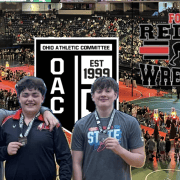
This weekend, three Fostoria Junior High wrestlers are carrying our town’s colors onto one of the biggest stages in Ohio. Seventh-grader Gannon Seitz, and eighth-graders Jackson Welly and Enrique Jimenez are in Youngstown for the OAC Junior High State Tournament.
Their regular season ended weeks ago, but these three never stopped. Early mornings, late nights, blood, sweat and a few tears — all to earn their shot at state.
Weigh-ins are Friday at 6:30 p.m. Wrestling runs Saturday and Sunday, as Gannon, Jackson, and Enrique battle the best in Ohio.
They’re not just wrestlers — they’re multi-sport athletes and leaders for Fostoria, showing what dedication at the junior high level really looks like.
From their families, teammates, coaches, and the entire Fostoria community:
Good luck, Gannon, Jackson, and Enrique. We’re proud of you. Go Redmen!

Two Hancock County women say the local child welfare and juvenile court systems are failing the very children they are supposed to protect. In detailed letters to the editor, Jamie Meade and Heidi Roby describe a pattern of delayed action, blocked family placements, and a lack of basic transparency that they believe has left dozens of children in government custody unnecessarily.
Meade’s letter is a tightly documented complaint alleging “ongoing systemic misconduct” by Hancock County Job & Family Services – Children’s Protective Services and the juvenile court. She argues that local practice is out of step with both Ohio law and federal child‑welfare mandates that strongly favor placing children with safe, willing relatives whenever possible.
She points specifically to:
Ohio statutes that require agencies to identify, notify, and assess relatives early in a case, and to prioritize the “least restrictive” placement options, including kinship care.
Federal Title IV‑E requirements that states show due diligence in locating relatives and make “reasonable efforts” to preserve or reunify families.
The Adoption and Safe Families Act’s demand for timely, lawful permanency planning, not open‑ended custody or delay.
According to Meade, those mandates are being routinely ignored. She describes cases where relatives step forward but:
Are never properly assessed through home studies or background checks.
Are told they must first hire counsel and file to “intervene” in court—an extra legal hurdle not required by statute for kinship consideration.
Are rejected without written findings or individualized reasons, leaving families with no clear explanation or path to challenge decisions.
She also alleges that entire families have been “blanket disqualified” based on bureaucratic discretion rather than case‑by‑case evaluation, and that visitation and contact have been restricted in ways that appear inconsistent with reasonable‑efforts requirements toward reunification.
Meade backs her concerns with county‑level data. In documents she cites, Hancock County reportedly had 81 children in custody in 2024, with only one placed in kinship care, and 102 children in custody in 2025, with 22 in kinship care while more than 80 remained in agency placements.
On paper, Ohio and federal policy treat kinship placement as a first‑line option. Yet Meade argues these numbers show a system defaulting to foster care and institutional placements, not family connections. She suggests this may put the county out of compliance with funding rules tied to Title IV‑E and other federal streams that require documented kinship efforts and least‑restrictive placements.
The financial questions go further: her letter raises concerns about possible misuse or misallocation of Title IV‑E and Title IV‑D funds, along with local levy dollars, if the county is accepting money premised on following laws it is not actually meeting.
Meade emphasizes that the issue is not a lack of safe relatives but a refusal to use them. She notes her own background as a long‑time licensed massage therapist who has hosted multiple foreign exchange students, without disqualifying history. She says her sister—a director of nursing married to a retired chief of police—has fostered six children and currently cares for three, yet the family has been “blanket denied” in Hancock County cases.
“They have blanket denied every single person that came forward and have never utilized Kinnect to Families,” Meade writes, referring to Ohio’s statewide program designed to locate and support kinship connections.
The result, she argues, is that children are being kept away from fit, willing, and experienced caregivers who are ready to step in, while the county maintains high custody numbers year after year.
Where Meade’s letter is legalistic and data‑driven, Heidi Roby’s is more personal and reflective, but the core concern is similar: families who raise serious safety issues or seek help from the system often feel lost and unheard.
Roby, who identifies herself as a parent in ongoing proceedings, describes navigating a maze of multiple agencies, unclear responsibilities, and delayed responses. She does not name specific officials or cases, but she says that when child‑safety allegations arise, families need:
Clear, consistent processes.
Transparent communication about what is happening and why.
Accountability when agencies don’t follow their own rules.
“Many parents are not asking for special treatment,” Roby writes. “Only for their concerns to be heard, properly reviewed, and addressed with the seriousness they deserve.”
Her goal, she says, is not to target individuals but to spark “a larger conversation” about whether child‑protection systems are truly working for the families who depend on them.
Meade’s letter explicitly asks for:
An independent review or investigation of Hancock County child‑welfare practices.
Media coverage to bring public visibility to kinship‑placement failures and due‑process issues.
Guidance on which state or federal oversight bodies can step in when local agencies appear out of compliance.
Advocacy to ensure the county meets its obligations under kinship and family‑preservation laws.
Both writers stress that this is ultimately about children’s rights and family rights—including constitutional due‑process protections when the state intervenes in family life.
They acknowledge that child‑protection work is complex and that not every allegation against a system will prove true. But they argue that when families present documented patterns of missed kinship placements, opaque decision‑making, and confusing or delayed responses to safety concerns, the public has a right to ask hard questions and demand clear answers.
For now, Meade and Roby are among the local voices pushing for those answers—and inviting others with similar experiences to step forward so that Hancock County’s child‑welfare system can be examined in full daylight.
“You can see what’s going on if you’re willing to open your eyes”
I am writing to request your assistance, and potential investigation into ongoing systemic misconduct involving child welfare proceedings in Hancock County, Ohio.
Through direct involvement and extensive documentation, I have uncovered patterns of conduct by Hancock County Children Services and the juvenile court that raise serious concerns under both Ohio law and federal child welfare mandates.
Specifically, the agency and court have engaged in practices that appear to conflict with:
• Ohio Revised Code §§ 2151.4116–2151.412 (mandatory kinship identification, notification, and case planning)
• Ohio Administrative Code 5101:2-42-05 and 5101:2-42-18 (least restrictive placement and required kinship assessment)
• 42 U.S.C. § 671(a)(19) and § 671(a)(29) (Title IV-E requirements for kinship preference and due diligence in locating relatives)
• 42 U.S.C. § 671(a)(15) (reasonable efforts toward family preservation and reunification)
• The Adoption and Safe Families Act (ASFA), which requires timely and lawful permanency planning—not systemic delay or obstructionDespite these mandates, the following patterns have been documented:
1. Systemic failure to identify, notify, and assess available relatives within statutory timeframes.
2. Complete absence of home studies, background checks, or individualized determinations for multiple qualified family members.
3. Requirement that all relatives file for formal intervention simply to be considered for placement—effectively creating a barrier not required by law.
4. Denial of kinship placement without written findings or documented justification, contrary to due process requirements.
5. Reliance on hearsay evidence and “trial by ambush” tactics, where critical information is withheld until hearings.
6. Abuse of discretion resulting in blanket disqualification of entire families without individualized assessment.
7. Restriction of visitation and family contact inconsistent with statutory “reasonable efforts” obligations.These practices are not isolated incidents but reflect a broader systemic pattern. I have many that you can interview. Publicly available data reflects that, in 2024, Hancock County had approximately 81 children in custody with only 1 placed in kinship care, raising significant concerns regarding compliance with both state and federal funding requirements tied to kinship placement. In 2025 they had 102 children and placed 22 in kinship still holding above 80 kids in custody, which seems to be a quota.
Additionally, concerns exist regarding the misuse or misallocation of federal Title IV-E funds, Title IV-D funding structures, and local levy resources, all of which are conditioned upon compliance with federal and state child welfare laws.
The cumulative effect of these actions has resulted in the separation of children from fit and willing family members without lawful process, raising serious concerns under the Fourteenth Amendment, including violations of procedural and substantive due process. I have hosted 6 foreign exchange students and a medical license massage therapist of 24 years – nothing obviously in my background. My sister is a director of nursing -her husband a retired chief of police and they’ve fostered 6 children and currently have 3 of the 6. They have blanket denied every single person that came forward and have never utilized Kinnect to families.
I am seeking assistance in the following areas:
• Independent review or investigation of Hancock County’s child welfare practices
• Media exposure to bring transparency and public awareness to these systemic issues
• Guidance on appropriate state or federal oversight agencies that can intervene
• Advocacy support to ensure compliance with kinship placement laws and constitutional protectionsI have preserved documentation, transcripts, and supporting evidence substantiating these concerns and am prepared to provide them upon request.
Thank you for your time and consideration. I respectfully request that this matter be reviewed with the urgency it warrants, as the rights of children and families continue to be affected.
Sincerely,
Jamie Meade
I recently read about local families speaking out regarding concerns within the child welfare and court systems, and I felt compelled to share that I am experiencing similar challenges.
As a parent currently involved in ongoing proceedings, I have encountered a system that can be difficult to navigate when serious child-safety concerns are raised. Like others, I have found myself seeking answers across multiple agencies, without clear direction or meaningful resolution.
This is not about assigning blame to any one individual. Rather, it reflects a broader concern: when allegations involving the safety and well-being of a child arise, families need clear processes, accountability, and timely responses that prioritize protection above all else.
I believe many parents are not asking for special treatment — only for their concerns to be heard, properly reviewed, and addressed with the seriousness they deserve.
My hope in sharing this is to contribute to a larger conversation about how we can ensure that systems intended to protect children are working as effectively and transparently as possible for the families who rely on them.
Sincerely,
Heidi Roby
