
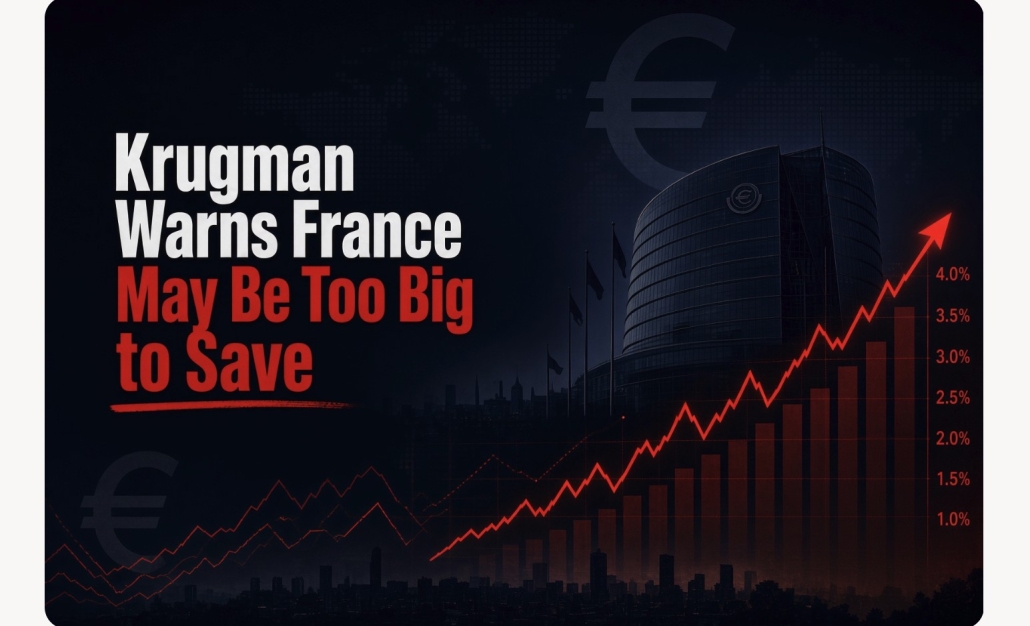
Krugman warns France may be “too big to save” as ECB faces limits and Bitcoin talk grows
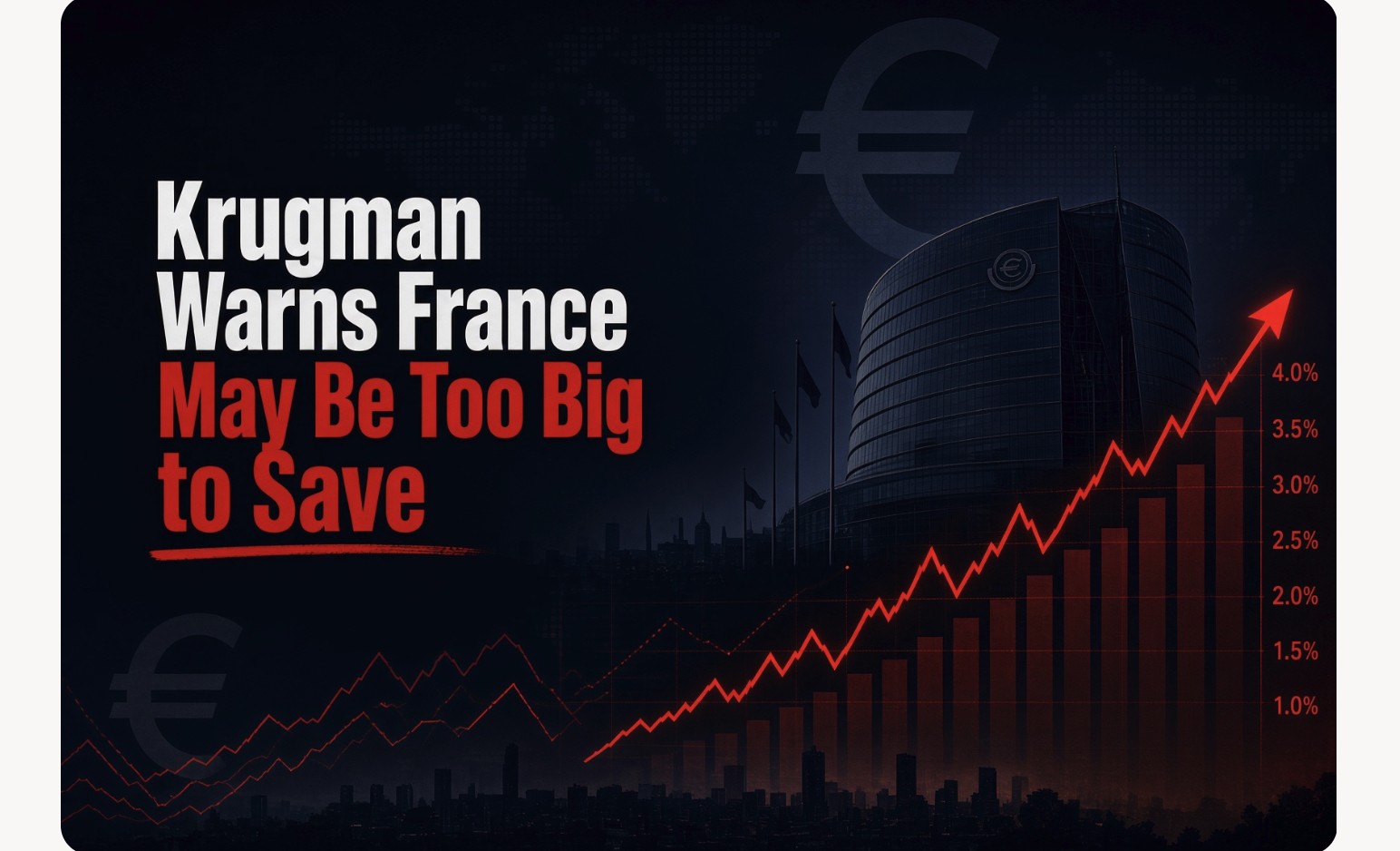
Krugman warns France may be “too big to save” as ECB faces limits and Bitcoin talk grows
France’s mounting debt is testing the European Central Bank’s willingness and ability to intervene, and one high-profile economist now says the country may have crossed the line from “too big to fail” to “too big to save.”
Nobel laureate Paul Krugman wrote last week that France is on a “fiscally unsustainable path.” Its public debt stands near €3.6 trillion, or about 119 percent of GDP—the highest since the euro’s creation. Budget deficits have stayed above 5 percent of GDP for years, driven by pension costs, political gridlock, and spending pressures. French 10-year bond yields have climbed toward 5 percent, the highest in roughly two decades, and the spread over German bonds has widened to levels not seen since the 2012 euro crisis.
Krugman’s core point is scale and politics. During the last euro crisis the ECB ultimately stepped in with the “whatever it takes” pledge. France is the euro zone’s second-largest economy. A full-scale rescue would be extremely expensive and would face fierce opposition from countries that already imposed austerity. France is also moving further from fiscal targets, not closer. That combination, Krugman argues, makes an orderly ECB bailout harder to justify and more divisive inside Europe.
Officials in Frankfurt and Paris are pushing back. Bank of France head Emmanuel Moulin said this month the country does not currently need ECB help and that the solution lies at home. Euro-zone finance ministers have told France to pass a credible 2027 budget to calm markets. The ECB’s main tool for buying a member’s bonds—the Transmission Protection Instrument—requires that the country pursue sound policies and is not simply facing self-inflicted fiscal trouble. France, with a deficit still projected around 5 percent and an excessive-deficit procedure underway, fails key conditions. Intervention is therefore legally and politically contentious.
A genuine French default remains a low-probability scenario in current market pricing—credit-default-swap spreads imply only a small chance over the next five years—but the tail risk is what has traders and crypto commentators talking. Because France cannot print its own currency, a loss of market access would force either severe austerity, restructuring, or some form of euro-zone money creation on a scale far larger than the Greek bailouts. Crypto figures such as Arthur Hayes have argued that any such forced printing by the ECB (and possible spillover into Fed or Treasury responses) would be a catalyst for Bitcoin, with some projecting sharply higher prices if the crisis deepens.
That link is speculative. Bitcoin does not hold French bonds, and past monetary expansions have not produced automatic, lasting gains. Still, the architecture of the euro means a true French funding crisis would be different from 2012: larger, more politically explosive, and harder for the ECB to paper over without either fracturing the currency union or expanding its balance sheet dramatically.
For households and businesses around Fostoria, Findlay, and Tiffin, the immediate effects would show up in higher global interest rates, a weaker euro, and volatility in retirement accounts and commodity prices rather than a direct French default. The story remains a European political and fiscal one—student protests, a contested 2027 budget, and an approaching presidential election—that markets are treating as a live risk to the euro zone’s stability.
Local discussion of markets, inflation, and what it means for area jobs and savings continues in the usual Facebook groups:
https://www.facebook.com/share/1JnFAMfmYm/?mibextid=wwXIfr
https://www.facebook.com/share/g/1Dedh3kHyy/?mibextid=wwXIfr
#MarketsInTurmoil


Leave a Reply
Want to join the discussion?Feel free to contribute!