
Stem Cell Therapy: How One Denver Clinic is Helping People With Joint Pain & Hair Loss
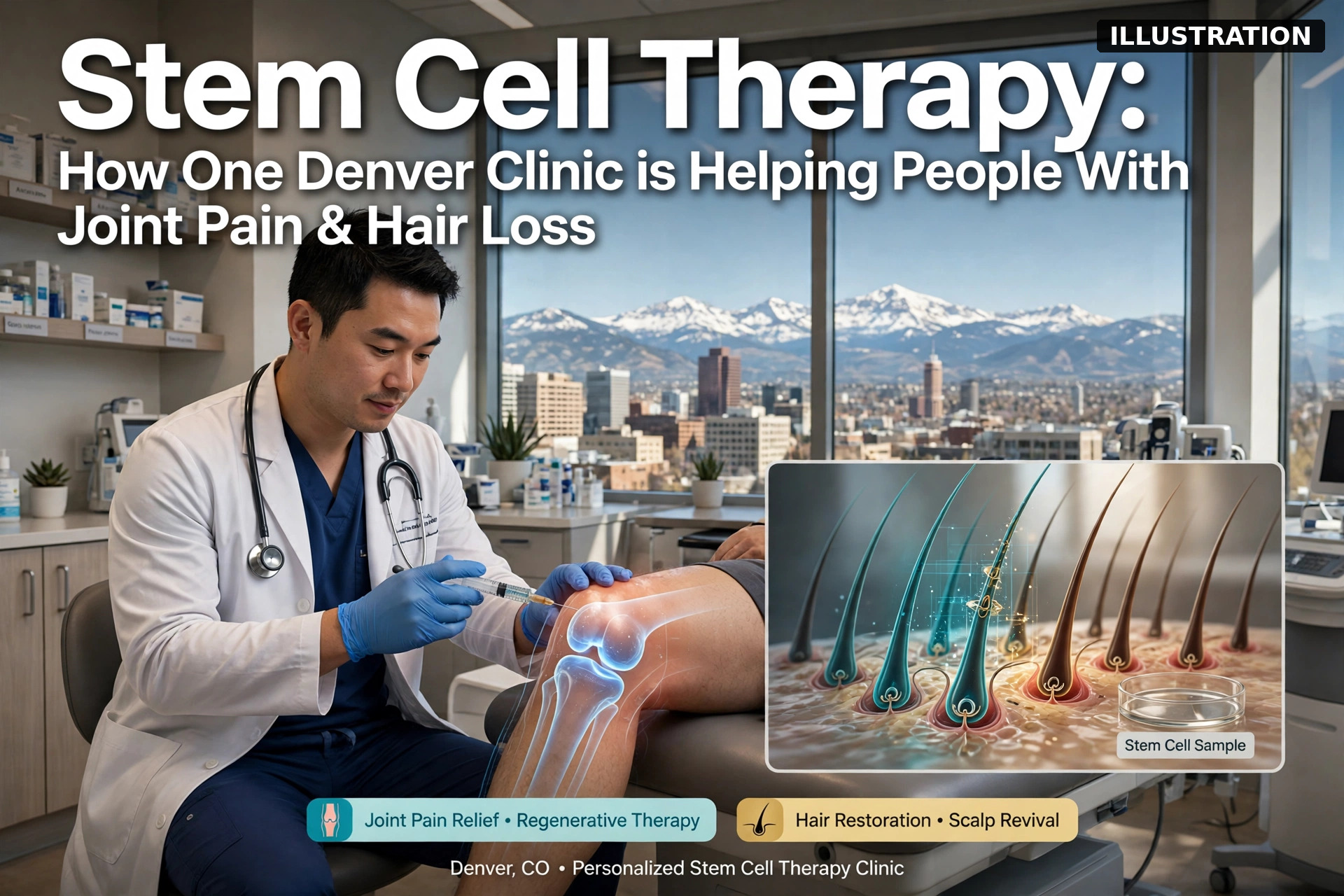
Illustration: AI-generated image provided with the article. It does not depict a specific patient or the Cendant clinic.
Joint pain and hair loss rarely come up in the same conversation. One sends people to an orthopedist, the other to a dermatologist or a hair transplant clinic. But underneath, both involve the same problem: tissue that is wearing down faster than the body can repair it. That shared biology is why a growing number of clinics offer regenerative treatments — including stem cell therapy — for both. In Denver, Cendant Stem Cell Center has built its practice around that idea, treating joint pain on the health side and hair loss through its sister practice, Cendant Hair.
What stem cell therapy is — and what it is not
Stem cell therapy is a form of regenerative medicine. The goal is not simply to mask symptoms, but to deliver cells and the signaling compounds they produce to damaged or weakened tissue, with the aim of supporting the body’s own repair processes. Depending on the treatment, the cells may come from the patient’s own body — commonly adipose (fat) tissue or bone marrow — or from donated birth tissue products. Once prepared, the material is injected into the area being treated: a painful joint, or the scalp in the case of hair loss.
It is important to be precise about the state of the science. Stem cell treatments are not FDA-approved for joint pain or for hair loss. The FDA says the only stem cell products approved for use in the United States are blood-forming stem cells derived from umbilical cord blood, and only for certain disorders that affect blood production — not for other uses. The agency also warns that regenerative products offered outside approved uses or a properly overseen clinical trial may be marketed illegally, and that patients may be deceived by those offers (the FDA on regenerative medicine therapies). That does not mean the research is empty — but it does mean patients should expect an honest conversation about evidence, not guarantees.
Stem cell therapy for joint pain
The most common joint complaints are driven by osteoarthritis and overuse: cartilage thins, the joint becomes inflamed, and everyday movements — climbing stairs, getting out of a chair, a round of golf — start to hurt. Standard care escalates from physical therapy and anti-inflammatory medication to cortisone injections, and eventually to joint replacement surgery. Stem cell therapy is generally considered by people who sit in the middle of that ladder: their pain is real and limiting, but they are not ready for, or do not yet need, a replacement joint.
The rationale is that regenerative cells and their growth factors may help calm inflammation and support the environment inside the joint. Patients typically seek treatment for knees most often, along with shoulders, hips, and other joints. Appointments at a center like Cendant Stem Cell Center in Denver begin with an evaluation of the joint, imaging, and the patient’s history, because not every painful joint is a good candidate — advanced “bone-on-bone” disease, for example, responds differently than earlier-stage wear. Recovery is usually far simpler than surgery: an injection-based procedure with a short period of modified activity rather than months of rehabilitation. Results, when they come, tend to build over weeks to months rather than overnight, and they vary from person to person.
Stem cell therapy for hair loss
On the hair side, the target is the miniaturizing follicle. In androgenetic alopecia — pattern hair loss — follicles shrink over successive growth cycles under the influence of DHT, producing finer and shorter hair until they stop producing visible hair at all (StatPearls on androgenetic alopecia). Importantly, research suggests the follicle’s stem cells often remain viable even in balding scalp, while progenitor cells are lost, which is one reason scientists see room for regenerative approaches (the review of stem cell-based therapy for hair loss).
The human evidence is early but not trivial. A 2026 systematic review in Stem Cell Research & Therapy pooled 20 clinical studies covering 724 patients across conditioned media, platelet-rich fibrin, stromal vascular fraction, extracellular vesicles, and stem cell or micrograft treatments, and found reported gains in hair density and thickness across most approaches — while stressing that the studies were small and heterogeneous, which limits firm conclusions (the systematic review). An earlier systematic review of 15 studies and 653 participants likewise reported increased hair density across cell types, with the same caveats about sample size, mixed protocols, and follow-up (the Cells systematic review).
In practice, clinics like Cendant Hair’s Denver location in Greenwood Village combine regenerative treatments with established options — including hair transplantation for areas where follicles are already gone. That combination matters: regenerative therapy aims at follicles that are weakened but alive, while only a transplant can move new follicles into a fully bald area. Patients comparing hair transplant clinics can use directories such as HairTransplantClinics.net to research providers, then confirm in consultation which parts of a plan are surgical and which are regenerative.
Who is a good candidate — and who should be cautious
Good candidates for stem cell therapy tend to share a few traits: a confirmed diagnosis, early-to-moderate rather than end-stage disease, and realistic expectations. For joints, that usually means pain that limits activity but a joint that still has some cartilage left. For hair, it means thinning with living follicles still present, rather than long-standing smooth baldness.
Extra caution is warranted for anyone being promised a cure, a guaranteed result, or a one-size-fits-all package priced before an examination. The International Society of Hair Restoration Surgery similarly advises patients to make sure a properly trained and licensed physician is responsible for their treatment, to ask who actually performs the procedure, and to be wary of false or exaggerated advertising claims (the ISHRS consumer advocacy guide). Ask any clinic what product is being used, where it comes from, what the evidence is for your specific condition, and what the alternatives are — including doing nothing.
Frequently Asked Questions
Is stem cell therapy FDA-approved for joint pain or hair loss?
No. The FDA has approved stem cell products only for certain blood disorders. Regenerative treatments for joints and hair are not FDA-approved, and the FDA advises patients to be cautious about products marketed outside approved uses or legitimate clinical trials (the FDA on regenerative medicine therapies).
How is stem cell therapy for joints different from a cortisone shot?
A cortisone injection mainly reduces inflammation for a limited period. Stem cell therapy is intended to deliver regenerative cells and signaling factors that may support the tissue environment in the joint, rather than only suppressing inflammation for a short time. That is the aim, not a proven guarantee. The evidence is still developing, and neither treatment is right for every joint, which is why an evaluation comes first.
Can stem cell therapy replace a hair transplant?
Not for areas that are already bald. Regenerative treatments target weakened, miniaturizing follicles that are still alive; they cannot create follicles where none exist. Many patients use regenerative therapy to support existing hair, sometimes alongside a transplant that restores areas already lost.
How soon do people see results?
Usually gradually. Joint patients who respond often notice change over weeks to a few months, and hair growth operates on the hair cycle’s timeline — visible change typically takes several months. Any clinic promising overnight transformation should raise a red flag.
Joint pain and hair loss are different problems, but both come down to tissue that needs support to repair itself. Stem cell therapy is an evolving attempt to provide that support — promising enough to take seriously, preliminary enough to approach with clear eyes. A consultation, including at a Denver clinic such as Cendant that works on both sides of that equation, should start with an evaluation, explain what the evidence does and does not show, and make clear whether you are a candidate before talking about treatment.
This article is for general information and is not medical advice. Stem cell treatments for joint pain and hair loss are not FDA-approved. Talk with a licensed clinician about your own situation.
Sources:
U.S. Food and Drug Administration, Important Patient and Consumer Information About Regenerative Medicine Therapies — https://www.fda.gov/vaccines-blood-biologics/consumers-biologics/important-patient-and-consumer-information-about-regenerative-medicine-therapies
StatPearls, Androgenetic Alopecia — https://www.ncbi.nlm.nih.gov/books/NBK430924/
Egger, Tomic-Canic and Tosti, Advances in Stem Cell-Based Therapy for Hair Loss, CellR4, 2020 (PMC7508456) — https://pmc.ncbi.nlm.nih.gov/articles/PMC7508456/
Behrangi et al., A systematic review of clinical evidence on conditioned media, platelet-rich fibrin, stromal vascular fraction, extracellular vesicles, and stem cells in androgenetic alopecia, Stem Cell Research & Therapy, 2026 (PMC13191867) — https://pmc.ncbi.nlm.nih.gov/articles/PMC13191867/
Krefft-Trzciniecka et al., Human Stem Cell Use in Androgenetic Alopecia: A Systematic Review, Cells, 2023 (PMC10047891) — https://pmc.ncbi.nlm.nih.gov/articles/PMC10047891/
International Society of Hair Restoration Surgery, Consumer Advocacy — https://ishrs.org/patients/consumer-advocacy/
Cendant Stem Cell Center — https://cendanthealth.com
Cendant Hair — https://cendanthair.com
HairTransplantClinics.net — https://hairtransplantclinics.net



Leave a Reply
Want to join the discussion?Feel free to contribute!