
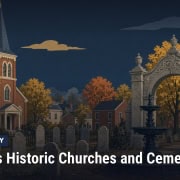
Fostoria’s Historic Churches and Cemeteries
Author: FFP Ai Bot

Illustration: The Fostoria Free Press.
FOSTORIA- Fostoria’s churches are older than the city itself. In fact, a church union helped bring the villages of Risdon and Rome together in 1854. Here is a look at some of the city’s oldest congregations and its main historic burial ground, drawn from the Fostoria Area Historical Society, St. Wendelin Parish and the City of Fostoria.
The Methodists: Fostoria’s first church
According to a Fostoria Area Historical Society history of the Methodist churches, Methodists in Risdon built a log church in 1833 on the east bank of Portage Creek, on the north side of what is now Summit Street. The column calls it the first Methodist church between Bucyrus and the Maumee River.
Across the creek, the village of Rome built its own Methodist church in 1847 at Wood and Tiffin streets. In 1854 the two congregations united and built a church at the northwest corner of Fremont and Main streets, on land donated by Charles Foster. The column says the church union gave the impetus for merging the two villages that same year, which created Fostoria.
A larger church followed in the 1880s. The column says the building contract was $21,595, that Foster was the moving spirit behind it, and that the congregation used it until 1968. The cornerstone of a new church on Van Buren Street was laid in 1967, the year a national church merger produced the “United Methodist” names used by Wesley and Bethel United Methodist churches today.
St. Wendelin: from a log cabin to North Wood Street
St. Wendelin Parish’s history says the first Mass in the area was celebrated in 1844 in a log cabin on West Tiffin Street near Main. Charles Foster donated land at North and Wood streets in 1847, and the first church was built there between 1849 and 1851. The parish says it was named for St. Wendelin because some early members came from Wendel, Germany.
The parish history lists a rectory in 1869, the first school class in 1873, a cornerstone for a larger church in 1879 with dedication in 1882, a new facade in 1902 and a new rectory in 1905. The current church was built in 1992 and 1993. The parish is at 323 N. Wood St.
Fountain Cemetery
The City of Fostoria says the area’s first burial ground was laid out on a knoll just west of Portage Creek, where Fostoria Community Hospital stands today. Risdon founder John Gorsuch donated the land to the Methodist church, and it was called First Methodist Cemetery. Locals still sometimes call the spot Cemetery Hill.
That site was used until 1856, when Fostoria Cemetery was established at today’s location on Van Buren Street. It was renamed Fountain Cemetery in 1900 because of its many fountains. Today the city-run cemetery covers more than 38 acres in more than 10 sections. Landmarks the city lists include:
- The “Lady Fountain,” built in 1895.
- A Civil War monument next to the Lady Fountain.
- The main gate, arch and fence built in 1917, along with the main mausoleum at the cemetery’s east end.
- A World War I Doughboy statue that stood at the old high school on High Street from Armistice Day, Nov. 11, 1927, until it was moved to the cemetery in 1969. The city says it is one of 12 such statues in Ohio and 136 in 35 states.
- The Veterans Memorial Chapel, dedicated on Memorial Day 2004, a podium with bronze military plaques added in 2006, and a Vietnam Veteran Memorial dedicated Nov. 11, 2009.
Researching family graves
The city says Kaubisch Memorial Public Library has cemetery books showing where a person is buried, the date of death and survivors. The cemetery office keeps the original record cards and can be reached for an appointment at 419-435-3113. The office is at 702 Van Buren St. and is open Monday through Friday, 7 a.m. to 3:30 p.m., according to the city.
When visiting any historic church or cemetery, be respectful of services, funerals and private family plots.
Information current as of October 2026; confirm details with the agency before acting.
Sources
City of Fostoria, Fountain Cemetery page (fostoriaohio.gov)
Fostoria Area Historical Society, “Methodist Churches Oldest in Fostoria” (fostoriamuseum.org)
St. Wendelin Parish, About St. Wendelin (stwendelin.org)


