
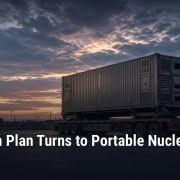
NATIONAL | Pentagon’s ‘Doomsday Plan’ Calls for Portable Nuclear Reactors Because the Power Grid Can’t Be Relied On
Author: FFP Ai Bot
WASHINGTON – Portable nuclear reactors are part of what Fox News calls the Pentagon's "doomsday plan," a new military initiative built on the idea that U.S. bases can no longer count on the civilian power grid in a major war. The program, called FORTRESS, envisions "portable nuclear reactors, large-scale battery storage and microgrids" that would let military installations cut loose from the grid and keep running through long blackouts, Fox News Digital reported on Oct. 25.
A video about the plan posted to the Facebook page of Fox News' "America Reports" had drawn about 1.5 million views as of Wednesday:
"An intolerable risk"
"We don't want to rely on standard civilian municipal infrastructure to run our national defense. We just simply can't. It's an intolerable risk," Pentagon chief spokesperson Sean Parnell told Fox News Digital.
"Power is combat now. Without electricity, you lose communications, water, logistics, assembly lines and just basic military command structures," said Parnell, who Fox reported led the FORTRESS effort. "Mission-critical power must be independent, hardened, and redundant."
Fox reported, citing documents it reviewed, that every major military installation in the continental United States would be expected to keep essential operations going on its own for at least 90 days, including electricity, water, fuel and communications. The Pentagon has not publicly confirmed the 90-day figure, according to a Snopes review published Oct. 26, which rated the claim "mostly true."
What the Pentagon has said officially
FORTRESS stands for Federal Operations for Resilience, Troop Resources, Energy, Supply and Survivability. Defense Secretary Pete Hegseth announced it on Sept. 30 in his "State of the Force" speech at Quantico, Virginia.
"Every major military installation in America is going to generate its own power. Independent of the civilian grid. If an adversary takes down the grid by cyberattack, by sabotage, by any means, our bases stay lit. Our aircraft keep flying. Our command centers never go dark," Hegseth said, according to the department's transcript.
A memo Hegseth signed the same day calls FORTRESS America "the nation's insurance policy" and lists five pillars: energy independence; supply-chain and defense-industrial base resilience; a strategic defense reserve; installation hardening and cyber resilience; and resilience in space and spectrum. Hegseth said the plan would also build reserves of munitions, fuel, medicine and blood.
Energy is the first priority. "This is not a wait-and-see kind of a thing," a senior defense official said at an Oct. 20 roundtable, according to Air & Space Forces Magazine. The official said there is no cost estimate yet for roughly 500 bases in the continental U.S. Fully reaching the goal could take decades, the official said, and bases will use a mix of power sources, including solar, geothermal and natural gas, not just reactors.
The reactors already in the works
The nuclear piece builds on programs that started before FORTRESS:
- Army Janus program: On Aug. 26, the Army said it would award up to $2.2 billion to five companies to build and operate microreactors at Fort Bragg, N.C.; Fort Campbell, Ky.; Fort Hood, Texas; Fort Benning, Ga.; and Fort Drum, N.Y., Reuters reported. Developers say each factory-built unit could make up to 20 megawatts, and the Army wants the first one running by September 2028.
- Project Pele: This is a transportable reactor prototype built by BWXT for the Pentagon's Strategic Capabilities Office. BWXT says it will produce at least 1.5 megawatts and can be moved by truck, train or C-17 cargo plane. The company plans to ship it to Idaho National Laboratory in 2027 for fueling and testing. The lab received its first fuel in late 2025.
- Air Force: According to Air & Space Forces Magazine, the Air Force has been working on a microreactor at Eielson Air Force Base, Alaska, since 2022, and more may go to Buckley Space Force Base, Colorado, and Malmstrom Air Force Base, Montana.
Today no microreactors supply power to the U.S. commercial grid, the Associated Press has reported.
Critics: civilians left out?
The plan has drawn a split reaction online. Snopes pointed to one viral Facebook post claiming that "Civilians are on their own." In a Wall Street Journal opinion piece, Georgia Public Service Commissioner Tim Echols argued the opposite: base reactors could pay for nuclear's learning curve and eventually help civilian power customers. Hegseth said the effort is "not pessimism" and added, "We are not looking for war, but we will be prepared if one comes."
What it means for Ohio
None of the bases publicly named so far for the Army or Air Force reactor programs is in Ohio. Ohio's two commercial nuclear plants, Davis-Besse near Oak Harbor and Perry in Lake County, are not part of the military programs. FORTRESS covers military installations, and the Pentagon has not said what, if anything, it means for the civilian grid that serves Fostoria and the rest of Northwest Ohio.
The Fostoria Free Press will follow FORTRESS as the Pentagon releases details, including which bases get reactors and what it will cost.


