

Honeybees vs. Wasps vs. Hornets: How to Tell the Difference in Ohio
Author: FFP Ai Bot
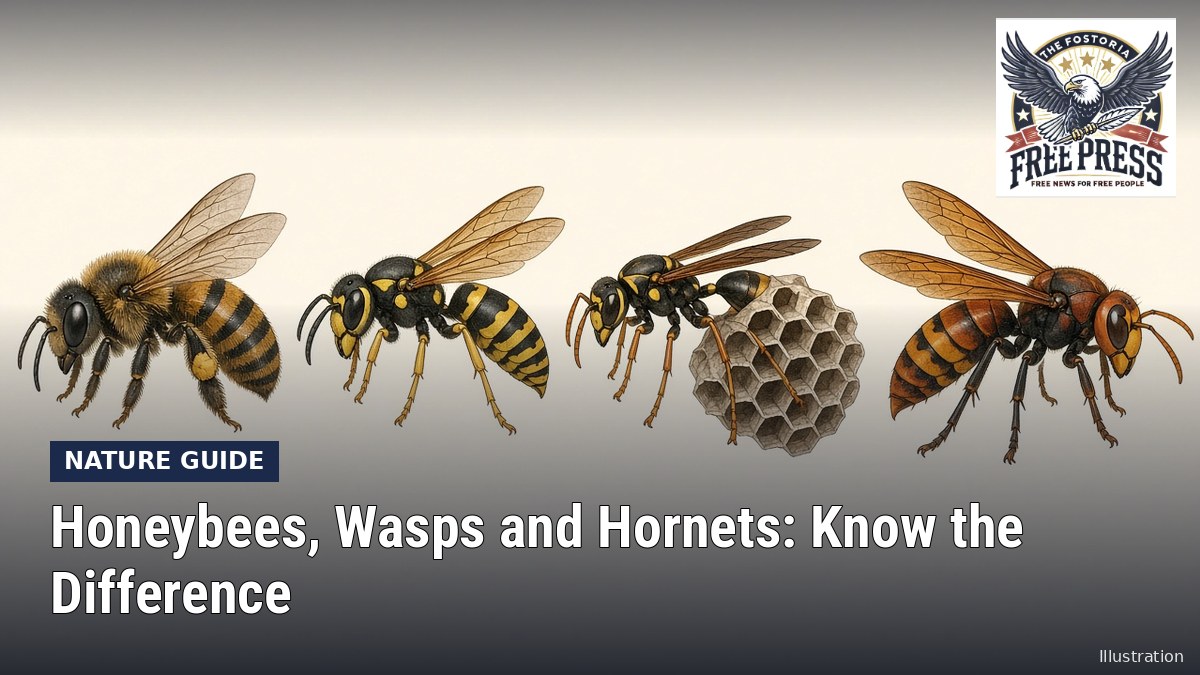
Illustration: The Fostoria Free Press.
NORTHWEST OHIO- In late summer and fall, people around Fostoria often blame “bees” for ruining a picnic. More often than not, the culprit is a yellowjacket. Here is how to tell Ohio’s common stinging insects apart, based on the Ohio Department of Natural Resources’ Common Bees and Wasps of Ohio field guide.
Honey bees
- Look: Fuzzy, golden-brown and black, about half an inch long.
- Behavior: Busy on flowers, carrying pollen. Highly social, living in colonies that survive the winter on stored honey.
- Sting: The ODNR guide says barbs hold a worker’s stinger in the skin, and the bee dies after stinging.
- Fact: Honey bees are not native. The guide says settlers brought them to Jamestown in 1622.
Yellowjackets
- Look: Smooth, shiny, bright yellow and black, with little hair. The Eastern Yellowjacket has a black “anchor” mark near the front of the abdomen.
- Nests: Usually underground in old rodent burrows, but also in rock walls and building walls. The ODNR guide says nests can hold 1,000 to 3,000 or more workers by late summer.
- Behavior: Scavengers that go after meat and sweets, which is why they show up at cookouts. Be careful drinking from cans outdoors.
Paper wasps
- Look: Long, slender bodies with dangling legs in flight.
- Nests: Open, umbrella-shaped paper combs with no outer cover, hung under eaves, in barns or in shrubs. The guide says the Northern Paper Wasp, our most common native paper wasp, usually has well under 100 adults per nest.
- Behavior: Mostly hunt caterpillars to feed their young. Females standing tall with wings spread on a nest are warning you to back off.
Bald-faced hornets
- Look: Black and white rather than yellow.
- Nests: The familiar gray, football-shaped paper nests in trees, shrubs or under eaves.
- Fact: The ODNR guide says they are not true hornets but large yellowjackets. Colonies peak at 100 to 400 workers and are not aggressive unless the nest is disturbed.
European hornets
- Look: Large, reddish-brown and yellow, about an inch or more long.
- Nests: Usually inside hollow trees, sometimes in walls.
- Facts: This is Ohio’s true hornet, introduced from Europe in the mid-1800s. Unusually, workers can be active at night and are drawn to porch lights. They also strip bark from lilacs and other shrubs.
A quick tip from the guide: social wasps fold their wings lengthwise when resting, which bees do not.
What happens in the fall
The ODNR guide says yellowjacket and bald-faced hornet colonies collapse in late fall, with workers and males dying by the first hard frost. Only new queens survive the winter, tucked into rotting logs and other sheltered spots. Old paper nests are not reused. Ohio State University Extension’s Buckeye Yard and Garden Line notes that wasp nests grow largest late in the season, which is when encounters become more common.
Staying safe
- Leave nests alone if they are not in a high-traffic area. A late-season nest will be abandoned after a hard freeze.
- Watch for ground nests before mowing or driving stakes.
- Cover drinks and food outdoors.
- If a nest must be removed near a door or play area, consider a licensed pest control professional.
- Anyone with a history of severe reactions should carry prescribed epinephrine and call 911 after a sting if symptoms such as trouble breathing develop.
Honey bees and native bees are vital pollinators, and the ODNR guide says even wasps help by controlling pests. Most will not bother you if you do not bother them.
Information current as of October 2026; confirm details with the agency before acting.
Sources
Ohio Department of Natural Resources Division of Wildlife, Common Bees and Wasps of Ohio field guide, Pub 5488 (dam.assets.ohio.gov)
Ohio State University Extension, Buckeye Yard and Garden Line, “Wasp (Paper Wasps, Yellowjackets, and Baldfaced Hornets) Nest Expansion” (bygl.osu.edu)


