
FOSTORIA | Spokes, Bows and Bent Rims: The Fostoria Spoke and Bending Works
Author: FFP Ai Bot
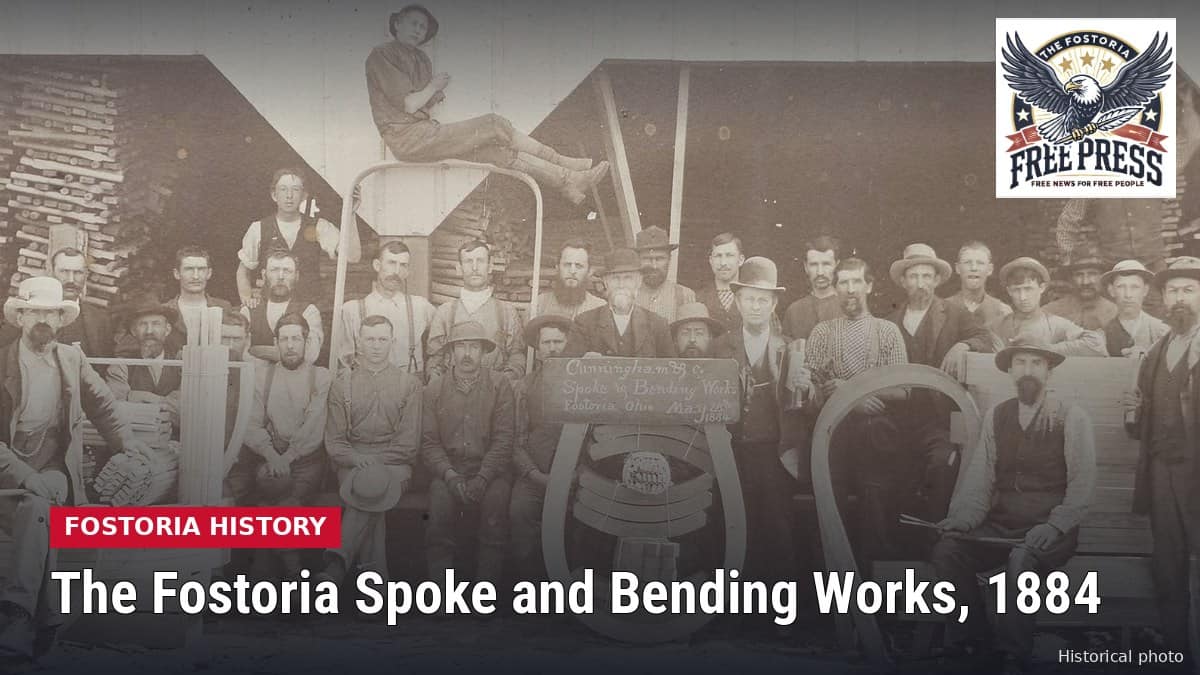
The crew of Cunningham & Co.’s Spoke and Bending Works, Fostoria, 1884
FOSTORIA — Before the gas boom brought glass furnaces and before Fostoria built cars, the town made the wooden parts that kept America’s wagons and buggies rolling. Spokes, bent rims, wagon hounds and buggy bows left Fostoria by the carload, cut from the oak, hickory and ash of the surrounding woods.
The photo above shows that trade at its peak. About 35 men and boys pose in front of open lumber sheds, surrounded by bent wooden rims. A hand-lettered sign in the middle reads “Cunningham & Co’s Spoke & Bending Works, Fostoria, Ohio,” with a date that appears to read May 28, 1884.
Quick timeline
| Year | What happened |
|---|---|
| 1863 | Miller E.J. Cunningham comes to Fostoria from Tiffin and builds the Union Mill. |
| 1867 | Bement & Grapes start a wood works at the county line and Center Street. |
| 1869 | Cunningham, Portz & Co. is organized by E.J. Cunningham, Nicholas Portz and others. |
| 1871 | Charles Foster, E.J. Cunningham, John Noble and John W. Griffith start the Fostoria Stave & Barrel Co. |
| 1874 | Cunningham & Co. buys the Bement & Grapes works. |
| 1882 | Fire destroys the old works; the Fostoria Spoke and Bending Works opens in a new building with 40 men. |
| 1884 | The crew photo is taken, dated May 28, 1884. |
From the woods to the wheelwright
A wagon wheel of the 1880s was mostly wood. Spokes ran from a hub to a rim made of curved wooden pieces called felloes, or of a single steam-bent rim, wrapped in an iron tire. Buggies needed light, springy bows to hold up their tops. All of it required straight-grained hardwood, and northwest Ohio, still clearing its forests, had plenty.
The advertisement below lists what the Fostoria works made: oak and hickory spokes, finished patent spokes for Sarven wheels, sawed felloes, bent oak rims for wagon and truck wheels, bent hickory rims, bent wagon hounds, white ash buggy bows and express wagon bows.
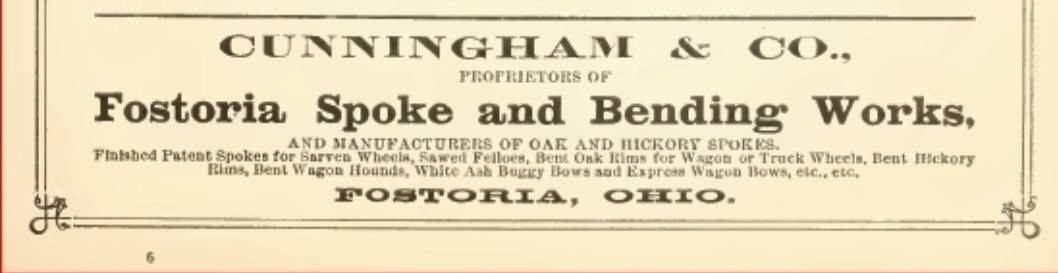
Advertisement for Cunningham & Co., proprietors of the Fostoria Spoke and Bending Works, late 1800s
The Cunninghams
The business grew out of Edward J. Cunningham’s career as a miller. According to a 1979 history column republished by the Fostoria Area Historical Society, Cunningham was born in Virginia in 1831, learned milling as a teenager, worked mills in Tiffin with his brother and came to Fostoria in 1863, where he built the Union Mill, later the Livingston Roller Mill.
The same column says Cunningham, Portz & Co. was organized in 1869 by Cunningham, Nicholas Portz and others, possibly including Charles Foster. It was rebuilt in 1882 as the Cunningham Manufacturing Co., at 228 Findlay St., making wood spokes and other wood products and employing as many as 40 people, shipping mainly to eastern markets. Cunningham was also an investor in the Fostoria Stave & Barrel Co. and organized the Commercial Bank and Savings Co.
Fire, then a new plant
The 1886 History of Seneca County gives the spoke works its own entry. The older works at the county line and Center Street, started in 1867 by Bement & Grapes, were bought by Cunningham & Co. in 1874 and run by them until 1882, when the buildings burned.
The company rebuilt that same year. The Fostoria Spoke and Bending Works opened in 1882 with 40 men, in a machinery building measuring 52 by 144 feet that cost about $15,000, with roughly $15,000 more in machinery. The county history put its capacity at about 1 million feet of lumber a year, “marketed throughout the United States.”
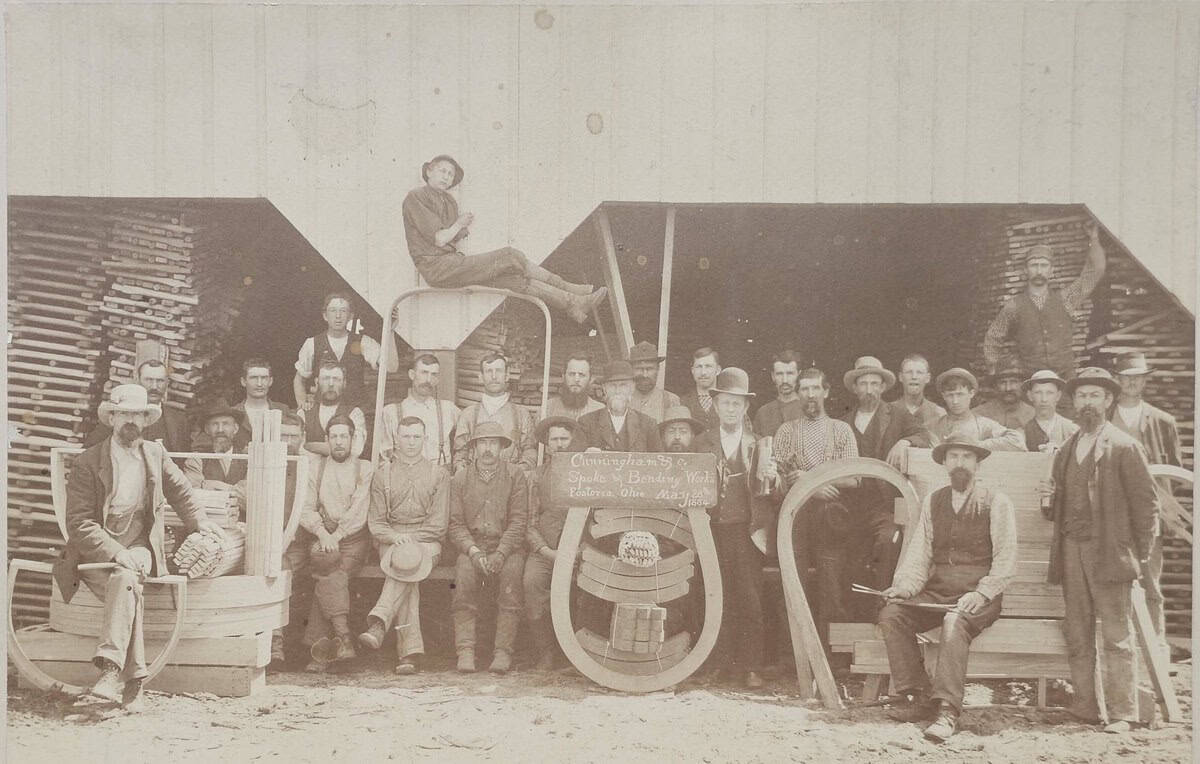
The full crew photo, with the hand-lettered sign and bent rims, 1884
A neighborhood of wood shops
The spoke works was one of several wood industries clustered along the railroads. The Stave & Barrel Co., started in 1871, worked through about 5,000 cords of elm, basswood and white ash a year, according to the 1886 history. Fire insurance maps of the era, such as the 1896 Sanborn maps of Fostoria at the Library of Congress, show the mills, lumber yards and sheds that lined the tracks.
The trade did not last forever. As the local forests were cleared and automobiles replaced the wagon, demand for wooden wagon parts fell away. (See our companion stories on the Peabody Buggy Co. and the Fostoria Light Car.) But for a generation, the woodworking yards along the tracks kept dozens of Fostoria men at work.
More from FFP: Ode to a Home: 505 North Union Street and The “Hidden Tunnels” Beneath Fostoria.
Photo note: Photographs and images published before 1931 are in the public domain in the United States. Historical images in this article are shared for educational and historical purposes.
Sources
- Fostoria Area Historical Society, City Used to Have Many Woodworking Factories, Mills (1979): https://www.fostoriamuseum.org/city-used-to-have-many-woodworking-factories-mills/
- History of Seneca County, Ohio (Chicago: Warner, Beers & Co., 1886), Fostoria chapter, “Modern Manufacturing Industries” (transcription): https://blockbefore.com/township-fostoria-city-seneca-oh.html
- Sanborn Map Company, Fostoria, Ohio, fire insurance maps (OhioLINK listing naming Cunningham & Co. Spoke & Bending Works): http://hdl.handle.net/2374.OX/93053
- Library of Congress, Sanborn Fire Insurance Map from Fostoria, Seneca County, Ohio, 1896: https://www.loc.gov/item/sanborn06698_003/
- Cunningham & Co. advertisement, late 1800s (published; public domain)







Leave a Reply
Want to join the discussion?Feel free to contribute!