
FOSTORIA | First Methodist: The Church That Helped Join Rome and Risdon
Author: FFP Ai Bot

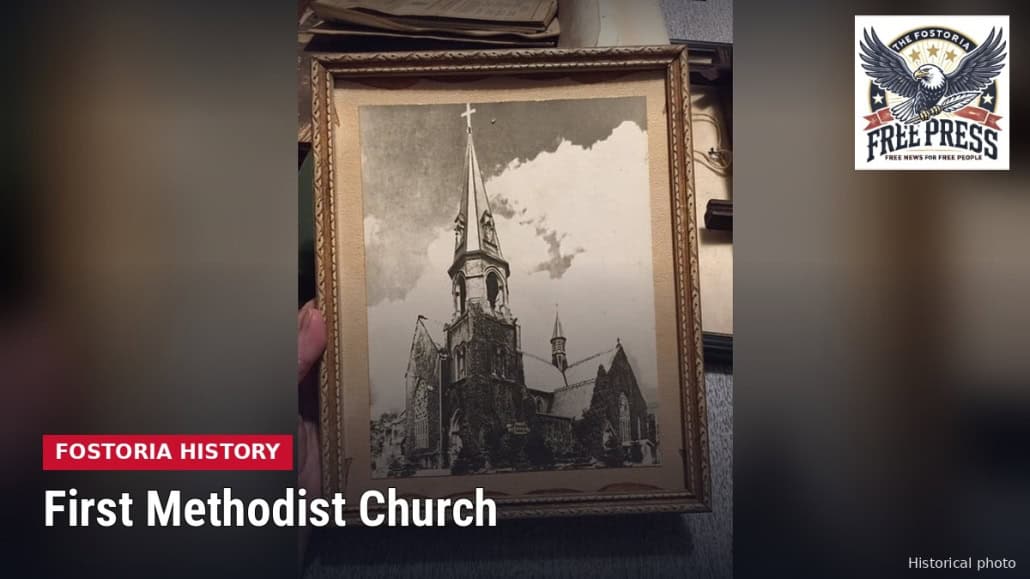
First Methodist Church, from a framed early print
FOSTORIA — A tall spire, topped with a cross, climbs above a brick Gothic church. Ivy covers the base of the tower, and pointed windows line the walls. These early photographs are identified as the First Methodist Church, the congregation whose story is tied to the founding of Fostoria itself.
This installment of our local history series looks at how a Methodist church helped join two pioneer villages into one city, and at the landmark building that stood at Main and Fremont streets for more than 80 years.
Quick timeline
| Year | What happened |
|---|---|
| 1833 | Methodists in Risdon build a log church, 26 by 36 feet, on the east bank of Portage Creek. |
| 1847 | The first Methodist church in Rome is begun at Wood and Tiffin streets. |
| 1854 | The two congregations unite in a new frame church at Main and Fremont, on land donated by Charles Foster. Rome and Risdon merge the same year. |
| 1883 | A new church is built next to the 1854 building for a contract price of $21,595. |
| 1967 | The cornerstone is laid for a new church on Van Buren Street. The congregation becomes Wesley United Methodist. |
| 1968 | The 1883 church’s last year as the congregation’s home. |
One church, one town
Methodist circuit riders reached this corner of Ohio before there was a Fostoria. According to a Fostoria Area Historical Society column drawn from Melvin L. Murray’s 1968 History of the Methodist Church in Fostoria, Ohio, Risdon’s Methodists built a log church in 1833 on the east bank of Portage Creek, the first Methodist church between Bucyrus and the Maumee River. Its membership grew to 425 by 1844.
The rival village of Rome began its own Methodist church in 1847 at what is now Wood and Tiffin streets. A minister, the Rev. George W. Collier, pushed the two congregations to unite and build halfway between the villages. Charles Foster donated land at Main and Fremont for the new church and a school beside it, and in 1854 a two-story frame church, 40 by 60 feet, went up there.
The church union gave momentum to the union of the villages, which joined the same year. The new town took the name Fostoria in honor of the Foster family.
The 1883 church

First Methodist Church, early 1900s
Within 25 years the congregation had outgrown its frame building. In 1883, according to the historical society column, the church announced that ground next to the 1854 church had been acquired and $22,050 subscribed. The building contract was let for $21,595, not including the stained glass windows and seats, and the women of the church raised another $2,500 for furnishings.
Charles Foster, later governor of Ohio and U.S. Treasury secretary, sat on the official board and was described as its moving spirit. Board members also included Andrew Emerine, P. D. Caples, J. J. Myers, J. F. Ritchart, John Noble and E. J. Padgham.
The photographs show a brick church in the Gothic style, with a tall spire at the corner and a smaller pinnacle beside it. The 1896 Sanborn fire insurance map at the Library of Congress labels a “1st M.E. Church” on North Main Street at Fremont. We could not confirm when these photographs were made; their style suggests the early 1900s.

The ivy-covered tower of First Methodist, early 1900s
A move to Van Buren Street
By the late 1950s, the church needed more room for its Sunday school and youth programs. Some members wanted to add on to the old church; others wanted to build away from the busy city center. After long discussion and balloting, about 60 percent voted for a new church on a new site.
The cornerstone was laid on Van Buren Street in 1967, the same year the national Methodist Church merged with the Evangelical United Brethren to form the United Methodist Church. Fostoria’s original Methodist congregation took the name Wesley United Methodist Church. The historical society noted that the new site brought the congregation back to the area that was once Risdon, where local Methodism began.
The 1883 building served the congregation until 1968. We were not able to confirm its later uses or what became of it, and we would welcome help from readers.
Church records are a rich source for local history. The Bowling Green State University Center for Archival Collections lists Fostoria church history materials, including records connected to Wesley United Methodist Church. For more on Fostoria’s early congregations, see our stories on First Baptist and St. Wendelin.
Were you married or baptized in the old First Methodist church? We would like to hear your memories.
Photo note: Photographs and images published before 1931 are in the public domain in the United States. Historical images in this article are shared for educational and historical purposes.
Sources
- Fostoria Area Historical Society, Methodist Churches Oldest in Fostoria (drawing on Melvin L. Murray, History of the Methodist Church in Fostoria, Ohio, 1968): https://www.fostoriamuseum.org/methodist-churches-oldest-in-fostoria/
- Library of Congress, Sanborn Fire Insurance Map, Fostoria, Ohio, 1896: https://www.loc.gov/item/sanborn06698_003/
- BGSU University Libraries, Special Collections, Fostoria (Ohio) — Church history: https://lib.bgsu.edu/findingaids/subjects/1352
- Wikipedia, Fostoria, Ohio (merger of Rome and Risdon): https://en.wikipedia.org/wiki/Fostoria,_Ohio





Leave a Reply
Want to join the discussion?Feel free to contribute!