
Stem Cell vs PRP for Hair Loss: How They Differ and What the Research Says
If you have started researching nonsurgical hair loss treatments, two names come up again and again: platelet-rich plasma (PRP) and stem cell hair restoration. Both are injected into the scalp. Both are called “regenerative.” And both are often offered by the same clinics.
They are not the same thing, though, and the evidence behind them is not equal. Here is a straightforward comparison.
Key takeaways
- PRP uses concentrated platelets from your own blood. Stem cell treatments use cells or cell products from fat, bone marrow or donor tissue.
- PRP has more published clinical trials. Stem cell and exosome research is newer and smaller.
- Neither is a cure for pattern hair loss, and results usually need maintenance.
- No stem cell or exosome product is FDA-approved for hair loss.
How PRP for Hair Loss Works
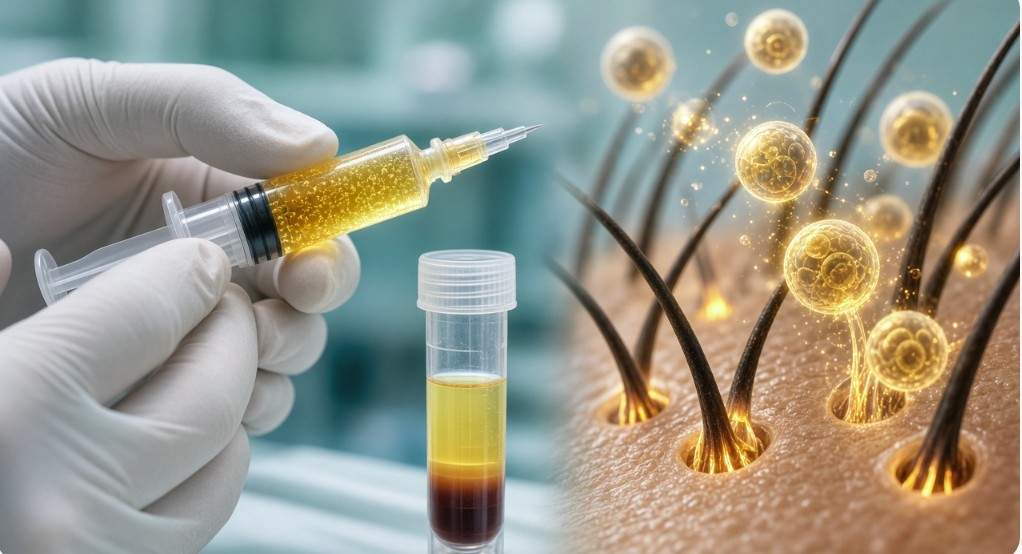
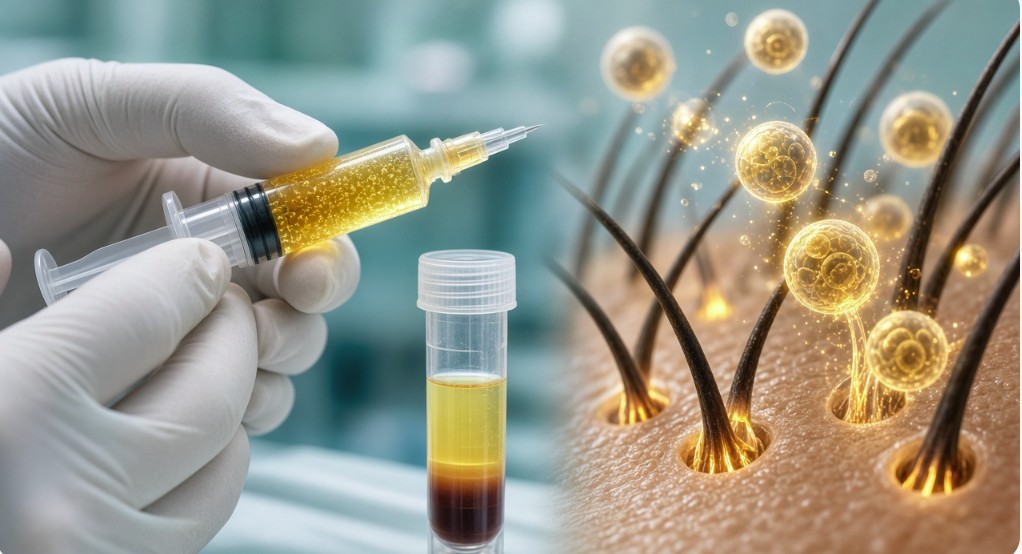
PRP starts with a simple blood draw. The blood is spun in a centrifuge to separate out a layer rich in platelets. Platelets carry growth factors that help tissue repair, and the idea is that injecting them into thinning areas helps weakened follicles stay in the growth phase longer.
Treatment is usually a series of sessions a few weeks apart, followed by periodic touch-ups.
How Stem Cell Hair Restoration Works
“Stem cell” hair treatments cover several different products:
- Stromal vascular fraction (SVF): cells processed from a small amount of your own fat.
- Bone marrow-derived cells: drawn from your own body and concentrated.
- Exosomes: tiny cell-signaling particles, usually made from donor stem cells grown in a lab.
- Conditioned media: the growth factor-rich liquid that stem cells release in culture.
The goal is similar to PRP, to send signals that support the dermal papilla cells and hair follicle stem cells that pattern hair loss disrupts. Stem cell approaches aim to provide a broader or longer-lasting set of signals. Whether they actually do is still being studied. For the full biology, see our explainer on stem cell hair transplant science.
What the Research Shows: Stem Cell vs PRP Hair Results
PRP evidence
PRP has the deeper track record. A 2015 randomized, placebo-controlled half-head trial in Stem Cells Translational Medicine (Gentile and colleagues) found higher hair density on the PRP-treated side in 20 patients with pattern hair loss. Some patients began losing hair again 12 to 16 months later.
A 2022 network meta-analysis in the Journal of Drugs in Dermatology (Gupta and Bamimore) pooled 25 trials. It found that results depended on how PRP was prepared and given, including how many sessions were done and how close together. That helps explain why PRP results vary so much from clinic to clinic.
Stem cell and exosome evidence
The stem cell side is promising but thinner. A 2020 randomized, double-blind trial in Stem Cells Translational Medicine (Tak and colleagues) found that a topical adipose stem cell extract increased hair count by 28.1% at 16 weeks, versus 7.1% with placebo, in 38 patients.
A 2023 systematic review in Cells (Krefft-Trzciniecka and colleagues) looked at 14 stem cell studies in androgenetic alopecia and found no major side effects. The authors said results should be interpreted with caution until confirmed in larger groups.
For exosomes, a 2025 systematic review in Clinical, Cosmetic and Investigational Dermatology (Al Ameer and colleagues) found 11 clinical studies, only two of them randomized trials, with small samples and varied methods.
Head-to-head data
There is very little direct comparison of stem cell treatments against PRP in well-designed trials. Most clinics that offer both base their recommendations on clinical experience and the individual patient, not on a definitive study showing one beats the other.
Side-by-Side Comparison
- Source: PRP comes from your blood. Stem cell treatments may come from your fat or bone marrow, or from donor tissue.
- Procedure: PRP needs only a blood draw. Autologous stem cell treatments may involve a small fat or bone marrow collection under local anesthetic.
- Evidence: PRP has more randomized trials. Stem cell and exosome evidence is earlier-stage.
- Regulation: PRP is prepared from your own blood with FDA-cleared devices, though using it for hair loss is off-label. FDA has not approved any stem cell or exosome product for hair loss and has warned about unapproved products.
- Cost: PRP is usually less expensive per session. Stem cell protocols generally cost more.
- Maintenance: Both typically need repeat treatments to maintain results.
Which Is Right for You?
The honest answer depends on your hair loss pattern, your budget and how much uncertainty you are comfortable with.
PRP may be a reasonable first step for early thinning, especially if you want a lower-cost option with more published data. Stem cell hair restoration may be discussed for people who want a more comprehensive regenerative approach, or as an add-on to an FUE hair transplant. Neither replaces grafts in areas that are fully bald, and neither replaces proven medications like minoxidil or finasteride when those are appropriate.
Not sure where you fit? Read our guide on who is a good candidate for stem cell hair restoration.
Talk to a Hair Restoration Physician
A scalp exam is the best way to sort out which option, or combination, makes sense. You can compare stem cell hair restoration and FUE options at cendanthair.com or request a consultation and quick quote from Cendant Hair. Here is what to expect at a hair restoration consultation.
This article is general information, not medical advice. Talk with a qualified, licensed physician before starting any treatment.
Frequently Asked Questions
Is PRP or stem cell treatment better for hair loss?
There is not enough head-to-head evidence to say one is clearly better. PRP has more published trials; stem cell treatments are newer and aim to deliver broader signaling.
How many PRP sessions are needed for hair loss?
Protocols vary, but many involve three or more sessions a few weeks apart, followed by maintenance. Research suggests the number and spacing of sessions affect results.
Can PRP and stem cells be combined?
Yes. Some clinics combine them, sometimes along with an FUE transplant. Ask your physician what each component adds and what evidence supports the combination.
Are stem cell hair treatments FDA-approved?
No. The FDA has not approved any stem cell or exosome product for hair loss.
Sources
- Gentile P, et al. The effect of platelet-rich plasma in hair regrowth: a randomized placebo-controlled trial. Stem Cells Translational Medicine. 2015. https://doi.org/10.5966/sctm.2015-0107
- Gupta AK, Bamimore M. Platelet-rich plasma monotherapies for androgenetic alopecia: a network meta-analysis and meta-regression study. Journal of Drugs in Dermatology. 2022. https://doi.org/10.36849/JDD.6948
- Tak YJ, et al. A randomized, double-blind, vehicle-controlled clinical study of hair regeneration using adipose-derived stem cell constituent extract in androgenetic alopecia. Stem Cells Translational Medicine. 2020. https://doi.org/10.1002/sctm.19-0410
- Krefft-Trzciniecka K, et al. Human stem cell use in androgenetic alopecia: a systematic review. Cells. 2023. https://doi.org/10.3390/cells12060951
- Al Ameer MA, et al. Exosomes and hair regeneration: a systematic review of clinical evidence. Clinical, Cosmetic and Investigational Dermatology. 2025. https://doi.org/10.2147/CCID.S543451
- U.S. Food and Drug Administration. Consumer Alert on Regenerative Medicine Products Including Stem Cells and Exosomes. https://www.fda.gov/vaccines-blood-biologics/consumers-biologics/consumer-alert-regenerative-medicine-products-including-stem-cells-and-exosomes



Leave a Reply
Want to join the discussion?Feel free to contribute!