FINDLAY | As the parent of a 6-year-old daughter, this was deeply unsettling and raised serious questions for me – Letter to the Editor
/0 Comments/in 1-Press Room, Findlay, Findlay Ohio 45840, Letters to the Editor/by Editor-in-Chief![]()
I wanted to reach out about something that genuinely shocked me as a Findlay parent. In light of one of your recent posts regarding rape and pandering allegations involving a Findlay community member, I ended up doing some deeper research and wanted to share a few things I learned.
While trying to better understand how Ohio’s sex offender classification system works, I discovered that the tier structure (Tier I, II, III) affects not only reporting frequency but also what information is made publicly visible. All tiers are required to register, but community notification and public database visibility differ significantly by tier.
Through my own research and conversations with local authorities, I learned that I live roughly 0.2 miles from a Tier I registered offender who does not appear in the searches many residents rely on. Like many people, I had always assumed those databases reflected everyone living nearby. Additionally, the same offender lives approximately 0.2 miles from a community swimming pool.
This raised serious questions for me about transparency and how residents are expected to interpret what the public registry does — and does not — show.
I feel this is something many people in our community likely misunderstand, and it could be a very important topic to clarify or explore.
-Concerned Findlay, Ohio Parent
TOUCHING STORY: Toledo Teen Overcomes Homelessness, Community Surprises Him With Car
/0 Comments/in 1-Homepage Featured, 1-Press Room, Toledo, Toledo Ohio/by Editor-in-Chief![]()
TOLEDO | A Toledo teen, Daron Webb, has gone from homelessness and depression to a steady job and a new car thanks to community support. Guided by TPS Superintendent Dr. Romules Durant, Daron graduated from Waite High School while also caring for his younger brother and walking more than a mile to his job with a local electrical company in all kinds of weather. Recognizing his determination, Dr. Durant reached out to Yark Automotive Group, which surprised Daron with a car, a gift shared widely online as a powerful example of #Community and #Support.
‘Single & Childless’ Women 25-40yr Projected to Hit Record High in 2030 by Morgan Stanley
/0 Comments/in 1-Press Room/by Editor-in-Chief![]()
Morgan Stanley’s “45% single and child‑free by 2030” figure comes from its SHEconomy research, especially the note “Rise of the SHEconomy” and related follow‑ups, which forecast that by 2030 about 45% of U.S. women ages 25–44 will be single (and widely cited as single and child‑free).morganstanley+3
Where the projection comes from
-
Morgan Stanley’s 2019 piece “Rise of the SHEconomy” explains that, based on U.S. Census data and their own economic forecasts, 45% of “prime working‑age women” (25–44) will be single by 2030, up from 41% in 2018, calling this the largest share in history.forbes+1
-
A later Morgan Stanley article on women and work during the pandemic repeated the same forecast: by 2030, 45% of women 25–44 will be single, framing this as an important consumer and labor‑market cohort.
-
Media and commentary outlets then extended or paraphrased this as “single and childless/child‑free,” describing a future in which around 45% of women 25–44 are both unmarried and without children
So, the original Morgan Stanley work is an economic/market forecast, not a demographic peer‑reviewed study, and its core claim is about single status; the “childless” language comes from secondary commentary built on that forecast.
Article: The 2030 “SHEconomy” – Why Morgan Stanley Thinks 45% of Women 25–44 Will Be Single
In recent years, one statistic has ricocheted through social media: by 2030, 45% of women ages 25–44 will be single and child‑free. Behind the viral headlines is a more technical source: Morgan Stanley’s “Rise of the SHEconomy” research, which looks at how shifting relationship and family patterns will reshape the consumer economy.
What Morgan Stanley actually projected
Morgan Stanley’s economists analyzed historical data from the U.S. Census Bureau and projected forward to 2030. Their key claim: about 45% of U.S. women in their prime working years (25–44) will be single by 2030, up from 41% in 2018, making single women the largest share in history for that age band.
This projection is not a moral argument but an economic one. The bank frames these women as a powerful consumer group—sometimes called the “Prime‑Age Single Woman” or part of the broader “SHEconomy”—with growing influence over spending in housing, travel, healthcare, financial services, and more.
How “single” turned into “single and childless”
The original Morgan Stanley articles emphasize single status—not having a spouse or partner in the household—as the key variable.
However, many secondary articles and opinion pieces blended this with trends in delayed childbearing and rising childlessness. Commentators began summarizing the forecast as:
-
“45% of women 25–44 will be single and childless by 2030.
This wording reflects two overlapping but distinct trends:
-
More women 25–44 will be unmarried or not cohabiting.
-
Separate research shows childlessness is rising and more women are reaching age 40–50 without children than in past generations.
Put together, it is plausible that a large share of prime‑age women in 2030 will be both single and without children, but Morgan Stanley’s own text focuses on singleness; the “child‑free” part is inferred and amplified by media.
Why Morgan Stanley expects more single women
The bank highlights several structural drivers for the rise of single women in prime working ages:
-
Later marriage: The average age at first marriage for women has climbed toward the late 20s and early 30s, shrinking the years spent married between 25 and 44.
-
Educational and career priorities: More women complete higher education and delay long‑term partnerships to focus on career growth and financial stability.
-
Financial independence: With higher labor‑force participation and earning potential, fewer women see marriage as a financial necessity.
-
Changing social norms: There is broader acceptance of remaining single, living alone, or choosing non‑traditional relationship structures.
From Morgan Stanley’s perspective, these forces do not simply describe personal choices; they reshape demand in sectors like real estate (more single‑occupancy housing), leisure and travel (more solo or friend‑group spending), and financial services (individual investing, retirement planning).
What this means for marriage, children, and policy
The projection has fueled intense debates about the future of family and fertility. Commentators concerned about declining birth rates cite it as evidence of a looming demographic crunch, while others see it as a sign of increased autonomy and bargaining power for women.
Key implications often discussed:
-
Fertility and aging: If a larger share of women spend their prime reproductive years single and potentially childless, countries like the U.S. may see further declines in fertility and more rapid population aging.
-
Household structure: Growth in single‑person households requires different housing, transportation, and care‑support policies compared with the traditional family model.
-
Labor markets and wages: Morgan Stanley argues that more single, career‑focused women could increase female labor‑force participation and put upward pressure on women’s wages, contributing to narrowing gender gaps.
Limitations and caveats
Despite its wide circulation, it is important to recognize what the 45% figure is—and is not:
-
It is a forecast, not a measured 2030 reality; it depends on assumptions about how trends continue.
-
It is not a peer‑reviewed demographic study but an investment‑bank research note designed to inform investors about consumer markets.
-
It focuses on single status, while “single and child‑free” combines that forecast with other research on childlessness that Morgan Stanley did not model in detail.
BREAKING | Fostoria Authorities Seize Suspected Fentanyl in Fostoria; Local Man Facing Felony Drug Charges
/1 Comment/in 1-Homepage Featured, 1-Press Room, Breaking Local News, Fostoria, Fostoria Ohio/by Editor-in-ChiefFostoria Sharing Kitchen Demolition for Rebuild Began This Week
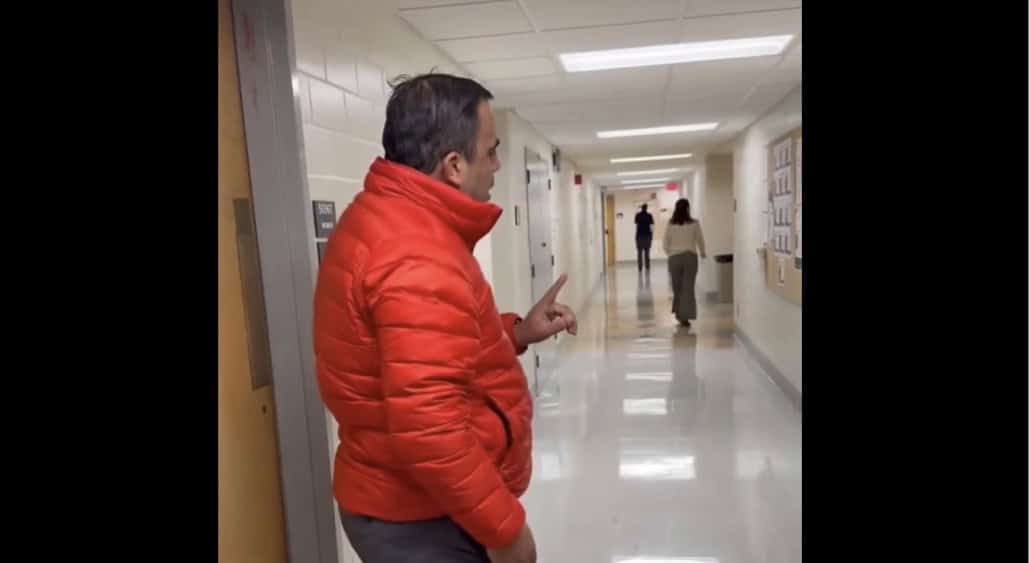
/0 Comments/in 1-Homepage Featured, 1-Press Room, Fostoria, Fostoria Ohio/by Editor-in-ChiefBREAKING | Ohio State University: Luke M. Perez attacks a journalist/documentarian on camera
/0 Comments/in 1-Homepage Featured, 1-Press Room, Ohio State University/by Editor-in-Chief![]()
![]()
![]()
Is Columbia Gas of Ohio ripping you off? – Price gouging without explanation
/0 Comments/in 1-Homepage Featured, 1-Press Room, Infrastructure/by Editor-in-ChiefPrice gouging without explanation.
WHAT REALLY BURNS ME!
Author: Thomas Domich
A couple of weeks ago I wrote a column speaking about Columbia gas of Ohio.
In that piece I was all over the place and I want very clear about what was going on.
So I’m writing again to clarify what I believe to be a money grab, and I believe that Columbia gas is ripping us all off.
I’m going to give you the facts as I know them and you decide.
note: I’ve asked Columbia gas directly for answers or comments about what I’m going to tell you, to no avail.
_________________
I’m sure you’ve all noticed that every winter your gas bill goes up, and it’s to be expected, due to the colder season. but how many of you have noticed that your gas bill goes up by almost 100% in one month?
But did you know that not only do your prices go up just because it’s colder, (regardless whether it’s colder or not) but it also goes up because they add five extra days in the billing cycle of November to December, and since we pay a month behind you pay for that in January.
Not only do they add an extra 5 days to that billing cycle but that’s the time of the year that they raise prices for regular consumption as well.
![]()
When they had the extra 5 days they estimate what 5 days of usage at your normal usage rate would cost and add that to your bill.
But they don’t only add days throughout the year to every month they subtract on some of them as well. So you’ll look at your bill and see how many days each month that you pay for gas usage if you told of the days throughout the year how many days you pay it comes to 367 and 1/4 days.
But wait a minute you say, there’s only 365 1/4 days in a year. And you would be correct in the end of the year you’re paying two extra days for the year, two extra days that do not exist.
But the hardest part is the extra five days that are added at the end of the year in the middle of winter along with the price increase.
I tried to reach out to Columbia Gas and speak with them about it but to no avail. The only answer I received from them is to contact customer service if I had any questions.
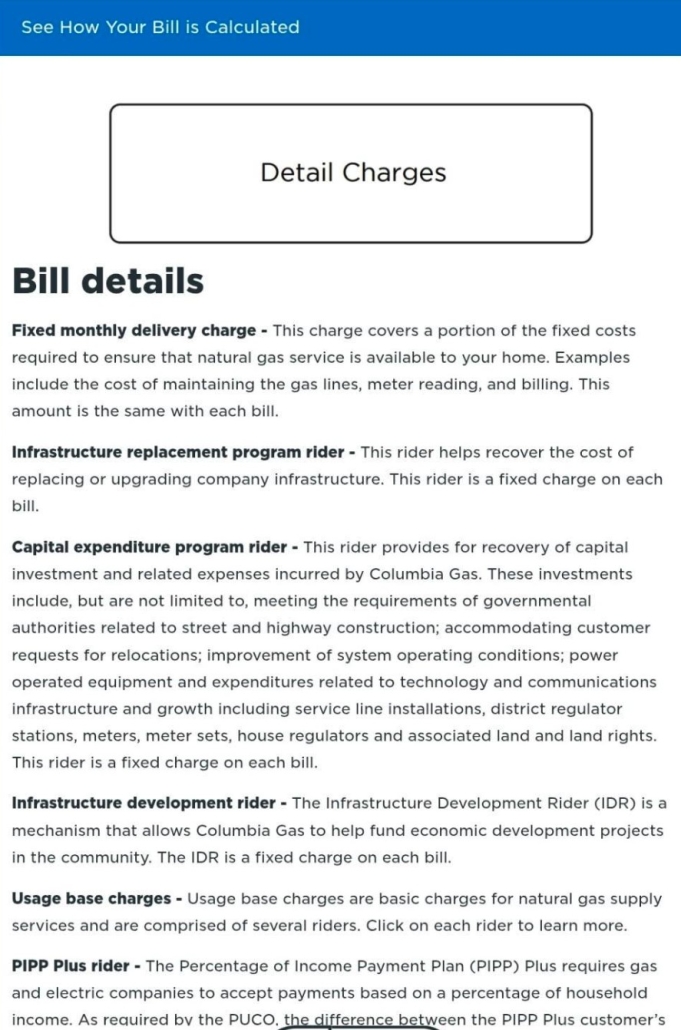
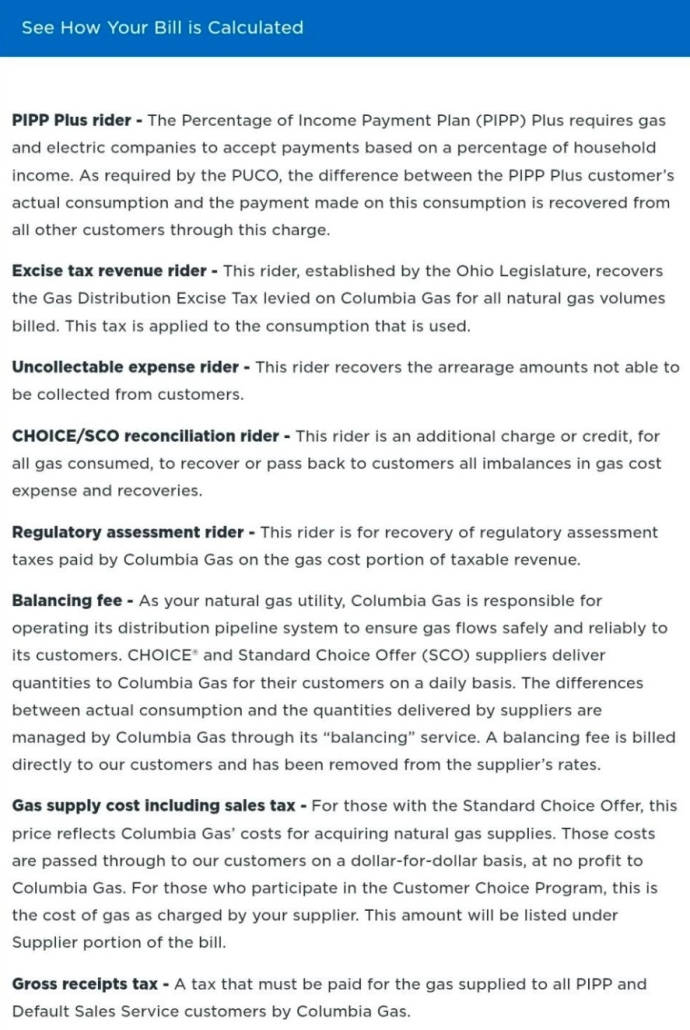
But let’s not forget the point that there are many many riders that we pay for that we shouldn’t and you will find attached in this column that shows what you pay for on riders.
But I’m going to give you a very short breakdown. First and foremost, the donations that Columbia Gas makes they received their money in return from those who pay their bills in full.
For the PIPP program, the difference between what the customer owes and what is actually paid the customers who pay their full Bill cover that as well.
We pay a rider which covers their automobiles the gas for said automobiles we also pay for construction and reconstruction of streets city taxes that they have to pay for tearing up the streets excise taxes that they pay to the government etc etc etc.
Remind you I understand that we have to pay utility bills but what I don’t understand is why are we paying such highly outrageous prices and I found out by simply going through my bill item by item online looking at each individual Rider that we pay.
You also can do the same thing if you go into your bill online and go into the detail Bill section and then click on any section that you would like on front or back of the bill it will open up fully and show you each individual thing you pay for.
Basically they’re not hiding it from anyone and it turns out that they can legally do this.
It is up to us what we pay for it is also up to us whether or not we get what we pay for.
But I will leave this up to you did you decide whether or not Columbia Gas is robbing us abusing the market or if it’s just okay by you that they take your money and use it for things that you may not want.
This is what burns me
Thomas Domich
![]()
![]()
Rage Bait or Rage Syndrome: Blaming a Facebook Post For Your Reaction
/0 Comments/in 1-Press Room/by Editor-in-Chief![]()
We’ve all seen it happen. Someone reads a Facebook post, feels offended, and instead of moving on—or reflecting on why they feel that way—they attack the poster. The blame shifts instantly from “I’m upset” to “You made me upset.” This reaction, often disguised as righteous outrage, reveals a growing problem in online culture: an erosion of personal accountability.
The truth is, no one can make you react. Social media may amplify emotions, but it doesn’t control them. When people treat their anger as someone else’s fault, they fall into a loop of entitlement—the belief that their feelings are someone else’s responsibility. That’s not emotional honesty; it’s avoidance.
This mindset has created what could be called a “Rage Syndrome,” a cycle where outrage becomes validation. Instead of scrolling past what they dislike, users feed on it because indignation feels powerful—until it doesn’t. The more we externalize blame, the less self-aware we become.
Healthy discourse requires both freedom of expression and emotional self-regulation. You can disagree, debate, or disengage—but you can’t expect the world to sanitize itself for your comfort. Taking ownership of your reactions doesn’t make you weak; it makes you grounded and mature in a digital world that rewards outrage more than understanding.
So next time a post gets under your skin, ask: Is this their fault—or am I just choosing to be mad?
BREAKING | Parent Files Police Report & Issues Public Warning About Newborn Caregiver in North Baltimore
/0 Comments/in 1-Homepage Featured, 1-Press Room, Breaking Local News, Child Abuse, Child Development, Child Welfare Investigations, Findlay, Findlay Ohio 45840/by Editor-in-Chief![]()
NORTH BALTIMORE, OH | Parent Issues Public Warning About Newborn Caregiver in North Baltimore
A local mother is urging other families to be cautious after raising serious concerns about a woman who provided in‑home childcare for her infant in North Baltimore. The parent says she never imagined having to make such a public statement, but felt compelled to speak out “as a mother” after her experience with caregiver Riley Engard.
Screenshot
According to the mother, her baby was in Engard’s care for several months and things seemed fine at first. The caregiver appeared kind and attentive, and there were no immediate red flags. Over time, however, the parent says a series of changes made her increasingly uncomfortable.
One of the first major concerns, she says, was no longer being allowed inside the home at pickup time and being told to wait outside for her baby to be brought out. Communication reportedly deteriorated as well. The mother says Engard often could not answer basic questions such as what the baby had eaten that day or how naps had gone. On several occasions, the parent says she noticed worrisome issues only after arriving home—problems she says were never mentioned to her at pickup and which she describes as “absolutely heartbreaking.”
The mother emphasizes that she consistently paid early, supplied diapers and other necessities, and tried to be supportive, even bringing food or coffee on difficult days. Despite this, she says her concerns were not clearly addressed and she received no satisfactory explanations.
After removing her child from care, the mother says she began speaking with other parents who had previously used the same provider. Several, she reports, shared similar worries, including what they believed were infrequent diaper changes and lack of basic communication about the children’s day.
A mother of four, she says she has never had an experience like this with any other childcare provider and stresses that she does not make such public accusations lightly. She decided to post her warning on Facebook, where she says she received overwhelming support and private messages from community members echoing her concerns.
The parent says she has since filed a police report so that her allegations are formally documented and can be reviewed by authorities. She hopes that by coming forward, other families will carefully research caregivers, ask direct questions, and trust their instincts if something does not feel right.
“Please be cautious and trust your instincts when choosing childcare,” she wrote. “Our babies are innocent and depend on us to protect them.”
![]()
Follow us on Facebook
Recent Posts
- FOSTORIA | The Mindful Beekeeper Marks 37 Honeybee Colony Relocations Across Northwest Ohio in 2025-2026 October 17, 2026
- SANDUSKY | Cedar Point Shuts Down Millennium Force After Bracket Falls From Ride Car Into Guest Area October 17, 2026
- WHITEHOUSE | Man, 27, Charged After Police Say He Fired Shots at Apartment Buildings; Officer Hurt During Arrest October 17, 2026