[Ai Analysis of Proposal]
Sara DeHaven, a Fostoria real estate broker and law student, has submitted a detailed written comment opposing the city’s proposed Ordinance 1357.07 on inspection and disclosure of lead or galvanized water service lines. DeHaven’s proposal urges city leaders to withdraw the ordinance and replace it with an evidence‑based, homeowner‑fair approach that guarantees safe drinking water without destabilizing the local housing market.
Who is speaking and why it matters
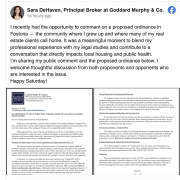
DeHaven is a principal broker at a Fostoria‑based real estate company and a J.D. candidate who grew up in the community and works with many local buyers and sellers. In her public post, DeHaven explains that the ordinance touches directly on both public health and local housing conditions, giving her a dual perspective as a housing professional and legal trainee. DeHaven invites discussion from both supporters and critics of the ordinance, signaling that her letter is meant to inform debate rather than simply attack city officials’ intentions.
Core concern: safe water, wrong mechanism
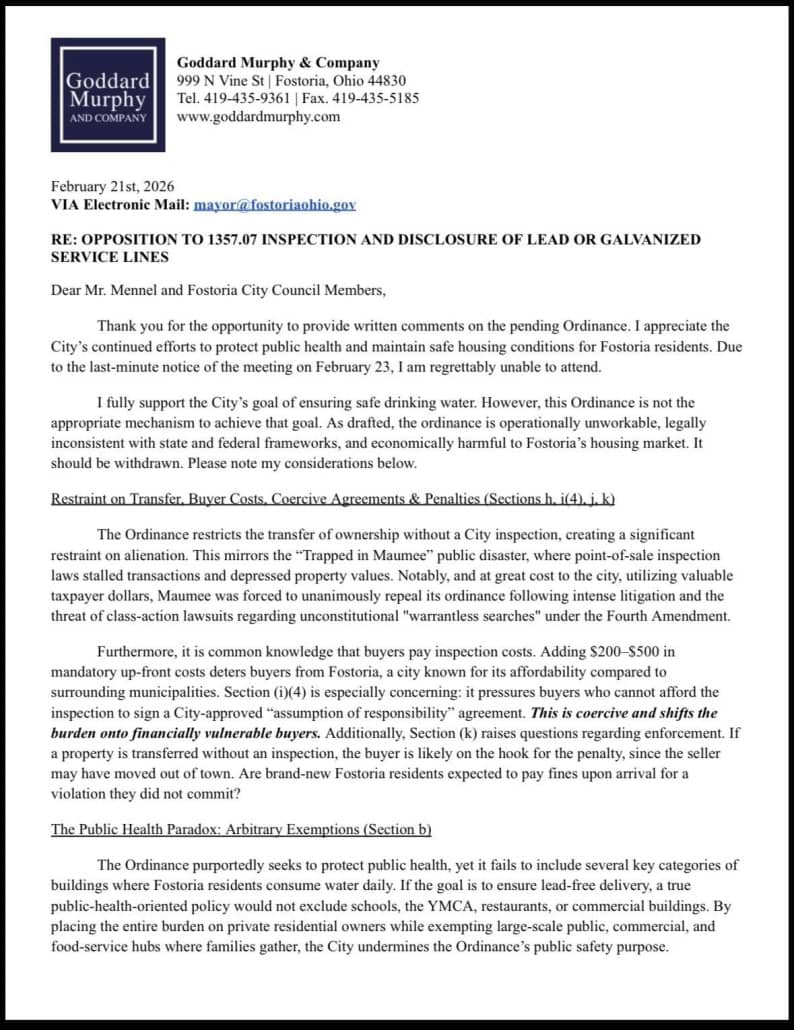
At the outset of her letter to the mayor and city council, DeHaven makes clear that she supports the city’s goal of ensuring safe drinking water for residents. However, DeHaven argues that this particular ordinance is “operationally unworkable, legally inconsistent with state and federal frameworks, and economically harmful” to Fostoria’s housing market. In DeHaven’s view, the proposal uses a blunt inspection and disclosure scheme that shifts risk and costs onto private property owners and buyers instead of holding the city responsible for its own infrastructure.
Buyer burdens and “coercive” paperwork
A major theme of DeHaven’s letter is that the ordinance would act as a restraint on the transfer of property, especially hurting financially vulnerable buyers. The measure would require a city inspection before a sale could close, adding new up‑front costs and the risk of delays or collapsed transactions if inspections cannot be scheduled quickly. DeHaven notes that buyers typically pay for inspection‑related expenses and warns that an extra few hundred dollars in mandated costs could deter buyers from choosing Fostoria over neighboring communities. DeHaven is especially critical of a section that pressures buyers who cannot afford or obtain an inspection to sign a city‑approved “assumption of responsibility” agreement, which she labels coercive because it shifts the burden for potential lead‑related problems onto the buyer from day one.
Unequal treatment of properties and public mains
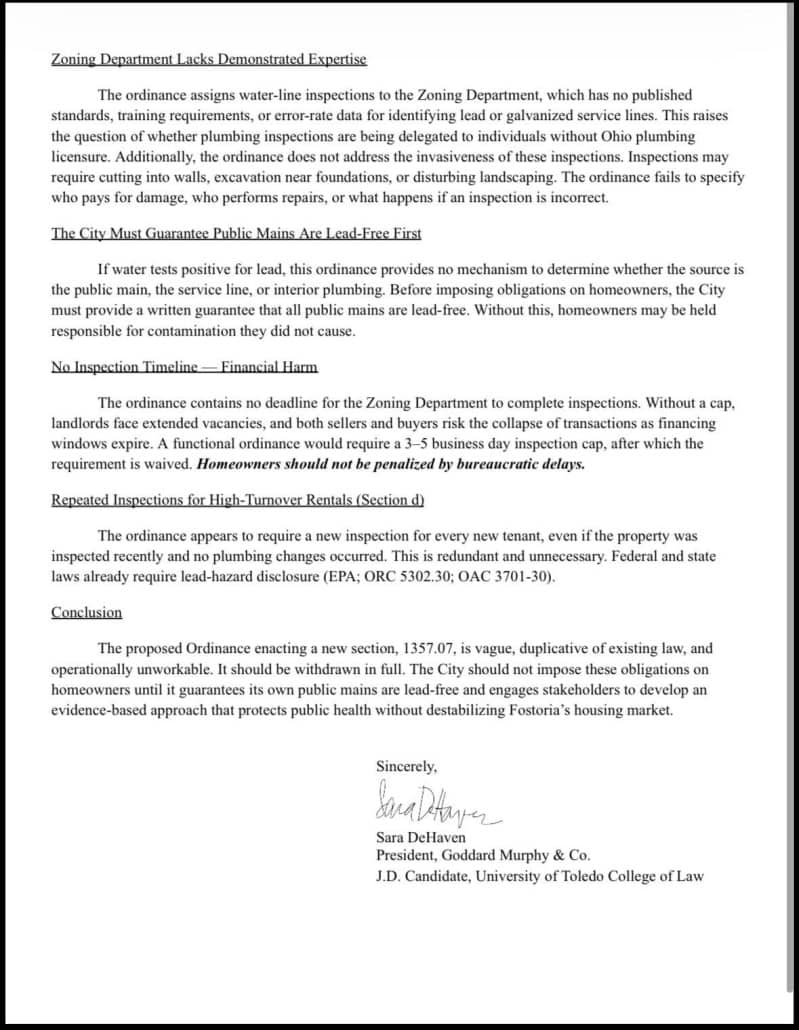
DeHaven’s proposal also highlights what she calls the “public health paradox” built into the ordinance’s exemptions. While the measure purports to protect residents from lead, DeHaven says it excludes key categories of buildings where people gather—such as schools, restaurants, and commercial sites—and focuses instead on private residential owners. This, DeHaven argues, undermines the public safety justification and raises fairness concerns for homeowners who would be uniquely burdened. In a later section, DeHaven insists that before imposing new requirements on property owners, the city should guarantee that its own public water mains are lead‑free and accept responsibility for any contamination originating from those mains.
Flaws in implementation: inspections, zoning, and timelines
Beyond policy objections, DeHaven points to several practical problems with how the ordinance is drafted. It assigns water‑line inspections to the Zoning Department, which DeHaven notes has no published standards, training requirements, or error‑rate data for lead or galvanized service line inspections. DeHaven questions whether these inspections would be done by individuals lacking appropriate plumbing licensure and flags that the ordinance does not address how invasive inspections might be, who pays for damage, or what happens if the city’s inspection is wrong. Another issue DeHaven identifies is the absence of a clear deadline for completing inspections. Without a defined turnaround time, landlords, buyers, and sellers could face open‑ended delays that jeopardize financing timelines and closings, exposing both residents and the local market to unnecessary financial risk.
Impact on rentals and repeated inspections
For rental properties, DeHaven warns that the ordinance appears to require new inspections every time a new tenant moves in, even if no plumbing work has occurred since the last check. DeHaven argues that this repetition is redundant with existing federal and state lead‑hazard disclosure rules and would impose needless costs on owners of high‑turnover rentals. In DeHaven’s analysis, layering this local requirement on top of federal EPA standards and Ohio statutes adds bureaucracy without meaningful public‑health gains.
What DeHaven’s proposal aims to achieve
Ultimately, DeHaven’s proposal is not simply to vote down the ordinance and walk away, but to push Fostoria toward a better solution. DeHaven urges city officials to withdraw Ordinance 1357.07 in its current form and to convene stakeholders to design a more targeted, evidence‑based framework. Such a framework, DeHaven suggests, should: guarantee that city‑owned mains are lead‑free before shifting obligations to homeowners; avoid coercive agreements that force buyers to assume broad liability; include reasonable timelines and clear inspection standards; and align with existing state and federal regulations. DeHaven’s goal is to protect public health while preserving Fostoria’s affordability, protecting property rights, and avoiding policies that could chill investment in local housing.