
FOSTORIA | Soda Fountains and Tinctures: A Look Back at Fostoria’s Old Drugstores
Author: FFP Ai Bot
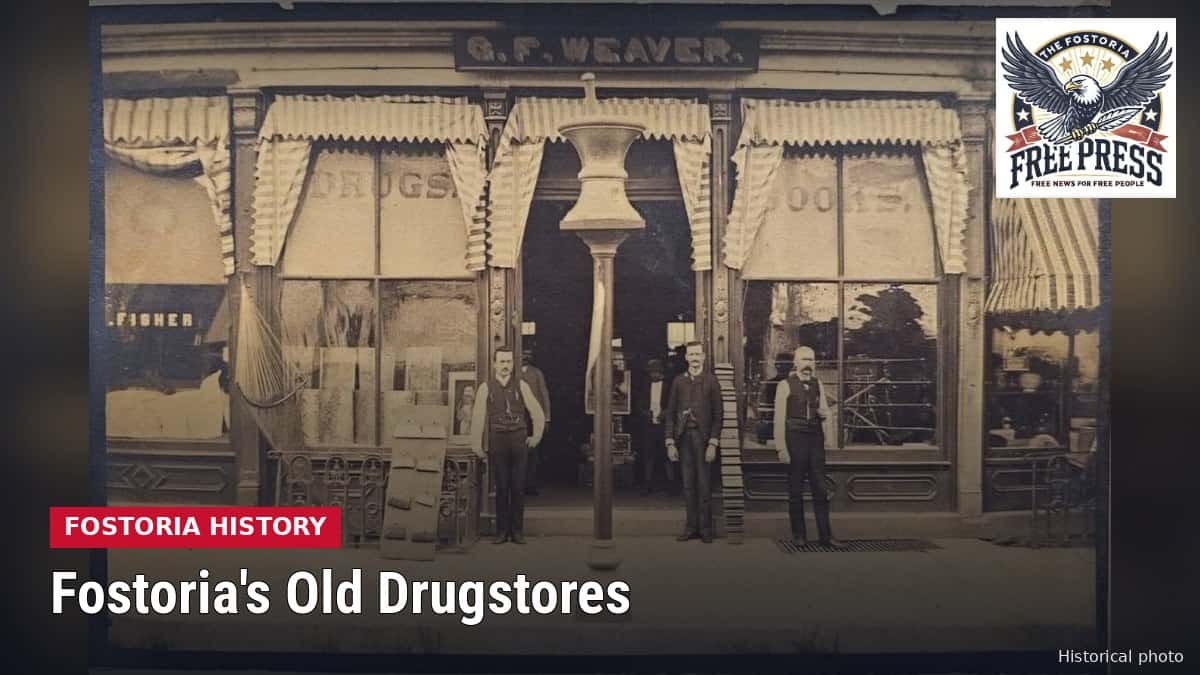
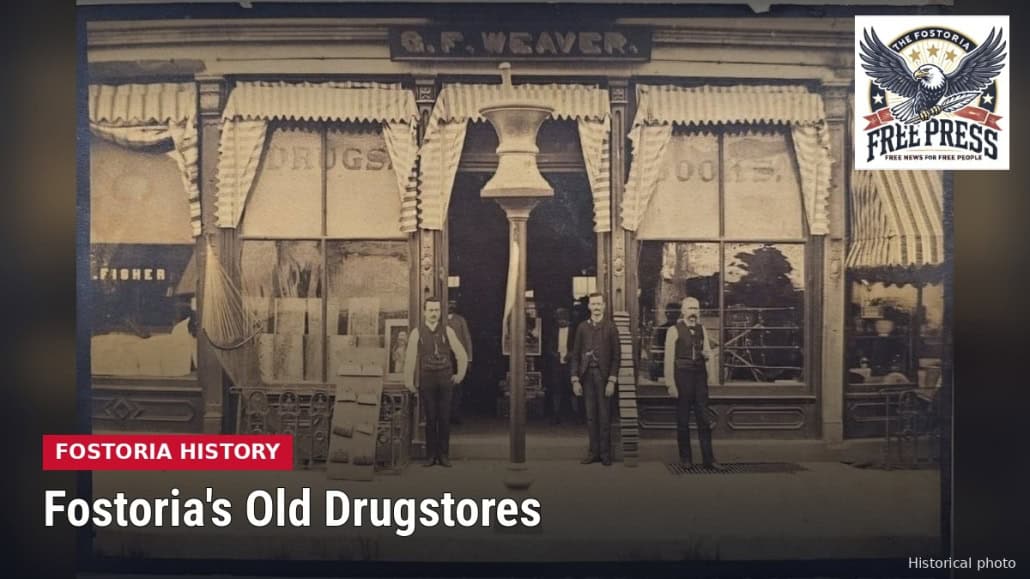
G.F. Weaver Drug & Book Store, North Main Street, 1880s
FOSTORIA — Before chain pharmacies and drive-through windows, Fostoria’s drugstores were part pharmacy, part bookstore, part gathering place. Druggists mixed tinctures and ointments behind tall wooden counters, and later generations stopped in for a malt or a sundae at the soda fountain.
In this installment of our local history series we visit a few of those stores, from the G.F. Weaver Drug & Book Store of the 1880s to Edison Cut Rate Drugs at Main and Center and Whitney Drugs on Elm Street. Facts come mainly from the Fostoria Area Historical Society’s archive of local history columns and Library of Congress fire insurance maps. Where a detail rests only on local memory, we say so.
Quick timeline: Fostoria drugstores
| Era | Store and location |
|---|---|
| Before 1891 | J.B. Van Dorn runs one of the earliest drugstores in town, in a frame building at Main and Center. |
| 1880s | G.F. Weaver Drug & Book Store operates at 115 N. Main St. |
| By 1890 | Eshelman & Harbaugh opens at Main and Tiffin; around 1903 it becomes Harbaugh & Mickey. |
| 1896 | The Sanborn fire insurance map marks a drugstore in the Andes Block corner at Main and Center. |
| 1920s-1930s | Ads list Harbaugh & Mickey (119 S. Main), Eaton’s Drugs (121 N. Main) and Bower Drug (W. Center). |
| 1936-1939 | The Harbaugh & Mickey store passes to Ross Rowan, then Johnson Drug Store. |
| Mid-1900s | Edison Cut Rate Drugs occupies the Andes Block corner; Whitney Drugs operates on Elm Street. |
The earliest druggists
Fostoria’s drug trade is nearly as old as the town. A local history column published in the late 1970s and early 1980s and republished by the Fostoria Area Historical Society notes that J.B. Van Dorn ran “one of Fostoria’s earliest” drugstores in the old frame building at the southeast corner of Main and Center, the site where the Alcott Block went up in 1893.
Across Main Street, the John Andes Block, built in 1878 at the corner of Main and Center, held a long line of drugstores in its first-floor corner room. An early photo shows painted signs for the Campbell & Godfrey Opera House Drug Store, a nod to the Andes Opera House upstairs. Later druggists in that same room included Bev. Campbell, Hoffman Bros. and Al Bohrer, according to the historical society. The 1896 Sanborn fire insurance map, preserved by the Library of Congress, labels the Andes Block corner simply “Drugs.”
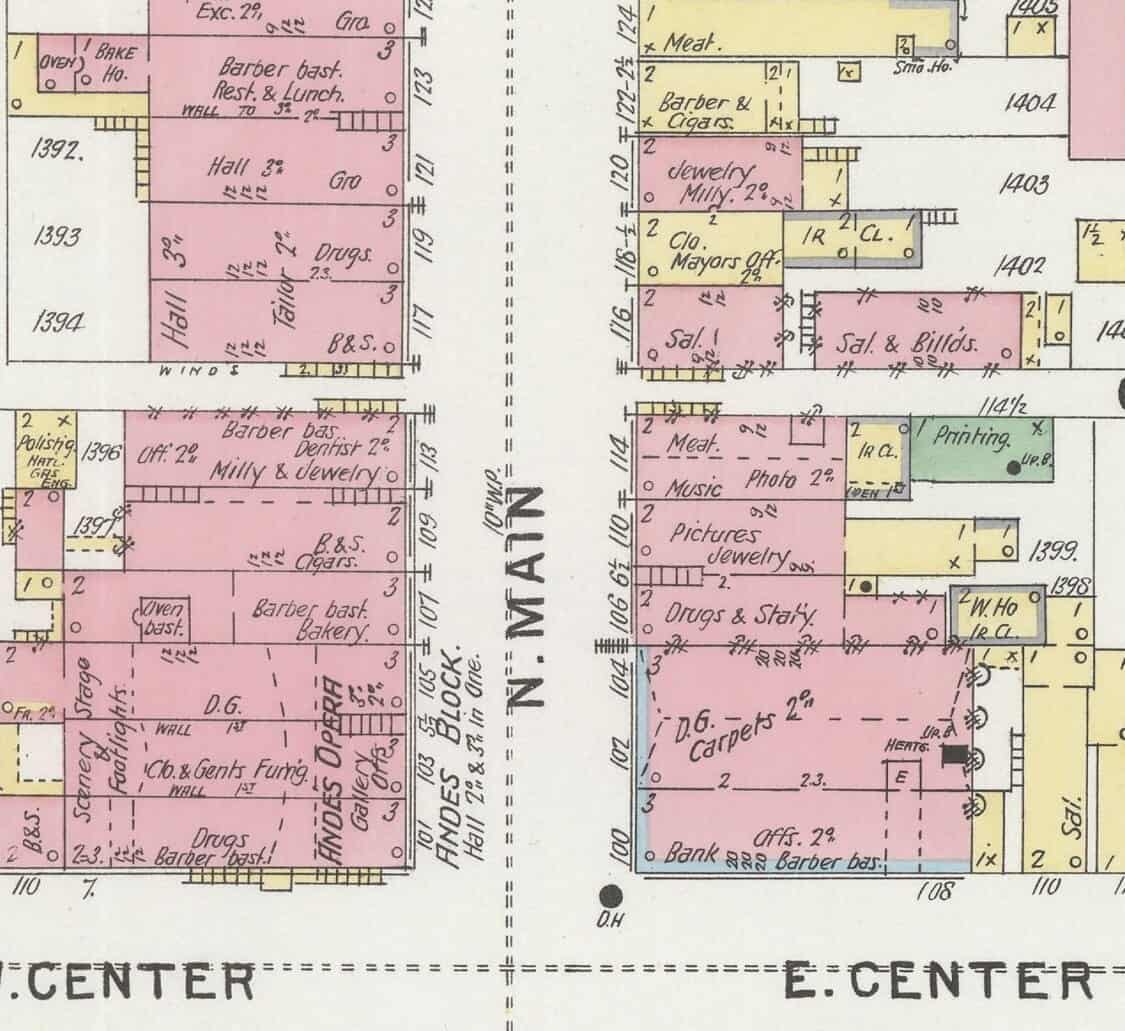
Sanborn fire insurance map detail, Main and Center streets, 1896
G.F. Weaver: drugs and books
The Weavers were best known for dry goods, but one family member took a different path. George F. Weaver ran a combined drug and book store at 115 N. Main St., a short walk from the family’s dry goods business. The 1880s photo at the top of this story shows the storefront, with “DRUGS” lettered on one window, “BOOKS” on the other, striped awnings and a hitching post at the curb. According to local accounts, the man on the far right may be George Weaver himself.
Stores like Weaver’s sold patent medicines, tinctures and ointments, but also stationery, schoolbooks and novels. In a small city in the 1880s, the drugstore was often where people bought their reading material.
Main and Tiffin: Eshelman & Harbaugh to Johnson Drug
At Main and Tiffin, Eshelman & Harbaugh was listed in the 1890 city directory. According to a former clerk quoted in the historical society archive, Don Mickey bought into the store around 1903, after marrying the partner’s daughter, and it became Harbaugh & Mickey. The store later moved next door to the new Union National Bank building. In 1936 it was taken over by Ross Rowan, and in 1939 it became the Johnson Drug Store. A list of 1920s and 1930s advertisers puts Harbaugh & Mickey at 119 S. Main St.
The same list names other drugstores of the era, including Eaton’s Drugs at 121 N. Main St. and Bower Drug Store on West Center Street. In the Botto Block on North Main, the Zemer & Orwig Drug Store shared the first floor with Woolworth’s for a time, and Longfellow Drug Store occupied 109 S. Main St. in the Weller Building.
Edison Cut Rate Drugs
By the mid-20th century the Andes Block corner belonged to Edison Cut Rate Drugs. In the 1950s its entrance carried a big sign promising “Lowest Prices in Ohio,” along with signs for Swift’s Ice Cream and fountain service for “Sodas, Sundaes, Malts,” and a Toledo Blade newspaper box stood by the door. Edison’s grew so much that after Dr. R.W. Hale died, the store took over his longtime office space on West Center Street, according to the historical society.
Whitney Drugs on Elm Street
Not every drugstore was downtown. Whitney Drugs operated in a modern, low storefront on Elm Street, with a striped awning and big plate-glass windows full of displays. According to local accounts, the building stood next to the spot now occupied by a Little Caesars restaurant. We have not yet found the years Whitney Drugs was in business; if you know, please tell us.
Other names come up whenever Fostorians share drugstore memories, including Chalfin’s. We could not document Chalfin’s location or years for this story, and we would welcome help from readers.
Then and now
The Andes Block, built in 1878, still stands at the northwest corner of Main and Center streets. It was refaced in 1982 as part of a downtown streetscape project and is part of the Fostoria Downtown Historic District, listed on the National Register of Historic Places in 2001.
115 N. Main St., where G.F. Weaver sold drugs and books, is home today to The Beach House, a salon and spa. Some of the original wooden trim from the old storefront still survives, according to local accounts.
The southeast corner of Main and Center, where Van Dorn had one of the first drugstores, later held the Alcott Block, which burned in 1962. (See our companion story on the Alcott Block.)
Which Fostoria drugstore was yours? Tell us about the soda fountain, the druggist or the comic book rack.
More from FFP: Downtown Fostoria Is Missing a Coffee House and The “Hidden Tunnels” Beneath Fostoria.
Photo note: Photographs and images published before 1931 are in the public domain in the United States. Historical images in this article are shared for educational and historical purposes.
Sources
- Fostoria Area Historical Society, W. Center From Early Days to Now (1982): https://www.fostoriamuseum.org/w-center-from-early-days-to-now/
- Fostoria Area Historical Society, Mystery Is Unfathomable: https://www.fostoriamuseum.org/mystery-is-unfathomable/
- Fostoria Area Historical Society, Main Street History Recalled: https://www.fostoriamuseum.org/main-street-history-recalled/
- Fostoria Area Historical Society, Momento Brings Memories (1977): https://www.fostoriamuseum.org/momento-brings-memories/
- Fostoria Area Historical Society, Historical Look at East Side of Main, From Tiffin to Center: https://www.fostoriamuseum.org/historical-look-at-east-side-of-main-from-tiffin-to-center/
- Fostoria Area Historical Society, Historical Report: Main From Sandusky to Center: https://www.fostoriamuseum.org/historical-report-main-from-sandusky-to-center/
- The Shoes (local history blog), Fostoria, Ohio’s Weller Building: https://theshoes1.wordpress.com/2026/02/21/fostorias-weller-building/
- Library of Congress, Sanborn Fire Insurance Map, Fostoria, 1896: https://www.loc.gov/item/sanborn06698_003/
- National Park Service, NRHP, Fostoria Downtown Historic District: https://npgallery.nps.gov/AssetDetail/NRIS/01001065




Leave a Reply
Want to join the discussion?Feel free to contribute!