
FOSTORIA | The American House and the Taverns and Hotels of Early Fostoria
Author: FFP Ai Bot
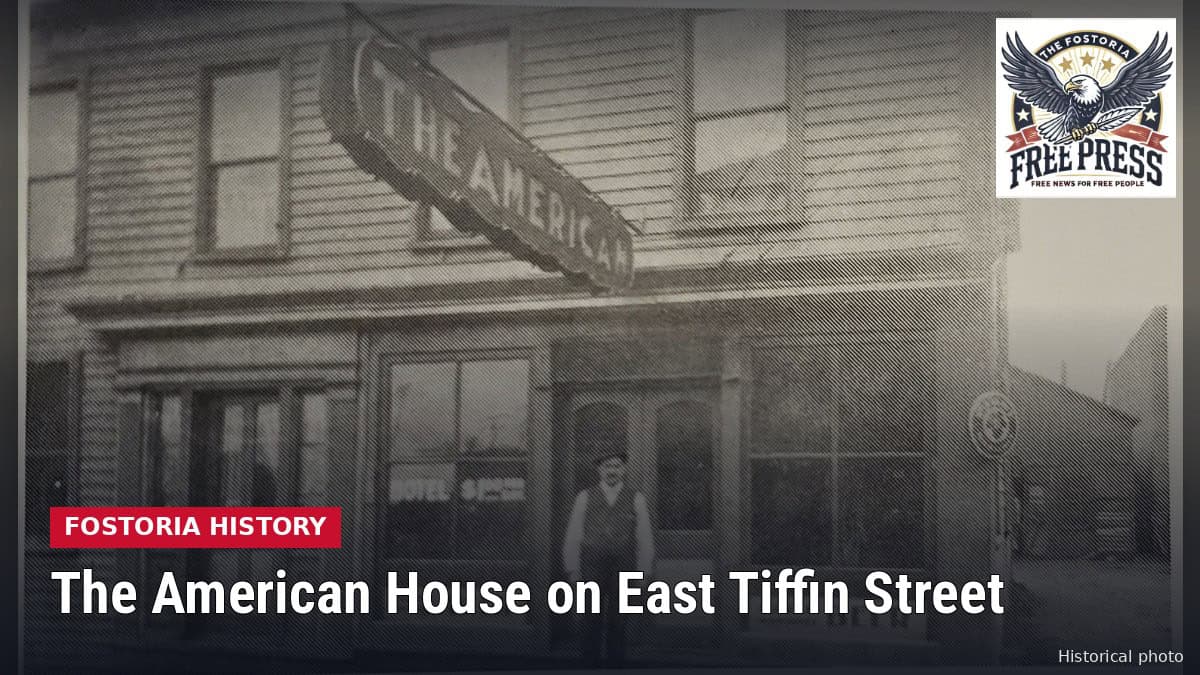
The American House, East Tiffin Street, early 1900s
FOSTORIA — Long before motels lined the highways, travelers coming into Fostoria by wagon, stagecoach and train needed a bed and a meal. The town answered with a long line of taverns and hotels, from log inns in the 1830s to the brick Hays House on Main Street. One of the longest-lived was the American House, a plain frame hotel on East Tiffin Street.
The photo above has been described as an 1870s view of a building that started out as the old Dutch House of 1835. The records tell a more complicated story, and the details in the picture point to a later date.
Quick timeline
| Year | What happened |
|---|---|
| 1832 | Jeremiah Mickey opens the first hotel in Risdon. |
| 1834 | Samuel Laird opens the first hotel in Rome, on the northwest corner of the public square. |
| 1835 | A small log hotel, later called the Dutch House, is built on Tiffin Street. |
| 1844 | James Hays builds a hotel on the Main Street site of the later Hays House. |
| 1854 | Rome and Risdon unite as Fostoria. |
| 1872 | David Hays builds the Hays House. |
| 1877 | The American House first appears in available city directories. |
| 1885 | The 51-room Earl House opens on East Tiffin Street. |
| 1912 | The American House is moved and divided into two houses. |
| 1913 | The Masonic Temple cornerstone is laid on the old hotel site. |
Log taverns in Rome and Risdon
Fostoria grew from two rival villages, Rome and Risdon, which joined in 1854 under the name Fostoria, as Destination Seneca County’s history of the town explains. Each had its own inn early on.
According to the 1886 History of Seneca County, Jeremiah Mickey opened the first hotel in Risdon in 1832 and ran it until his death. In Rome, Samuel Laird opened the first hotel in 1834, on the northwest corner of the public square. The county history says the Laird house changed hands several times, and that one later owner went into the counterfeiting business, a reminder of how rough the frontier town could be.
The same history says Rome’s second hotel, “kept in 1838, on Tiffin Street, now called the ‘Dutch House,’ was a small log house built in 1835.” A third hotel went up in 1844, when James Hays built on the Main Street site where the Hays House later stood. It burned about 1849. Thomas Hays put up a brick hotel there in 1858, and David Hays built the larger Hays House in 1872.
The American House
When the American House was built is not known for certain. A 1979 history column republished by the Fostoria Area Historical Society says the hotel first shows up in available city directories in 1877, with John Hollinger as proprietor. Later operators included F. Gotwallis in 1889-90, Yochum and Co. from 1893 to 1896, Geo. T. Yager in 1902-03 and John G. Kirschner from 1903 to 1912.
The column suggests that the American House may have replaced the 1835 Dutch House on Tiffin Street, but says that cannot be proved. The frame building in the photo is clearly not the log house the county history describes.
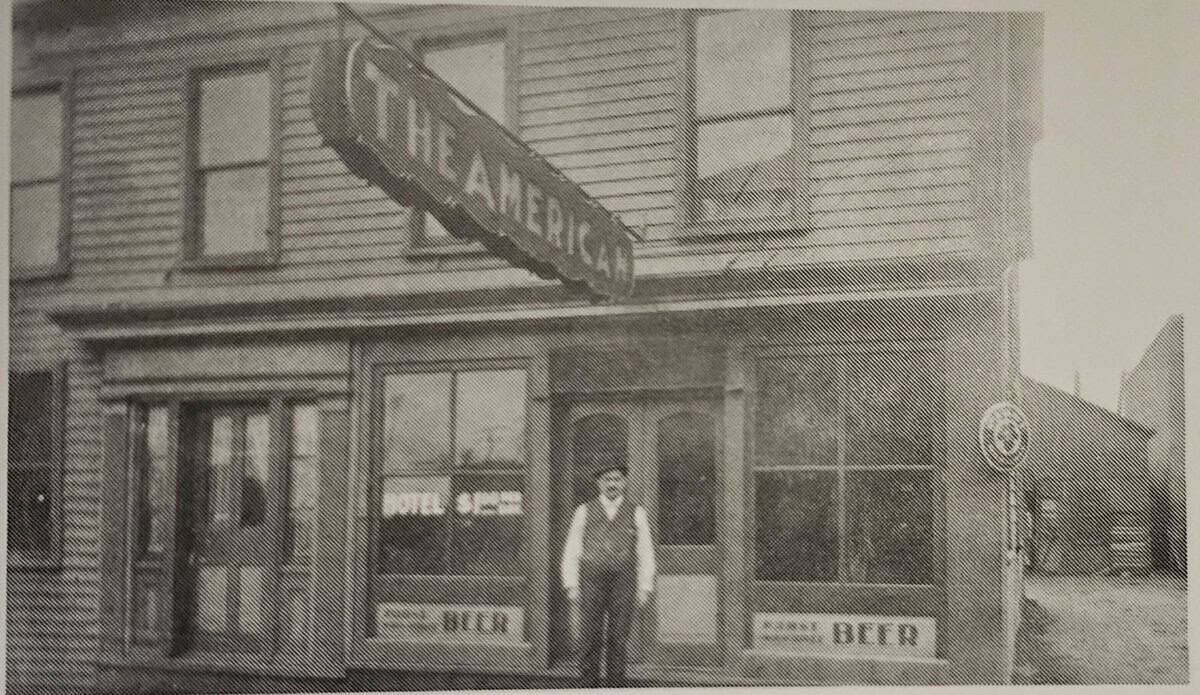
The American House, with its hanging sign, its window sign advertising rooms and a man in the doorway
Reading the photo
The 1979 column describes what appears to be this same photograph, pointing out a window sign advertising rooms at $1 a day and a Pabst Milwaukee emblem on the corner of the building. It identifies the man in the doorway as presumably proprietor John G. Kirschner. If that is right, the picture dates from his years running the hotel, 1903 to 1912, rather than the 1870s.
The American House stood on East Tiffin Street on the site later taken by the Masonic Temple. The temple’s cornerstone was laid in 1913. The column says John Longacre bought the old hotel in 1912 and had it moved to the 400 block of East Tiffin Street, where it was split and remodeled into two houses that were still standing in 1979.
A boom-town hotel trade
The American House was one of many hotels that served Fostoria during the gas boom of the late 1800s. The county history notes the Earl House, finished in August 1885 on East Tiffin Street with 51 rooms. The Hays House on Main Street, beside the interurban station, was the best known. It burned along with the Alcott Block in 1962. (See our companion story on the Alcott Block.) Downtown in the boom years can be explored on the 1896 Sanborn fire insurance maps of Fostoria at the Library of Congress.
More from FFP: Ode to a Home: 505 North Union Street and The “Hidden Tunnels” Beneath Fostoria.
Photo note: Photographs and images published before 1931 are in the public domain in the United States. Historical images in this article are shared for educational and historical purposes.
Sources
- Fostoria Area Historical Society, Two Tiffin Street Homes Made From Hotel (1979): https://www.fostoriamuseum.org/two-tiffin-street-homes-made-from-hotel/
- Fostoria Area Historical Society, Hays Hotel Quite a Place in Fostoria’s Early Days (1981): https://www.fostoriamuseum.org/hays-hotel-quite-a-place-in-fostorias-early-days/
- History of Seneca County, Ohio (Chicago: Warner, Beers & Co., 1886), Fostoria chapter, “Hotels” (transcription): https://blockbefore.com/township-fostoria-city-seneca-oh.html
- Library of Congress, Sanborn Fire Insurance Map from Fostoria, Seneca County, Ohio, 1896: https://www.loc.gov/item/sanborn06698_003/
- Destination Seneca County, From Risdon and Rome to the Rails: https://www.destinationsenecacounty.org/blog/from-risdon-and-rome-to-the-rails-the-birth-of-fostoria-and-its-railroad-legacy/






Leave a Reply
Want to join the discussion?Feel free to contribute!