
FOSTORIA | Pianos in the Parlor: Bertha M. Wickerd, C. W. Gilliard and Fostoria’s Music Dealers
Author: FFP Ai Bot
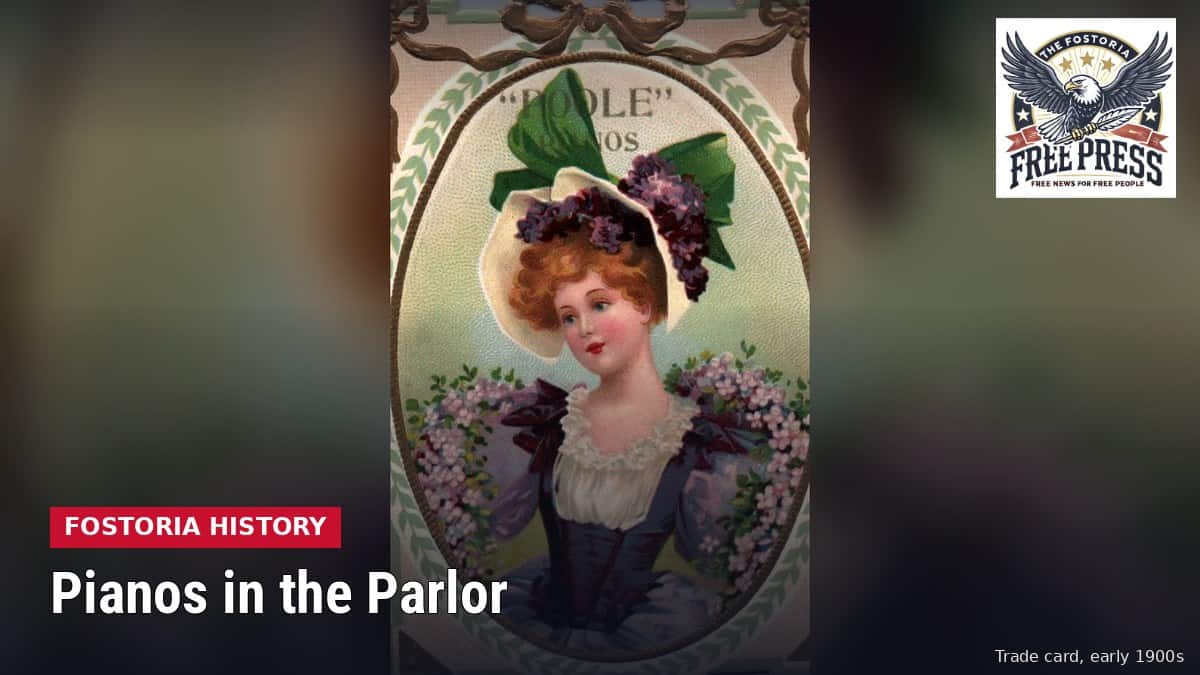
Poole Pianos trade card sold by a Fostoria dealer, early 1900s
FOSTORIA — Long before radios and record players filled the evenings, the piano was the center of many Fostoria homes. Families gathered around it to sing, children took lessons on Saturday mornings, and local dealers competed to sell the instruments and the sheet music that went with them.
This installment of our local history series looks at two small pieces of that world: an early 1900s advertising card for Poole pianos sold by a Fostoria woman dealer, and a 1929 children’s piano book stamped by a later Fostoria music store.
Quick timeline
| Year | What happened |
|---|---|
| 1892-1893 | William H. Poole organizes the Poole Piano Co. at 5 and 7 Appleton St. in Boston. |
| 1906 | A trade paper calls Bertha M. Wickerd “the well-known woman piano dealer of Fostoria.” Her King piano exhibit wins first premium at a fair in Fostoria. |
| 1912 | Poole moves its factory from Boston to Cambridge, Mass. |
| March 13, 1915 | The Bertha M. Wickerd Music Company is incorporated in Fostoria to carry on her business after her death. |
| 1929 | Theodore Presser Co. copyrights “Happy Days in Music Play.” |
| 1981 | A historical society column profiles Mrs. C. W. Gilliard, who once played piano for silent movies. |
A lady in lilacs
The card shown at the top of this page is an embossed, die-cut trade card. On the front, a young woman in a plumed hat and lilac-trimmed gown stands inside an oval frame, with “Poole Pianos” lettered faintly above her.
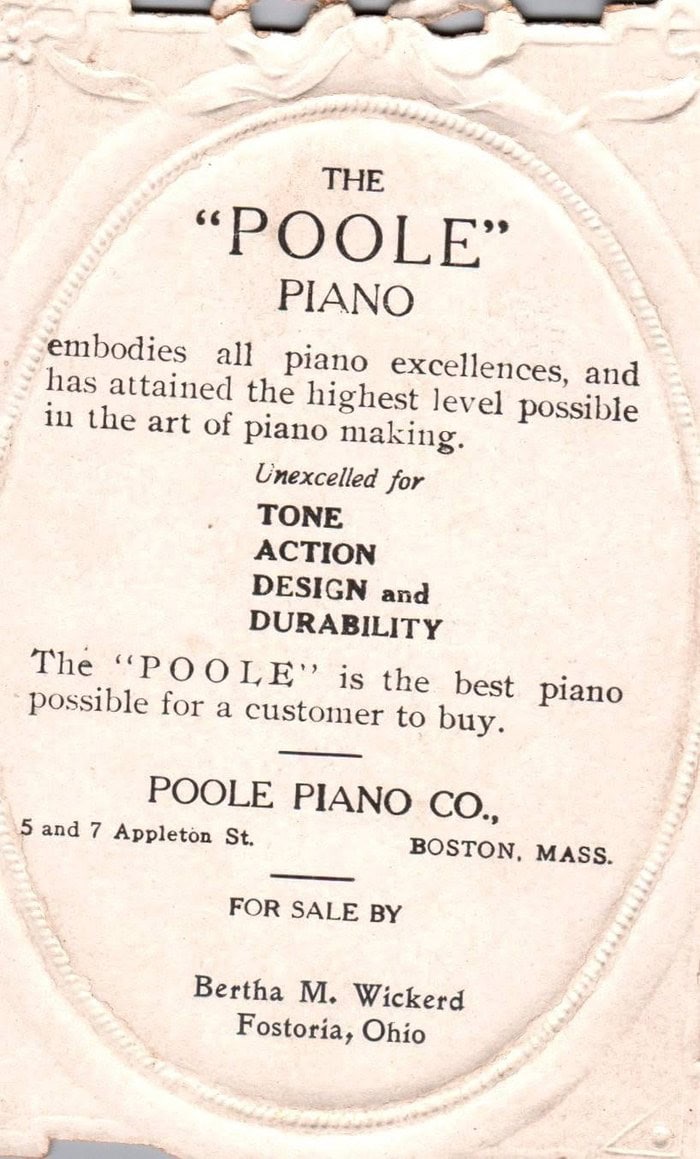
The back of the card: “For sale by Bertha M. Wickerd, Fostoria, Ohio”
The back makes the sales pitch. “The Poole Piano embodies all piano excellences,” it says, “unexcelled for tone, action, design and durability.” At the bottom are the maker, “Poole Piano Co., 5 and 7 Appleton St., Boston, Mass.,” and the local seller: “For sale by Bertha M. Wickerd, Fostoria, Ohio.”
The Boston address helps date the card. According to the 1915 obituary of founder William H. Poole in The Music Trade Review, he organized the company in 1892 at 5 and 7 Appleton St. and stayed there until 1912, when he moved to a larger plant in Cambridge. Other histories give the founding year as 1893. Either way, the card was most likely printed before 1912.
Bertha M. Wickerd, piano dealer
A woman running her own piano business was unusual for the time, and the trade press took notice. In September 1906, The Music Trade Review reported that “Bertha M. Wickerd, the well-known woman piano dealer of Fostoria, O.,” had written to piano maker Arthur J. King that her exhibit of the King piano at “the county fair held at Fostoria last week” had won first premium.
In the spring of 1915, the same paper reported that the Bertha M. Wickerd Co. of Fostoria had incorporated with $10,000 in capital “to take over and conduct the business of the late Bertha M. Wickerd.” Ohio’s corporate records, searchable through the Ohio Secretary of State, list The Bertha M. Wickerd Music Company of Fostoria as incorporated on March 13, 1915. We have not yet found where her store stood or how long the company lasted.
C. W. Gilliard: pianos, radios and music
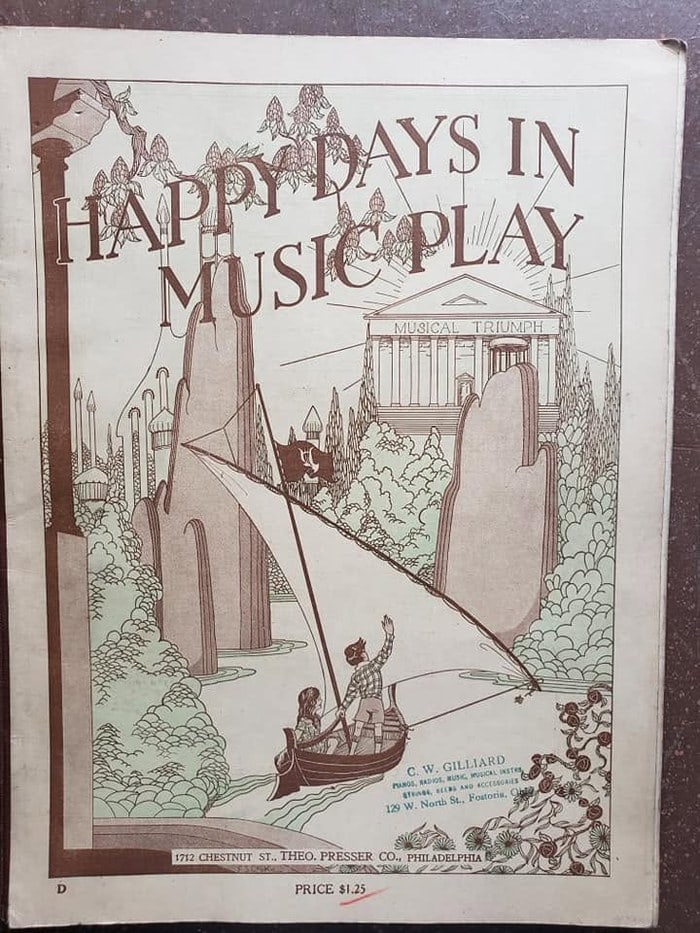
“Happy Days in Music Play,” a children’s piano book first copyrighted in 1929, with a Fostoria dealer’s stamp
The second artifact is a children’s piano book, “Happy Days in Music Play,” with a sailboat drifting past a fanciful “Musical Terrace” on the cover. Copyright records list it as a book by Preston Ware Orem and James Francis Cooke, copyrighted June 20, 1929, by the Theodore Presser Co. of Philadelphia. A September 1929 ad in The Etude, Presser’s music magazine, promoted it as the sequel to “Music Play for Every Day.”
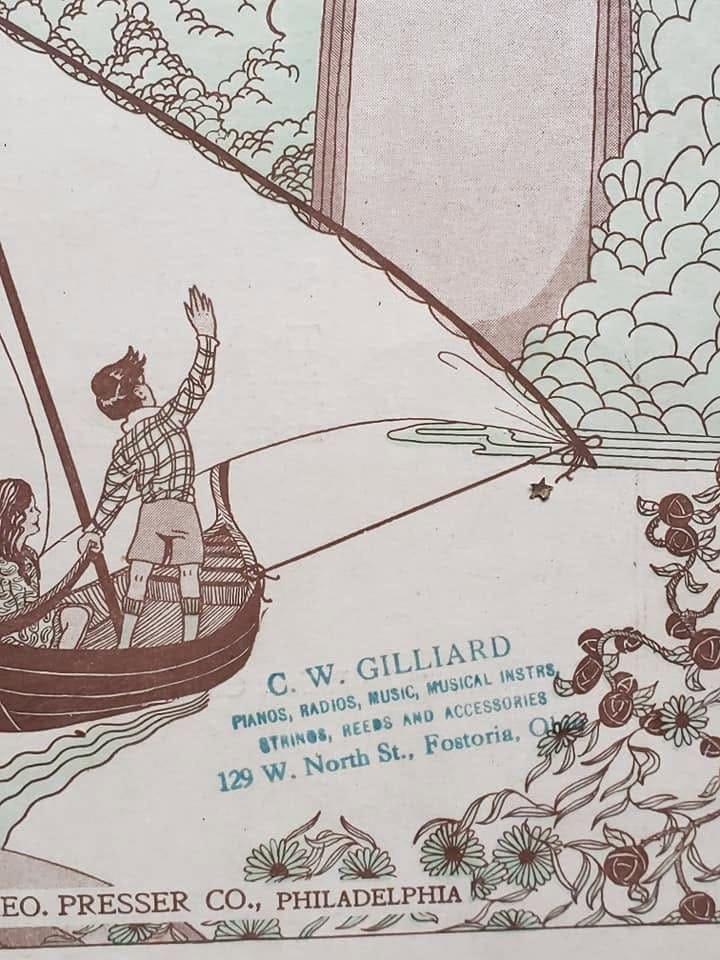
Close-up of the dealer stamp: “C. W. Gilliard, Pianos, Radios, Music … 129 W. North St., Fostoria, O.”
In the lower corner is a blue rubber stamp from the Fostoria store that sold it: “C. W. Gilliard, Pianos, Radios, Music, Musical Instruments, Strings, Reeds and Accessories, 129 W. North St., Fostoria, O.” The word “Radios” is a clue that the stamp dates from the radio age, not the earlier piano boom. Piano dealers had been adding new machines for years. In 1915, a Baltimore piano dealer told The Music Trade Review he was adding talking machines as piano sales slowed.
The Gilliard name turns up again in a 1981 Fostoria Area Historical Society column. The writer visited Mrs. C. W. Gilliard, who told him she had played piano at the Luna, which the column described as Fostoria’s first movie house, on South Main Street. In those silent-film days, she was still a student at the old Central High School. Before the visit ended, she sat down at one of her two pianos and showed she still had the touch. She also said that at one time she gave as many as 18 piano lessons to children on Saturdays. The column does not say whether she worked in the store.
A town full of music
Other names from Fostoria’s music trade appear in the historical society’s street-by-street lists, though their dates are not always given: the J. P. Gade Piano Co. in the Main Street Block on South Main, H. C. Jennings, piano tuner, on North Main, and the Sherwood Music School on North Main.
For more on the shops of the era, see our story on Fostoria’s Main Street merchants. Under U.S. law, as explained by the U.S. Copyright Office, works published in 1929 entered the public domain at the start of 2025, the same rule that let us share the 1929 Red and Black yearbook.
Did your family buy a piano from Wickerd or Gilliard, or take lessons from a Fostoria teacher? We would like to hear from you.
Photo note: Photographs and images published before 1931 are in the public domain in the United States. Historical images in this article are shared for educational and historical purposes.
Sources
- The Music Trade Review, Vol. 43, No. 11 (September 1906), Bertha M. Wickerd item: https://elibrary.arcade-museum.com/Music-Trade-Review/1906-43-11/20
- The Music Trade Review, Vol. 60, No. 14 (spring 1915), “B. M. Wickerd Co. Incorporated” and Mann Piano Co. items: https://elibrary.arcade-museum.com/Music-Trade-Review/1915-60-14/8
- The Music Trade Review, 1915 (Vol. 60, No. 21), “Death of Wm. H. Poole”: https://elibrary.arcade-museum.com/magazines/mtr/MTR-1915-60-21/MTR-1915-60-21-73.pdf
- Ohio Secretary of State, Business Search (The Bertha M. Wickerd Music Company, entity 35031, filed March 13, 1915): https://businesssearch.ohiosos.gov/
- The Etude, September 1929 (Theodore Presser Co. advertisement): https://digitalcommons.gardner-webb.edu/etude/771
- Fostoria Area Historical Society, No More Theaters, Meat Markets on Main Street (Sept. 10, 1981): https://www.fostoriamuseum.org/no-more-theaters-meat-markets-on-main-street/
- Fostoria Area Historical Society, 52 Years of Weekly Readers (Oct. 15, 1981): https://www.fostoriamuseum.org/52-years-of-weekly-readers/
- Fostoria Area Historical Society, South End Business History (Oct. 28, 1981): https://www.fostoriamuseum.org/south-end-business-history/
- Fostoria Area Historical Society, North Main Street Continued (Nov. 21, 1979): https://www.fostoriamuseum.org/north-main-street-continued/
- U.S. Copyright Office, How Long Does Copyright Protection Last?: https://www.copyright.gov/help/faq/faq-duration.html








Leave a Reply
Want to join the discussion?Feel free to contribute!