
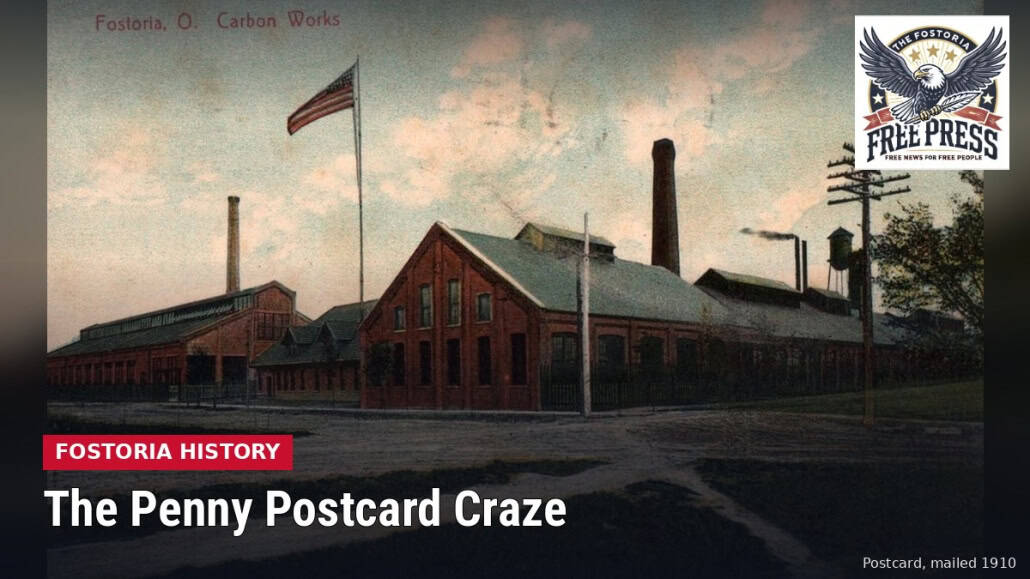
FOSTORIA | “This Picture Is Where I Am Working”: Fostoria and the Penny Postcard Craze
Author: FFP Ai Bot
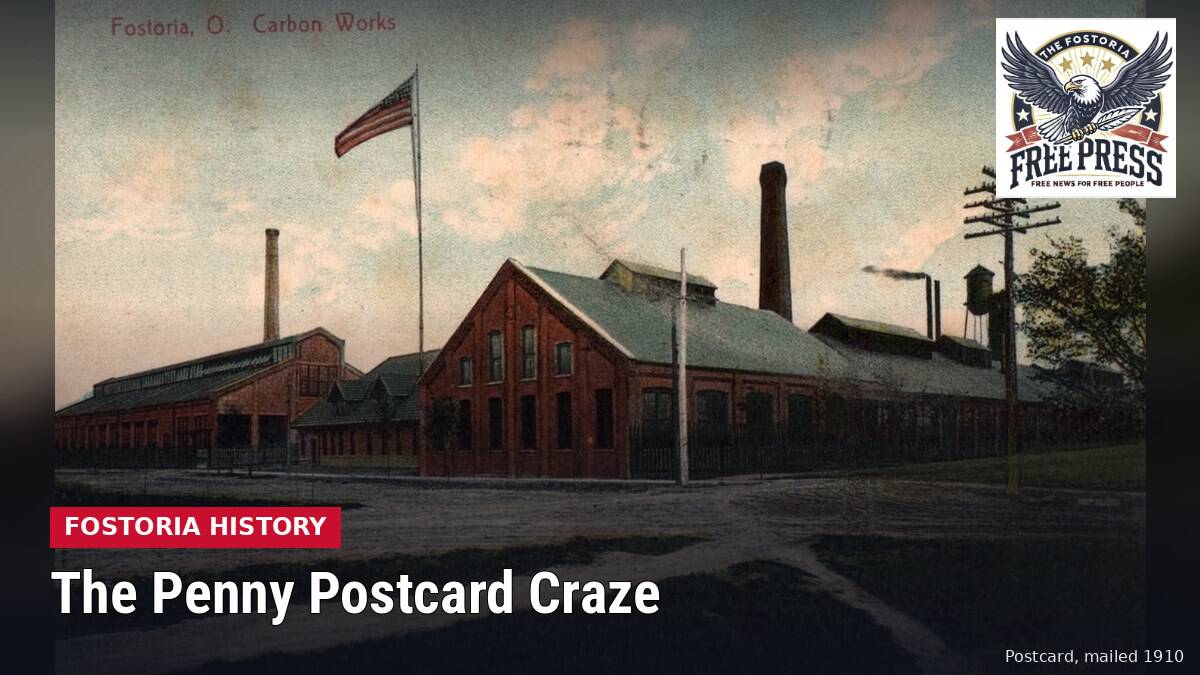
“Fostoria, O. Carbon Works,” mailed from Fostoria in August 1910
FOSTORIA — On a hot August night in 1910, someone in Fostoria dropped a penny postcard in the mail. On the front was the Carbon Works. On the back, the writer explained why: “this picture is where I am working.”
That little card, and a handful of others like it, open a window on one of the biggest fads of the early 1900s: the picture postcard. This installment of our local history series looks at how Fostoria views were printed, sold and mailed during what the U.S. Postal Service calls the golden age of postcards.
Quick timeline
| Year | What happened |
|---|---|
| 1898 | Congress approves a one-cent postage rate for privately printed postcards, starting July 1. |
| 1901-1902 | “Post Card” replaces “Private Mailing Card” on the address side. |
| 1902 | Rural free delivery becomes a permanent service. |
| 1907 | Starting March 1, writers may put a message on the address side, next to the address. |
| 1909 | Congress raises import duties on foreign-made postcards. |
| About 1910 | The postcard craze peaks. A Fostoria Carbon Works card is mailed in August. |
| 1914 | A “Made in Germany” Fostoria card is mailed on Nov. 27, months after World War I began in Europe. |
| 1917-1919 | The war-time postcard rate is 2 cents. It drops back to 1 cent on July 1, 1919. |
| 1925-1928 | Privately printed postcards cost 2 cents to mail, then return to 1 cent on July 1, 1928. |
A penny, a picture and a few lines
The front of the 1910 card, shown at the top of this page, carries the printed title “Fostoria, O. Carbon Works” over a hand-colored view of the red brick plant, its flag and its tall stack. The story of the plant itself is told in our earlier look at Fostoria factories on early postcards.
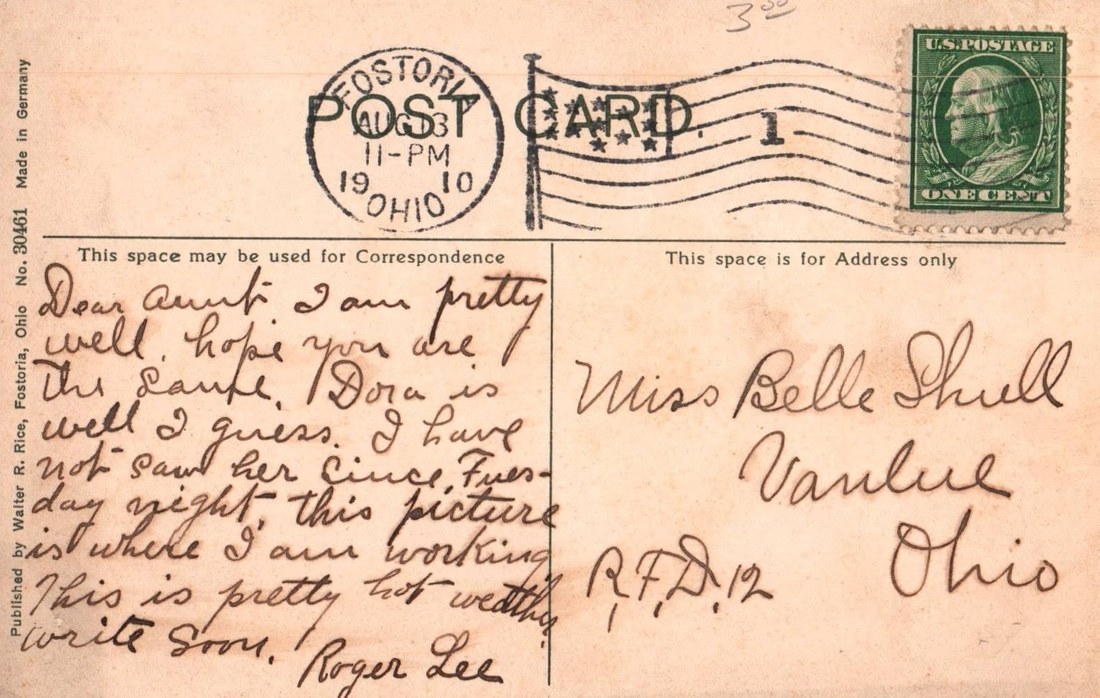
The back of the same card: Fostoria postmark, August 1910, a one-cent stamp and “Published by Walter R. Rice, Fostoria, Ohio … Made in Germany”
The back tells a different story. A Fostoria machine postmark reads August 1910, 11 p.m., beside a green one-cent Benjamin Franklin stamp. A line divides the card: “This space may be used for Correspondence” on the left and “This space is for Address only” on the right. The writer used every inch, sending news of family, a note about the weather (“pretty hot”) and the line about the Carbon Works. The card went to a rural route address near Vanlue.
Each of those details reflects a postal rule. According to the U.S. Postal Service historian, privately printed postcards got a one-cent rate starting July 1, 1898, and messages were not allowed on the address side until March 1, 1907. That is why cards from this era have a “divided back.” Rural free delivery, made permanent in 1902, carried cards straight to farm mailboxes. The Postal Service history notes that the peak years of rural delivery, 1901 to 1909, matched the postcard craze.
“Published by Walter R. Rice”
Printed sideways along the edge of the same card is “Published by Walter R. Rice, Fostoria, Ohio No. 30461,” and on the other side, “Made in Germany.” Local merchants often ordered views of their own town from big printers, many of them in Germany, and sold the finished cards in their shops. The Postal Service history says local views turned up in drugstores, newsstands and other shops, and that during the height of the craze most postcards sold in the United States were made in Germany. We have not yet found who Walter R. Rice was or where he sold his cards. If you know, please tell us.
One factory, many versions
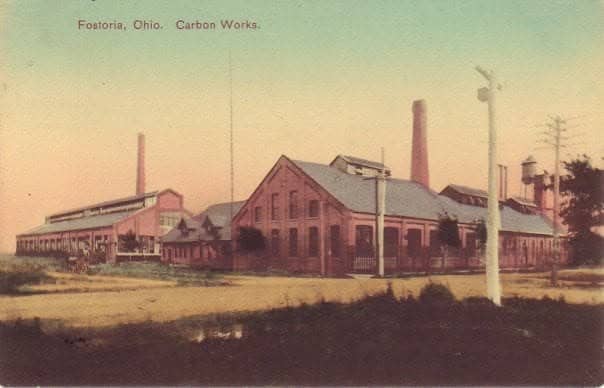
“Fostoria, Ohio. Carbon Works,” a similar view with different coloring, early 1900s
The Carbon Works was a favorite subject. This card, titled “Fostoria, Ohio. Carbon Works,” shows the plant from a very similar spot, but it was colored in soft yellows and greens. Early color cards were usually made from black-and-white photographs, with the color added during printing, so the same scene could come out looking quite different from one printing to the next.
“Carbon Works, Fostoria, Ohio,” another publisher’s view with a large flag, early 1900s
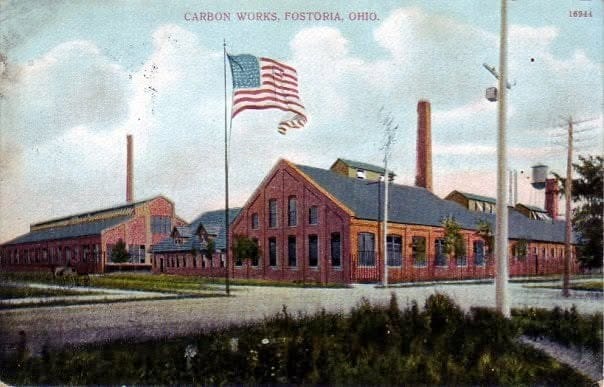
Another card, “Carbon Works, Fostoria, Ohio,” shows the plant from a different angle under a huge American flag. It carries its own number in the upper corner, a sign that it came from a different printing run, and perhaps a different publisher.
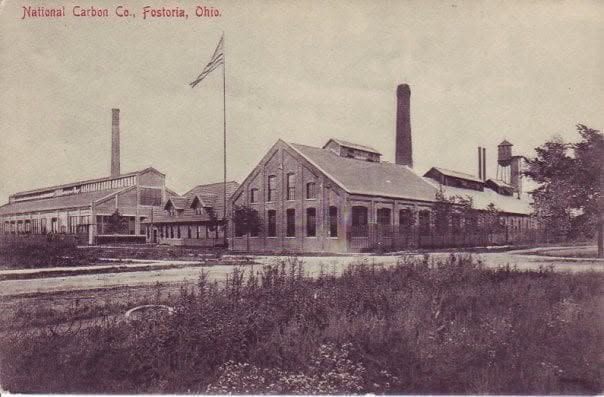
“National Carbon Co., Fostoria, Ohio,” a sepia card, early 1900s
A sepia card uses the company name instead: “National Carbon Co., Fostoria, Ohio.” It shows long, low factory buildings, a flagpole and several stacks across an open field. The National Carbon Co. owned the Fostoria works in these years.
Made in Germany, mailed in 1914
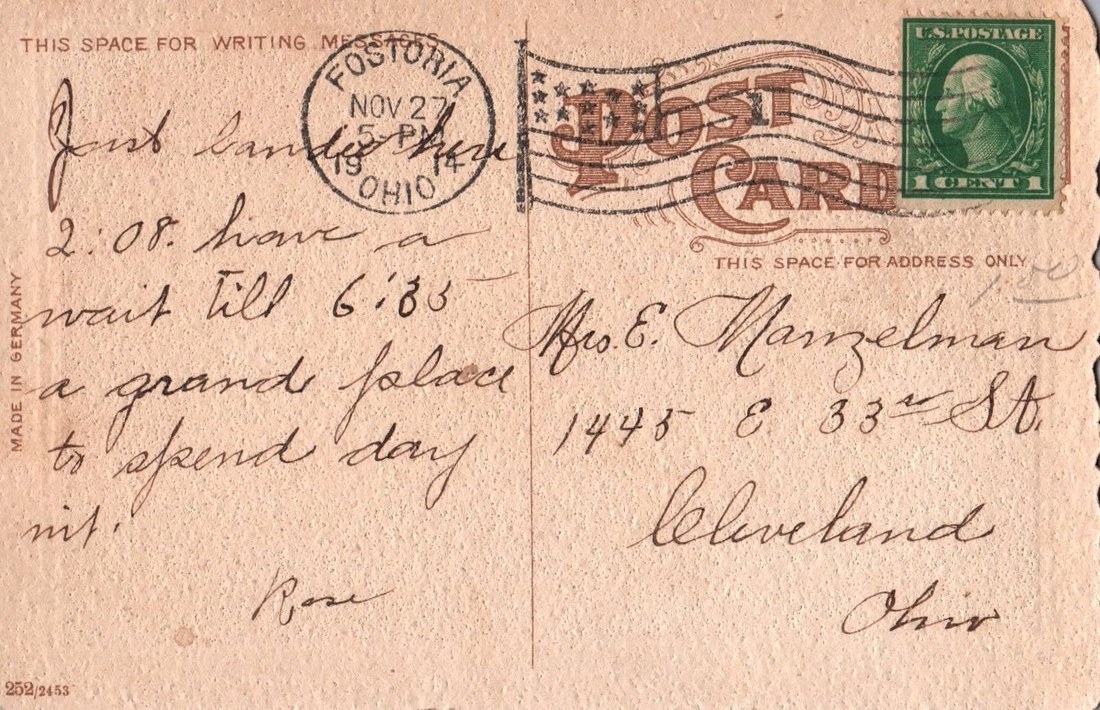
The back of another Fostoria card, postmarked Nov. 27, 1914, also marked “Made in Germany”
This card was mailed from Fostoria at 5 p.m. on Nov. 27, 1914, with a green one-cent George Washington stamp. The front is believed to show North Main Street, much like a card in our story on Fostoria homes and streets on early postcards. The writer had “just landed” at 2:08 and faced a wait until 6:35. It reads like a traveler waiting for a connecting train, which would fit a city crossed by as many railroads as Fostoria. Our story on the LE&W depot and the Iron Triangle has more on the railroads.
The card is also marked “Made in Germany,” even though World War I had begun in Europe that summer. It was most likely printed before the war began. The Postal Service history notes that the 1909 tariff and the war, which cut off cheap, high-quality imports, are both often blamed for ending the craze. It also suggests the fad may simply have run its course as telephones spread.
Still a penny, mostly
For most of these years, mailing a postcard really did cost a penny. The Postal Service rate history shows the rate went to 2 cents on Nov. 2, 1917, during the war, and came back to 1 cent on July 1, 1919. Privately printed postcards cost 2 cents again from April 15, 1925, to July 1, 1928, while government-issued postal cards stayed at a penny.
Today, cards like these are some of the best records of what Fostoria looked like more than a century ago, and their backs often hold clues about the people who mailed them. Do you have old Fostoria postcards in a shoebox or album? We would like to hear from you.
Photo note: Photographs and images published before 1931 are in the public domain in the United States. Historical images in this article are shared for educational and historical purposes.
Sources
- U.S. Postal Service, Historian, Stamped Cards and Postcards (September 2014): https://about.usps.com/who-we-are/postal-history/stamped-cards-and-postcards.pdf
- U.S. Postal Service, Rates for Stamped Cards and Postcards: https://about.usps.com/who/profile/history/postcard-rates-since-1873.htm
- Postcard backs: printed text and postmarks on the 1910 and 1914 cards shown in this article




Leave a Reply
Want to join the discussion?Feel free to contribute!