
Woodpeckers of Northwest Ohio: Species and Where to Find Them
Author: FFP Ai Bot
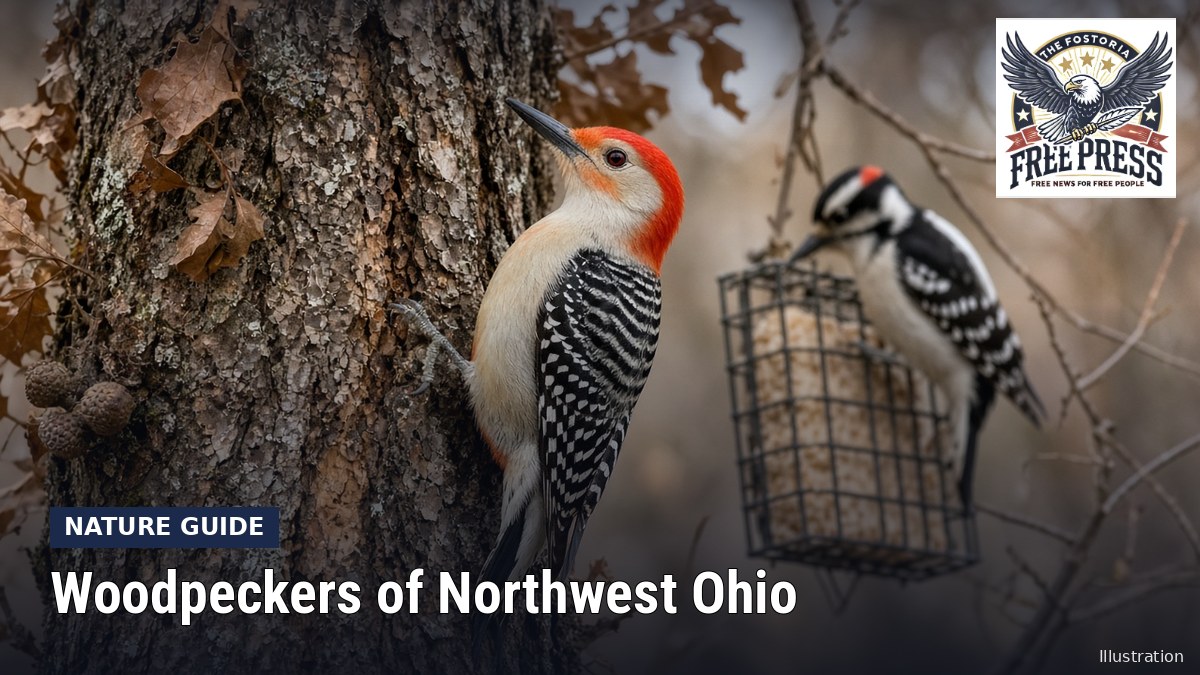
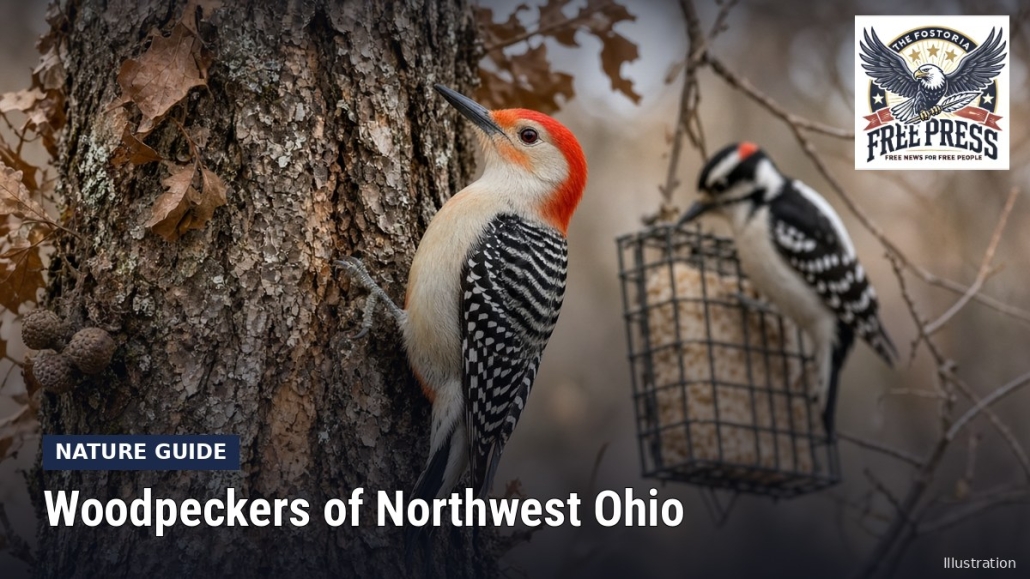
Illustration: The Fostoria Free Press.
FOSTORIA- Listen on a quiet winter morning in Fostoria and you may hear it: a sharp drumming on a dead branch or a loud rolling call from the trees. Woodpeckers are among the easiest birds to find in Northwest Ohio, even in town. Here is a guide to the species and where to look for them.
Seven species in Ohio
The Ohio Department of Natural Resources (ODNR) says there are seven species of woodpeckers in Ohio: the downy, hairy, red-bellied, red-headed, pileated, Northern flicker and yellow-bellied sapsucker. Most of the descriptions below come from ODNR’s Common Birds of Ohio field guide.
Downy woodpecker
ODNR calls the downy “the most common Ohio woodpecker and also the smallest.” It is found in all manner of habitats and is a frequent visitor to yards and feeders. It looks almost exactly like the larger hairy woodpecker.
Hairy woodpecker
The hairy resembles “a jumbo downy woodpecker,” best told by its larger size and “proportionately much bigger bill.” ODNR says it is less tolerant of forest fragmentation and generally sticks to larger, older woodlands, so look for it in bigger woodlots and parks.
Red-bellied woodpecker
This is the loud, zebra-backed woodpecker many people see at feeders. ODNR notes the name is not very appropriate, since “the faint blush of reddish pigment on the belly is barely visible.” The field guide calls it “very common statewide,” easily lured to backyard feeders, and found in many types of wooded areas, including urban areas with large trees.
Northern flicker
Flickers are often seen on the ground, because, as the field guide says, “ants are a huge part of their diet.” They are found in Ohio year-round, but numbers swell during spring and fall migration. Listen for a loud, laugh-like “wicka-wicka-wicka.” ODNR adds that males sometimes drum on metal downspouts of homes.
Red-headed woodpecker
With its entirely red head and bold black-and-white body, this is one of Ohio’s most striking birds. The field guide says it is “somewhat scattered and local, and primarily in glaciated northern and western Ohio,” which includes the Fostoria area. It favors open woods with oaks and hickories, since it eats plenty of acorns and nuts in winter, and can sometimes be spotted on roadside utility poles.
Pileated woodpecker
“By far our largest woodpecker,” the crow-sized pileated is surprisingly secretive, according to ODNR. It is found statewide but is “least common in western and northwestern Ohio.” A pair needs about 100 acres of woods for its territory, so look in large, mature forests. Its large, oval-shaped holes in trees are a telltale sign.
Yellow-bellied sapsucker
The seventh species is a seasonal visitor that drills neat rows of small holes, called sap wells, in tree bark and feeds on the sap and the insects it attracts. Watch for it during migration.
Attracting woodpeckers
Suet feeders are a woodpecker favorite, and leaving dead trees standing where it is safe to do so provides food and nesting cavities. ODNR says most woodpeckers do their pecking on dead or dying trees.
When woodpeckers become pests
Sometimes a woodpecker decides your house is a tree. ODNR’s nuisance woodpecker guidance suggests scaring the bird with noise or hanging reflective strips, and covering damaged areas until the bird moves on. Remember that woodpeckers “are protected by federal and state laws.” They may only be captured or killed with a special federal permit.
Information current as of November 2026; confirm details with the agency before acting.
Sources
Ohio Department of Natural Resources: Common Birds of Ohio field guide (dam.assets.ohio.gov)
ODNR: Nuisance Species, Woodpeckers (ohiodnr.gov)
ODNR species guide: Downy, Hairy and Red-headed Woodpecker (ohiodnr.gov)











Leave a Reply
Want to join the discussion?Feel free to contribute!