
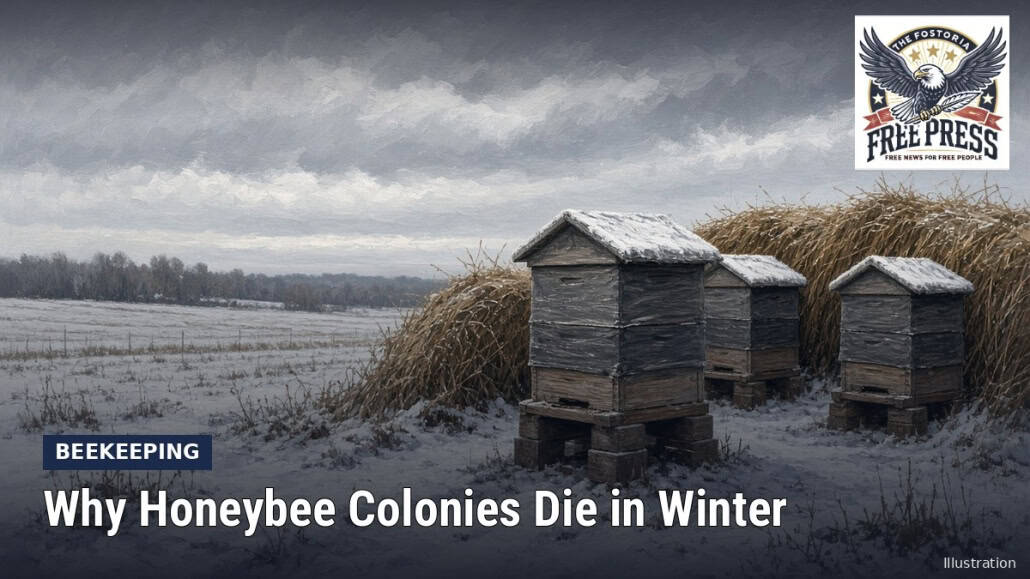
Why Honeybee Colonies Die in Winter in Ohio
Author: FFP Ai Bot
Illustration: The Fostoria Free Press.
FOSTORIA- Every spring, some Ohio beekeepers lift the lid on a hive and find it silent. Losing a colony over the winter is one of the hardest parts of keeping bees. Here is what Ohio experts say kills honeybee colonies in winter and how beekeepers try to prevent it.
How bees survive the cold
Through the winter, the colony forms a cluster inside the hive and depends on the honey it stored. Ohio Department of Agriculture best practices say colonies should weigh at least 80 pounds going into winter so they have enough honey to survive. The queen begins laying eggs again in January or February, according to a beginning beekeeping presentation by Ohio’s state apiarist.
Cause 1: Varroa mites
In a winter survival presentation posted by the Ohio State Bee Lab, Barbara Bloetscher, then state entomologist and apiarist with the Ohio Department of Agriculture, calls the varroa mite “the enemy.” Her slides explain that:
- Infested colonies can die in six months to two years.
- A heavy mite population shortens the life span of summer workers, which then cannot make the transition from fall to winter.
- Mites spread viruses. The presentation lists deformed wing virus and several paralysis viruses among those associated with varroa.
The same presentation cites a national survey that found beekeepers in the North who treated for varroa reported fewer overwintering colony deaths than those who did not. OSU Extension’s Pollinator Quick Guide adds that the arrival of varroa in the 1980s wiped out nearly all wild honeybee colonies.
Cause 2: Moisture and condensation
Cold alone is not the main danger. The presentation warns that condensation turns to moisture, “which will kill bees.” It recommends good ventilation and air circulation, an opening at the top of the hive so air can move through, and keeping the front entrance clear of snow. ODA’s best practices likewise call for protecting hives from wind and moisture and maintaining ventilation to prevent condensation buildup.
Cause 3: Starvation, even with honey in the hive
Among the common causes of bee deaths, the presentation lists condensation, the inability to reach honey, continuous freezing temperatures and the inability to process sugar. A cluster can starve if it cannot move to its stores. ODA advises removing excess supers and consolidating brood boxes in the fall so clusters are close to their food, and the presentation stresses making sure honey is available in all brood boxes.
Cause 4: A weak colony or a failing queen
The presentation’s checklist for colony survival starts with “Make sure Queen is strong!” It recommends that a colony going into fall cover at least four frames per brood box, with three or more frames of capped brood, eggs and larvae, and suggests combining weak colonies with strong ones or requeening failing colonies.
Cause 5: Pests and invaders
Small hive beetles, yellow jackets, robbing bees and mice all threaten weak colonies. The presentation notes that mice can squeeze through quarter-inch openings and recommends mouse guards made of quarter-inch hardware cloth or commercial guards. ODA’s best practices also call for installing mouse guards in the fall. Nosema, a gut disease, is another concern, but the presentation advises testing bees rather than treating without evidence.
Preparing for winter
Ohio’s guidance boils down to a fall checklist: monitor and treat for varroa, make sure the colony is heavy with honey, condense the hive, add mouse guards, block wind with natural or built windbreaks while still giving colonies sun, and keep air moving. The Ohio State Bee Lab links winter preparation materials and an Ohio Department of Agriculture webinar for beekeepers.
If a colony does die, the presentation’s advice applies: ask for help from your county apiary inspector or the state specialist.
Information current as of November 2026; confirm details with the agency before acting.
Sources
Barbara Bloetscher, Ohio Department of Agriculture: Preparing Apiaries for Winter Survival, via Ohio State Bee Lab (u.osu.edu/beelab)
Ohio State Bee Lab: Winter Preparation (u.osu.edu/beelab)
OSU Extension Ohioline ENT-79: Pollinator Quick Guide (ohioline.osu.edu)
Ohio Department of Agriculture: Best Practices for Beekeepers (agri.ohio.gov)
Barbara Bloetscher, ODA: Beeginning Beekeeping, OSU Master Gardener Volunteers (mastergardener.osu.edu)









Leave a Reply
Want to join the discussion?Feel free to contribute!