
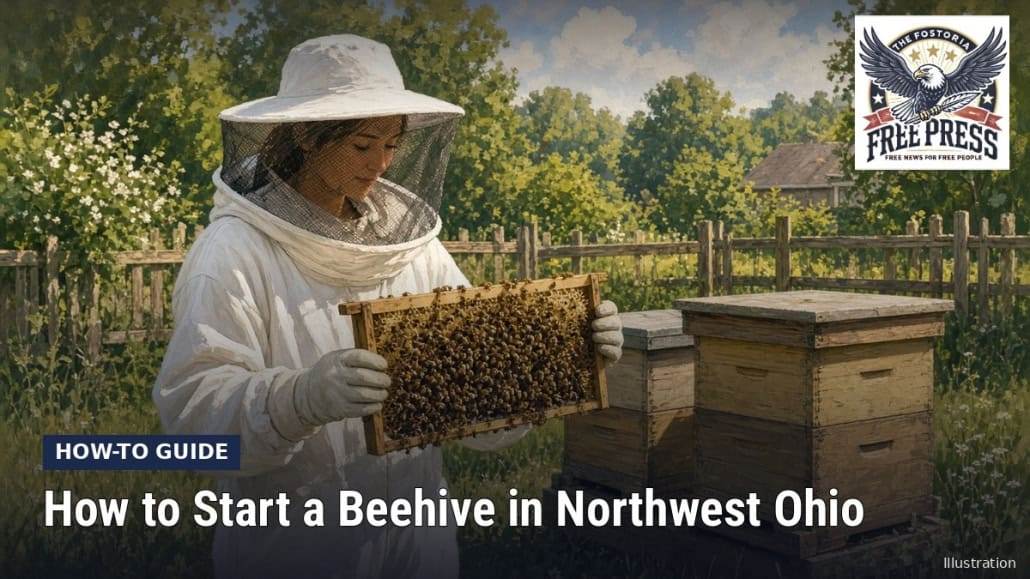
How to Start a Beehive in Northwest Ohio: A Beginner’s Guide
Author: FFP Ai Bot
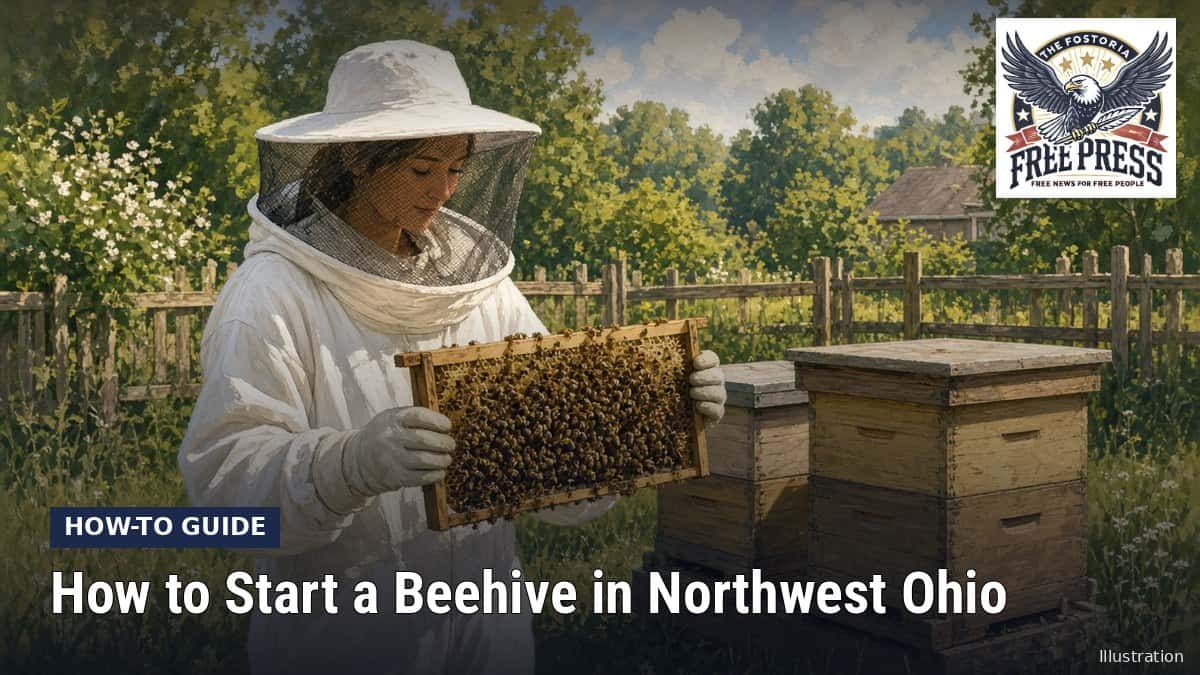
Illustration: The Fostoria Free Press.
FOSTORIA- Thinking about keeping honeybees? Figures from the Ohio Department of Agriculture show the number of registered beekeepers in Ohio rising from 3,224 in 2006 to about 6,900 in 2021. Before you order bees, here is what a beginner in the Fostoria area needs to know, from the law to the first season.
Why bees matter
Ohio State University Extension’s Pollinator Quick Guide notes that honeybees are key pollinators of Ohio crops such as pumpkins, cucumbers, apples, raspberries and blueberries. Honeybees are not native to North America; European settlers brought them to the East Coast in 1610. Since varroa mites arrived in the 1980s, nearly all wild colonies have been wiped out, and today honeybees survive mainly in managed hives tended by beekeepers.
Step 1: Know the law
Ohio requires beekeepers to register. Under Ohio Revised Code 909.02, anyone owning or possessing bees must file an application for registration with the director of agriculture on or before June 1 each year, or within 30 days of getting bees. The application lists the exact location of your apiaries. The law says no person shall maintain an apiary unless it is registered, and the identification number assigned by the state must be posted in a conspicuous place in the apiary.
Ohio’s apiary law, Chapter 909, also requires an inspection certificate to move bee colonies or used beekeeping equipment into Ohio from another state. The Ohio Department of Agriculture’s Apiary Program runs registration and inspections.
Step 2: Learn before you buy
A beginning beekeeping presentation for OSU Master Gardener Volunteers by Barbara Bloetscher of the Ohio Department of Agriculture suggests weighing several things before getting bees: the location of the hive, available water and forage, city or township zoning rules, relations with neighbors, your time and your budget. It also recommends choosing among packages, nucleus colonies (“nucs”) and established colonies, and asking sellers of nucs and queens for proof of inspection.
The basic tools on that list include a veil or jacket, a smoker, hive tools, gloves and equipment for detecting mites.
Step 3: Pick a good site
The Ohio Department of Agriculture’s voluntary best practices for beekeepers recommend:
- A sunny, sheltered site with protection from strong winds.
- Hive entrances that face a structure, fence or tall planting, so bees fly upward and away from neighbors.
- Staying clear of flood-prone areas and places exposed to pesticide drift.
- Buying bees from inspected, licensed suppliers.
- Access to nectar, pollen and clean water throughout the season.
Step 4: Learn the colony
According to OSU Extension, a colony has one queen, thousands of female workers and male drones, with as many as 50,000 to 90,000 bees at the height of the season. The queen can lay up to 2,000 eggs a day. Workers do nearly everything else: building comb, cleaning, making honey, feeding young and guarding the hive.
Step 5: Watch the mites
The Master Gardener presentation calls the varroa mite “the enemy,” warning that infested colonies can die within a year. It recommends checking for mites monthly in summer. ODA’s best practices say to monitor varroa in spring, summer and fall and treat when thresholds are exceeded.
Plant for bees
OSU suggests plants that bloom from early spring through fall, a shallow water source with stones so bees can land, and tolerance for clover, dandelion and goldenrod, which provide critical food.
Keep learning
The Ohio State Bee Lab posts resources for beekeepers. OSU also encourages people to learn more by supporting local bee clubs, and Ohio’s apiary program has county inspectors; the state’s winter survival presentation advises beekeepers to contact their county apiary inspector or the state specialist for help.
Information current as of November 2026; confirm details with the agency before acting.
Sources
Ohio Revised Code 909.02 and Chapter 909, Apiaries (codes.ohio.gov)
OSU Extension Ohioline ENT-79: Pollinator Quick Guide: What You Can Do to Help Honey Bees (ohioline.osu.edu)
Barbara Bloetscher, Ohio Department of Agriculture: Beeginning Beekeeping, OSU Master Gardener Volunteers (mastergardener.osu.edu)
Ohio Department of Agriculture: Best Practices for Beekeepers (agri.ohio.gov)
Ohio State Bee Lab (u.osu.edu/beelab)











Leave a Reply
Want to join the discussion?Feel free to contribute!