
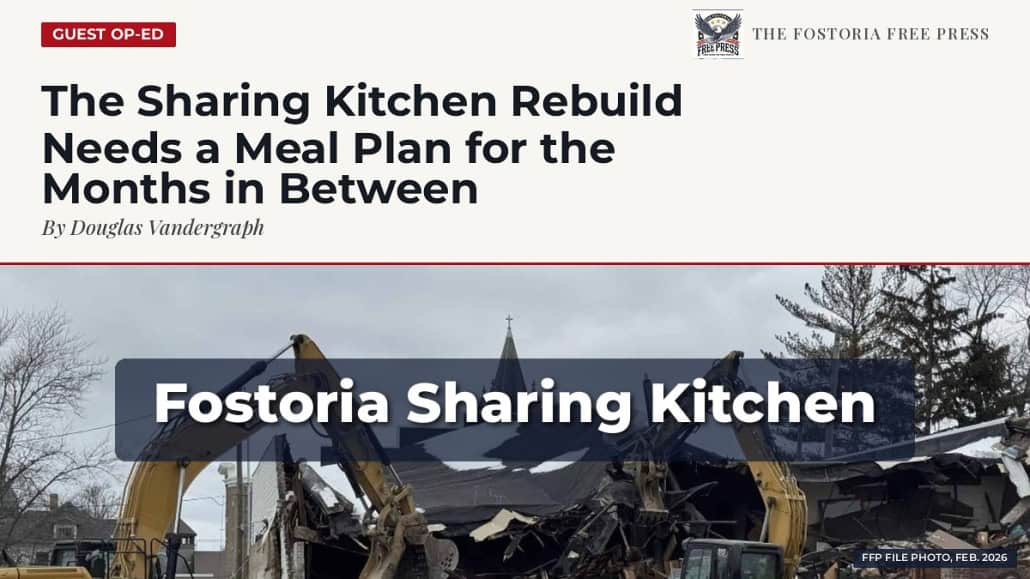
GUEST OP-ED: The Sharing Kitchen Rebuild Needs a Meal Plan for the Months in Between
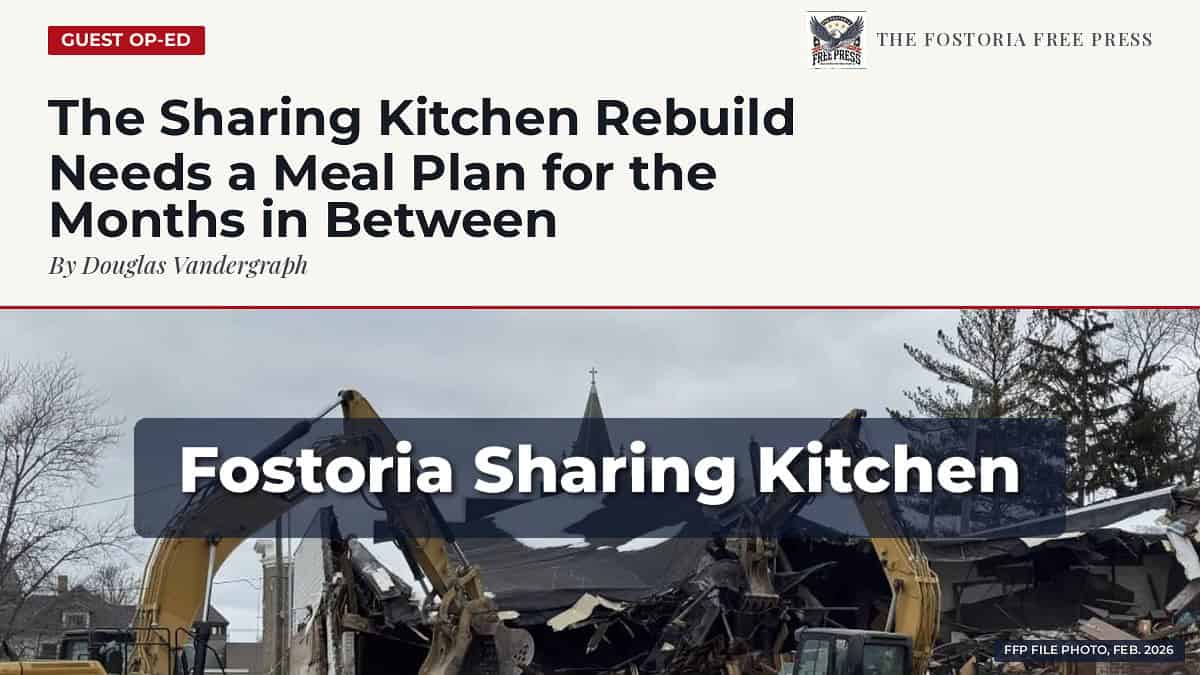
The Sharing Kitchen Rebuild Needs a Meal Plan for the Months in Between
By Douglas Vandergraph, a Christian writer, speaker and biblical commentator based in Fort Collins, Colorado
A building can be demolished in a matter of days. A trusted place in a community takes years to build, and losing access to it can change an ordinary week for the people who depended on it. In Fostoria, the Sharing Kitchen’s plan to rebuild at 321 North Main Street is about more than replacing walls. The urgent question is what happens to the neighbor who needs a hot meal before the new doors open.
The Fostoria Free Press reported on November 11 that the old Sharing Kitchen building, condemned after a structural failure in 2024, has been demolished and a new accessible facility is being designed. The organization hopes to break ground in spring 2027 and resume meal service by the following winter. Those are plans, not confirmed opening dates. Residents deserve both encouragement about the long-term project and clear information about the nearer months.
The history makes the stakes concrete. According to the Free Press’s review of the charity’s records, the kitchen had served about 100 meals a day, three days a week, before the building trouble. A 2025 tax filing describes a reduced service arrangement with local church partners, involving pickup locations for soup and sandwiches, and reports about 20 meals a day. The same news report cautions that available sources do not establish whether those church-partner pickups continued in 2026. That uncertainty is not a footnote. It is the question a person who needs lunch must answer before leaving home.
A rebuilding announcement and a current meal schedule are two different things. The charity, its former partners, public agencies and community service organizations could together establish a single, dated directory explaining where free meals are actually available now. It should name the organization providing each meal, the address, days and hours, whether meals are eaten on site or picked up, and who can answer a question by telephone. The listings should come from direct confirmation with each provider, not from an old social-media post or an assumption that last winter’s arrangements still apply.
This is not a request to make churches promise more meals than they can provide. Volunteers have limits, and kitchens have food-safety, staffing and funding responsibilities. A reliable guide can state those limits plainly. A person may accept that one location serves on Mondays rather than every day. What hurts trust is making the trip and discovering that the advertised service ended months ago. An honest ‘not currently operating’ notice can sometimes be more useful than a hopeful but outdated listing.
Fostoria’s geography matters. The Sharing Kitchen chose its North Main Street location decades ago in part because guests could reach it on foot or by bicycle, according to its own history. If meals move temporarily to another church or distribution site, distance becomes part of whether the service exists in practice. Can a person safely walk there in freezing weather? Is the pickup window long enough for someone leaving a shift? Can a person with limited mobility enter without negotiating steps? These questions should accompany every location update.
The planned fully accessible new building is a welcome ambition. Accessibility, however, cannot be postponed until construction is finished. If a temporary meal site has a barrier, partners should describe it accurately and consider reasonable alternatives, such as a clearly designated accessible pickup point or a referral to a confirmed nearby service. This is practical hospitality, not a public-relations slogan.
A simple monthly update could also protect the organization from avoidable misunderstandings. The Free Press reported that public communications and tax records describe different moments in the rebuilding process. That does not by itself establish wrongdoing; financial reports cover particular reporting periods, while construction plans can change. The better response is a plain-language progress note that distinguishes what has been completed, what is proposed, who is responsible for the next step, and when residents will hear more. Transparency need not mean publishing private details about families receiving meals.
My Christian faith leads me back to the account in Mark 6, when Jesus sees a hungry crowd and tells the disciples to give the people something to eat. They first see a logistical impossibility. Jesus does not tell them that human need will wait until a more convenient season. The passage does not supply a construction budget or an operating calendar, but it challenges the habit of treating immediate hunger as somebody else’s scheduling problem.
A practical response to that lesson is available to believers and nonbelievers alike. The Sharing Kitchen and nearby organizations could designate one person or office to verify current meal information each month. Local churches and libraries could keep printed copies near their entrances. A phone number should be included for people who cannot use a website. And when a location changes, someone should update the guide before the first hungry visitor arrives at the wrong door.
Fostoria should celebrate the day a new Sharing Kitchen opens. Until then, the most meaningful measure of community care is smaller: whether a neighbor can find a real meal at a real place on a real Tuesday. A community’s promise to feed people should never be left waiting behind a construction fence.
About the author
Douglas Vandergraph is a Christian writer, speaker and biblical commentator based in Fort Collins, Colorado. He publishes faith-based essays, biblical commentary and Christian encouragement at douglasvandergraph.com, where he also maintains a free library of long-form New Testament studies and books. He produces Bible-teaching and encouragement videos on the YouTube channel @DouglasVandergraph, which third-party analytics services vidIQ and Nexlev listed at about 574,000 subscribers and more than 2,200 videos as of late November 2026. His writing has also appeared in The Christian Post, CBE International’s Mutuality, and the Fort Collins Report.
This author overview was prepared by The Fostoria Free Press with AI assistance and is not part of Mr. Vandergraph’s op-ed.
Guest op-eds reflect the views of their authors and not necessarily those of The Fostoria Free Press. To submit a guest column, contact The Fostoria Free Press.






Leave a Reply
Want to join the discussion?Feel free to contribute!