
Camp Seneca and Early Military History Along the Sandusky River
Author: FFP Ai Bot
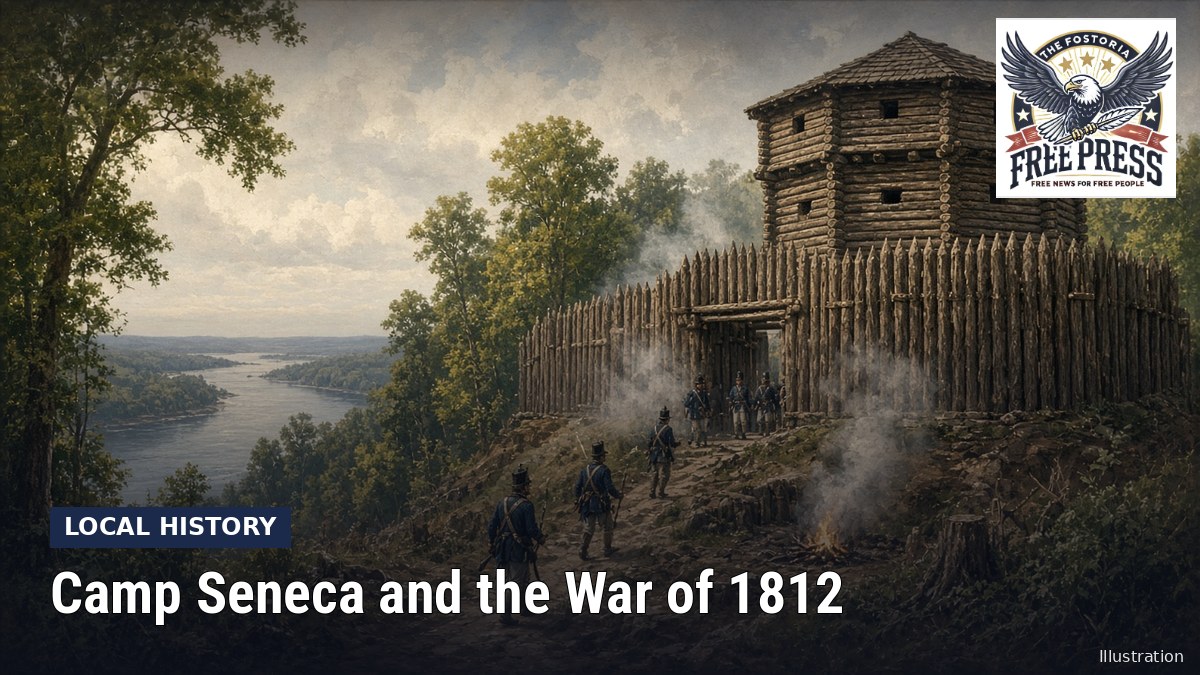
Illustration: The Fostoria Free Press.
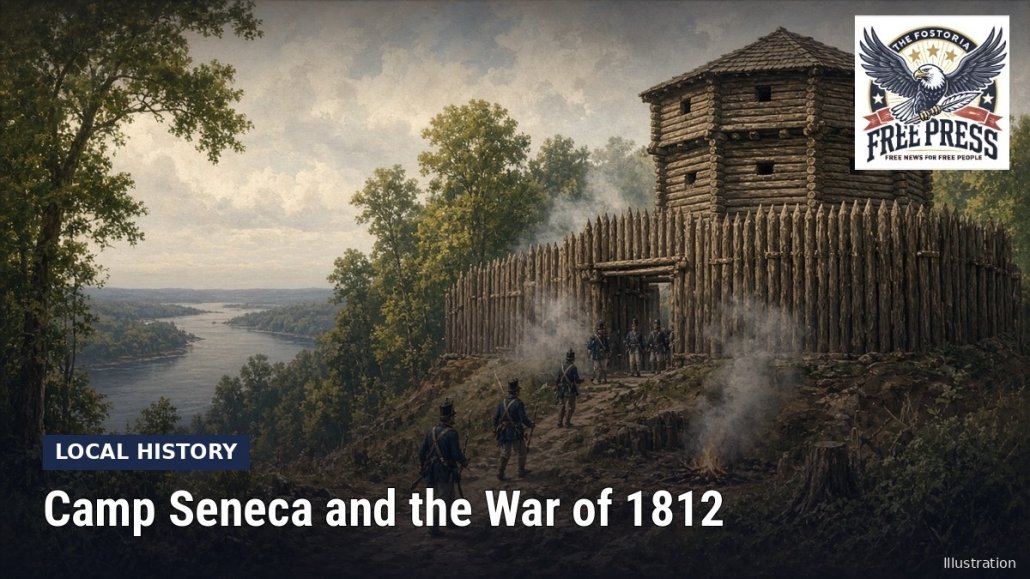
FOSTORIA- East of Fostoria, between Tiffin and Fremont, on a bluff above the Sandusky River at what is now Old Fort, stood one of the most important American posts of the War of 1812 in Ohio. General William Henry Harrison called it Camp Seneca. History remembers it as Fort Seneca.
A chain of forts along the river
In 1813, the Sandusky River valley was a military highway. As Harrison prepared to retake Detroit and invade British-held Canada, he built a chain of forts northward along the Sandusky and the old Scioto-Sandusky Trail: Fort Ferree at present-day Upper Sandusky, Fort Ball at present-day Tiffin, Fort Seneca at Old Fort and Fort Stephenson at present-day Fremont, according to notes on the Fort Seneca – Harrison Trail marker in the Historical Marker Database. The forts protected American supply and communication lines.
Building Camp Seneca
Destination Seneca County, in its America 250 historical driving tour, says Harrison ordered the construction of “Fort (or as he called it, Camp) Seneca” in July 1813 as a supply depot along the Army Road, formerly the Scioto-Sandusky Trail. It sat on a 40-foot bluff on the west side of the Sandusky River.
The tour describes 12-foot oak pickets enclosing about 1.5 acres, with a large blockhouse at the southwest corner and smaller blockhouses at the others. The pickets were extended to enclose a freshwater spring so the garrison would have water in a siege. In late summer 1813, roughly 800 troops were stationed there, preparing to move north against British and Native American forces at Fort Malden.
Harrison’s headquarters
Harrison made Fort Seneca his headquarters from July until September 1813. The 1913 marker at Old Fort, placed by the Daughters of the American Revolution, says that here he “received from Commodore Perry his famous message, ‘We have met the enemy and they are ours,'” after the naval battle on Lake Erie.
Troops at Fort Seneca could hear the fighting downstream when British forces failed to take Fort Stephenson, according to the driving tour. Harrison was criticized for not marching to help, but the tour says such an effort would have been “foolhardy” given the size of the enemy force.
The DAR marker also records that warriors of four Native nations allied with the Americans, the Delawares, Shawnees, Wyandots and Senecas, joined Harrison’s army at the fort for the invasion of Canada, a campaign that ended with the Battle of the Thames.
After the war
The fort was abandoned after the war. Like other forts along the Army Road, it gave early settlers temporary shelter. The driving tour says Rev. James Montgomery, the agent for the Seneca Reservation created in 1817, lived with his family in the fort’s large blockhouse for seven years.
A few miles upriver, the village of Fort Seneca took its name from Harrison’s post. Its Ohio historical marker, erected in 1987, says the village was surveyed Jan. 14, 1836, after a general store and grist mill were established near the Scioto-Sandusky trail in the 1820s.
Visiting today
Nothing of the stockade survives, but you can visit the marker at the intersection of County Road 51 and Harrison Street in Old Fort. It is one stop on “Tracking the Troops, Tippecanoe and Perry, Too!”, a five-county driving tour that follows Harrison’s route through Wyandot, Seneca, Sandusky, Wood and Ottawa counties. It makes a good day trip for history fans from Fostoria.
Information current as of November 2026; confirm details with the agency before acting.
Sources
Destination Seneca County: America 250 Historical Driving Tour, Fort Seneca (destinationsenecacounty.org)
Historical Marker Database: Fort Seneca – Harrison Trail marker, Old Fort (hmdb.org)
Historical Marker Database: Fort Seneca, Ohio Historical Marker 2-74 (hmdb.org)









Leave a Reply
Want to join the discussion?Feel free to contribute!