Terra State’s Financial Crisis: A (Fired) President Who Ignored the Warning Signs
When Terra State Community College President Dr. Ronald Schumacher stood before reporters in March 2026 and called the state’s fiscal watch designation a “surprise,” documents and a mounting paper trail told a different story — one of missed deadlines, unpaid taxes, leadership turnover in the finance office, and red flags that went unaddressed for years under his watch.
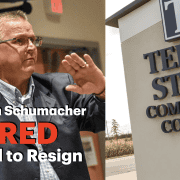
On April 2, 2026, the Terra State Community College Board of Trustees accepted Schumacher’s resignation during a special session, effective immediately. Sources familiar with the situation indicate the resignation was not voluntary in any meaningful sense — Schumacher was pushed out as the board moved swiftly to contain the damage after state intervention became unavoidable.
A Crisis Years in the Making
The financial troubles at Terra State did not emerge overnight. According to the Ohio Auditor of State, auditors reviewed the college’s finances covering the period from July 1, 2023 through June 30, 2024, and found that the institution had failed to submit payroll withholdings to the Regional Income Tax Agency (RITA) over a four-month period in 2023 — a basic and fundamental obligation of any employer. The college also had delinquent sales tax payments to the Ohio Department of Taxation stretching across 2022, 2023, and 2024. These were not isolated mistakes. They were a pattern.
The auditor issued a finding for recovery of $22,255.46 against two former college financial officers — former Chief Financial Officer Mary Johnson and former Vice President of Finance Jacqueline Foos — whose failures directly caused the penalties and interest the college was forced to absorb. The auditor’s report was unambiguous: the penalties “would have been avoided had the employer payroll withholding submissions been submitted by the required due dates”.
Schumacher Deflected and Minimized
Rather than acknowledge the severity of the problem when the Ohio Auditor of State recommended the college for fiscal watch on March 17, 2026, Schumacher publicly downplayed the designation. He told reporters the college had been expecting only a lesser “fiscal caution” designation, calling the fiscal watch “truly a surprise”. He attributed the financial chaos to high turnover in the finance office, noting the college had cycled through four financial officers in recent years.
But critics point out that Schumacher, as president, was ultimately responsible for the stability of that finance department — and that persistent turnover, missed deadlines, and delinquent tax payments are exactly the type of systemic failures that a college president is duty-bound to identify and correct. Instead, by his own admission, the college had “missed some deadlines and had a few late payments” going back to at least 2022.
The Ohio Department of Higher Education officially notified the college of its fiscal watch status on March 23, 2026 — the same day the Auditor’s findings against the two former finance officials were published. Less than two weeks later, Schumacher was gone.
The Board Acts
The Board of Trustees moved decisively once state pressure reached a critical point. In its official press release, the board announced the appointment of Dr. Cory Stine, Senior Vice President for Innovation and Strategic Planning, as Interim President. The board outlined a sweeping financial remediation plan requiring the college to develop a formal recovery strategy under review by the Ohio Department of Higher Education, with a mandate to resolve all deficiencies within a three-year window.
The plan also calls for a full systems audit to align the college’s accounting procedures with state compliance standards, and mandates a frequent, mandatory review cycle of all college finances — a direct response to the lax oversight that allowed the problems to fester under Schumacher’s tenure.
What Comes Next
Interim President Cory Stine now faces the unenviable task of stabilizing an institution under a state fiscal watch clock that is already ticking. The Board is scheduled to hold its next regular meeting on April 22, 2026, where the specifics of the financial recovery plan are expected to be further formalized.
Terra State, which serves approximately 2,000 students through its College Credit Plus program alone and fields 12 athletic teams, remains open and fully operational. But the institutional credibility lost during years of financial neglect will take far longer to repair than any three-year recovery plan can address.
The central question that the board, state officials, and the community of Fremont, Ohio now face is a straightforward one: how did a public institution entrusted with taxpayer dollars reach this point — and why did it take state auditors to force accountability that should have come from within?
Sources: Ohio Auditor of State, Terra State Community College official press release, Fremont News-Messenger, WTOL11, Yahoo News