
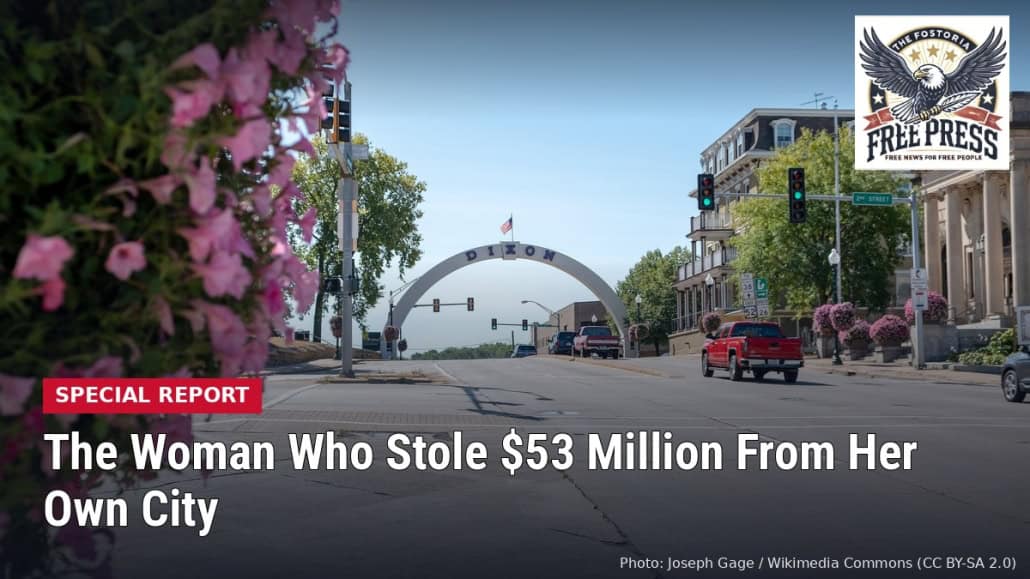
DIXON, ILL. | The Woman Who Stole $53 Million From Her Own City and Got Away With It for Two Decades
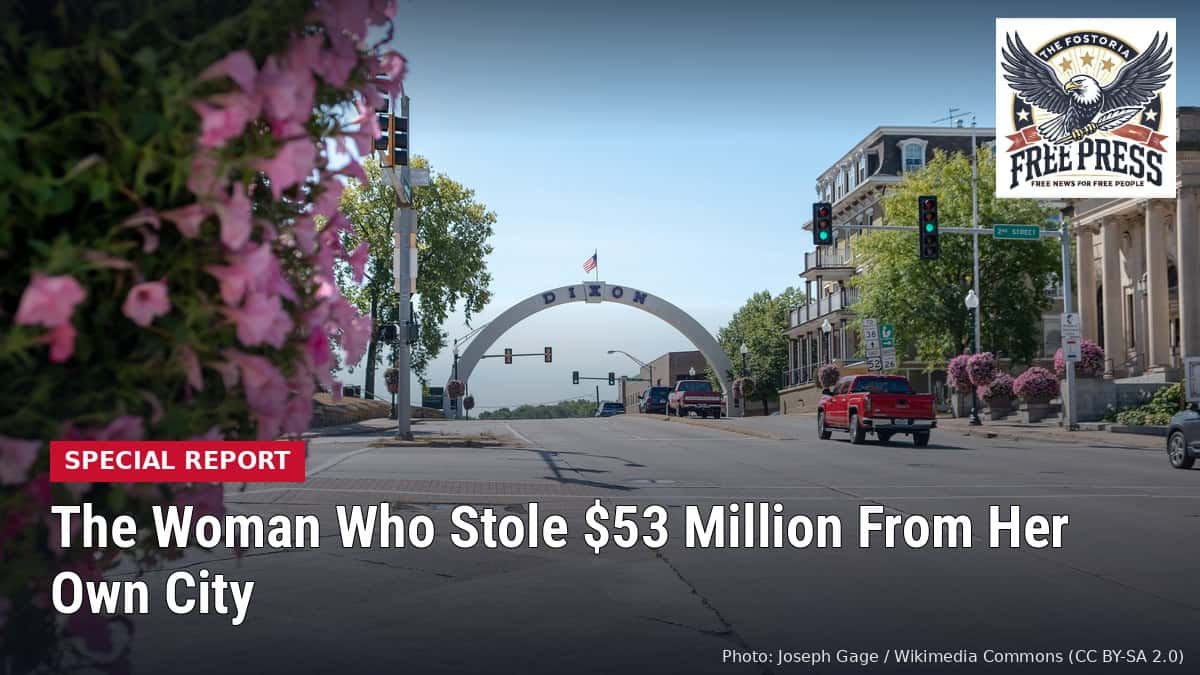
Galena Avenue and the Dixon arch in downtown Dixon, Ill. (file photo). Photo: Joseph Gage from USA, CC BY-SA 2.0, via Wikimedia Commons (https://commons.wikimedia.org/wiki/File:Dixon_Arch_Past_the_Pink_Flowers_(50310003216).jpg). Overlay added by FFP; this adapted image is shared under the same CC BY-SA 2.0 license.
For more than two decades, the woman who kept the books in Dixon, Ill., was stealing the city blind, and almost nobody noticed.
Rita A. Crundwell, Dixon’s comptroller and treasurer, took $53,740,394 from the city between December 1990 and her arrest in April 2012, according to federal prosecutors. She ran the money through a secret bank account, covered it with fake state invoices, and spent it on one of the most decorated quarter horse operations in the country. Meanwhile, she sat in budget meetings and told city leaders that money was tight because of the economy and because the State of Illinois was behind on its payments.
It is believed to be the largest theft of public funds in Illinois history, the U.S. Attorney’s Office for the Northern District of Illinois said. Dixon officials and many news outlets have called it the largest municipal embezzlement in U.S. history. Crundwell pleaded guilty to federal wire fraud in 2012 and was sentenced in 2013 to 19 years and 7 months in prison. She was released to community confinement in 2021, and President Joe Biden commuted her sentence in December 2024.
Her case is a small-town story with a global lesson. Fraud by trusted insiders costs organizations around the world billions of dollars every year, and the controls that would have caught Crundwell early are simple and well known. Here is the full story, from the first stolen dollar to today.
Who she was
Dixon sits on the Rock River about 100 miles west of Chicago and had about 15,733 residents at the time of the case, federal prosecutors said. It is best known as the boyhood home of President Ronald Reagan.
Crundwell began working in Dixon’s finance department in 1970 while she was still in high school, according to her plea and sentencing documents. She was appointed comptroller and treasurer in 1983 and handled all of the city’s finances from then until her arrest. Her salary was $80,000 a year at the end.
Under Dixon’s old commission form of government, executive authority rested with the City Council and four elected commissioners who oversaw finance, health and safety, public property and streets, and department heads reported to individual elected officials. City officials later said Crundwell’s isolation in the finance department was the key factor that kept her fraud hidden, Northern Public Radio reported.
The secret account and the fake invoices
On Dec. 18, 1990, Crundwell opened a bank account in the name of the City of Dixon that she alone controlled, prosecutors said. It was called “RSCDA – Reserve Fund.” The initials stood for “Reserve Sewer Capital Development Account,” but no such city account really existed, and she never told anyone about it. Checks written on the account listed the holder as “R.S.C.D.A., C/O Rita Crundwell,” according to the FBI’s criminal complaint.
She began moving city money into it in January 1991. The method was simple:
- She shifted money from Dixon’s money market account and other city accounts into the city’s Capital Development Fund account.
- She wrote checks from the Capital Development Fund payable to “Treasurer” and deposited them into the secret RSCDA account.
- She then spent the money on her horse business, personal credit card bills, real estate and vehicles.
To make the transfers look legitimate to auditors, she created 159 fictitious invoices that appeared to come from the State of Illinois, prosecutors said. One example from her plea agreement: On Sept. 8, 2009, she wrote two city checks for $150,000 and $200,000, deposited them into the Capital Development Fund, and the same day wrote a $350,000 check to “Treasurer” that went into the secret account. A fake invoice claimed the $350,000 paid the state for a Dixon sewer project the state had completed. That same afternoon she moved $225,000 from the secret account into her personal RC Quarter Horses account to cover a check she had already written for a quarter horse. Without the city money, prosecutors said, the check would not have cleared.
She took more than $181,000 in 1991. The yearly total kept growing, peaking at $5.8 million in 2008, and she took an average of more than $2.5 million a year over the scheme, according to the Justice Department. At sentencing, prosecutors also presented evidence that she stole at least $25,000 from a separate city account for Dixon’s Sister City program between 1988 and 1990, before the charged scheme began.
How she hid it in plain sight
Crundwell’s cover story was the city’s own money troubles. While she was taking millions, she took part in budget meetings with council members and department heads and repeatedly blamed the city’s shortfalls on a weak economy and on the state being late with its payments, prosecutors said. The cuts that followed had “a significant impact on city operations,” the Justice Department said.
At her sentencing hearing, several Dixon officials, including the police chief and a city commissioner, testified that the theft crippled the city’s budget. Michael Stichter told the court that Crundwell rejected his request to replace rusted trucks, citing a lack of funds, BBC News reported, citing NBC Chicago.
She also controlled the paper trail. Crundwell picked up the city’s mail herself, including the bank statements for the secret account, so no one else would see them, according to the plea agreement. When she was away, she asked a relative or other city employees to collect the mail and set aside anything addressed to her, including those statements.
Why the audits missed it
Dixon’s books were reviewed every year by outside accountants. CliftonLarsonAllen (formerly Clifton Gunderson) was the city’s auditor until 2005, and Janis Card and Associates of Sterling, Ill., handled the audits from 2005 until Crundwell’s arrest, Shaw Local reported. None of them caught the theft.
Dixon sued the two accounting firms, CPA Samuel S. Card, and Fifth Third Bank, which handled the city’s checking accounts, in Lee County, seeking $53 million in damages for negligence. Court documents described by Shaw Local included deposition statements from two Clifton employees who worked on Dixon’s account saying the firm did not verify the projects Crundwell created with fake Illinois Department of Transportation invoices. The city’s lawsuit also pointed to red flags such as invoices missing the state emblem or proper contact information. The city accused Fifth Third of letting Crundwell withdraw more than $48,000 directly from the Capital Development Fund and of not accounting for the secret account when auditors asked for a list of all city accounts.
The case never went to trial. In September 2013, after a 17-hour negotiating session in Chicago with 37 participants, including insurers, the parties reached a $40 million settlement, which the Dixon City Council approved on Sept. 25, 2013. Shaw Local reported the shares as $35.15 million from CliftonLarsonAllen, $3.85 million from Fifth Third Bank and $1 million from Janis Card and Associates. Some outlets reported slightly different splits. About $10.35 million of the settlement went to the city’s attorneys. A Fifth Third spokesman said the bank settled without admitting liability, and NBC Chicago later reported that none of the companies admitted wrongdoing.
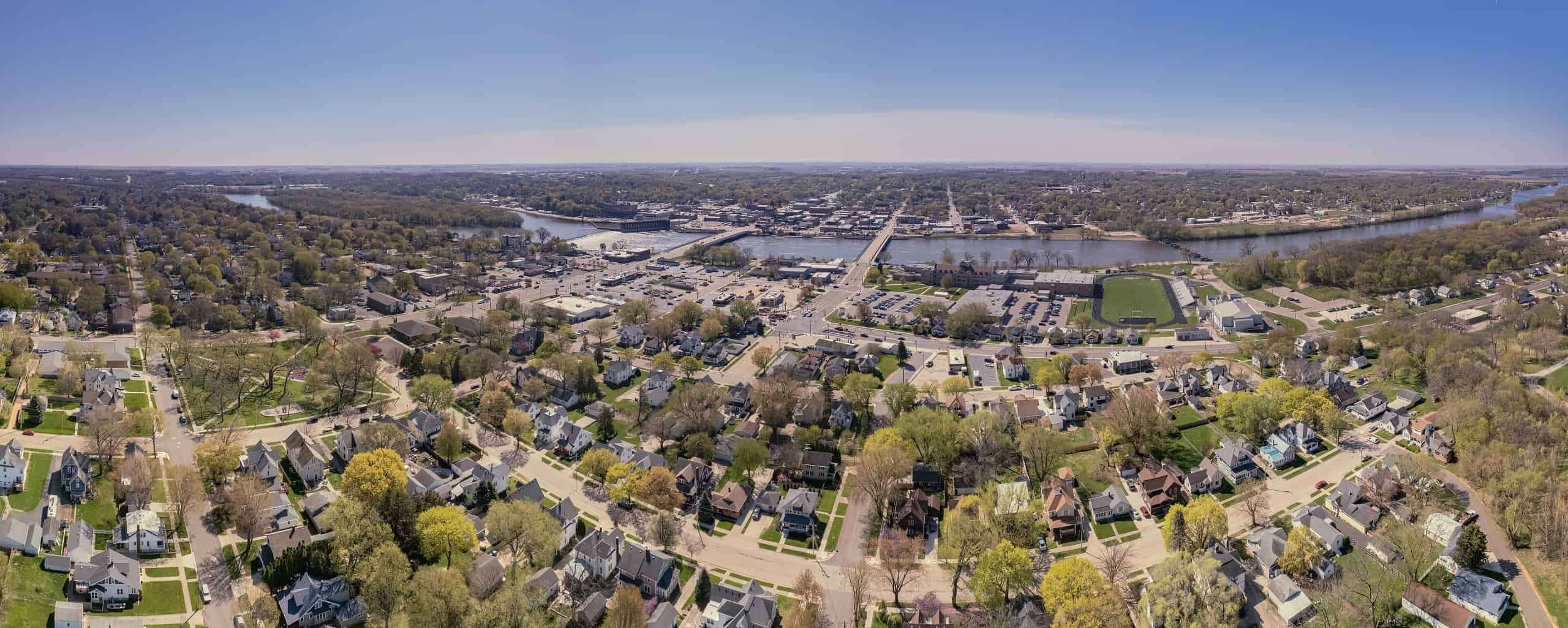
An aerial view of Dixon, Ill., a city of about 15,700 people on the Rock River (file photo). Photo: Stevedrone91, CC BY-SA 4.0, via Wikimedia Commons (https://commons.wikimedia.org/wiki/File:Dixon_Panorama-2.jpg).
The quarter horse empire
Crundwell owned RC Quarter Horses LLC and kept her horses at her ranch on Red Brick Road in Dixon, at the Meri-J Ranch in Beloit, Wis., and with trainers around the country, prosecutors said. Her horses were not hobby animals. At the time of her arrest, she had been the leading owner at the past eight American Quarter Horse Association World Shows, based on points, and at the 2011 show in Oklahoma City she entered 19 horses and won nine world championship titles, Quarter Horse News reported. BBC News reported her operation produced 52 AQHA world champions.
The FBI’s complaint listed some of what the city’s money bought, including a 2009 Liberty Coach motor home for $2,108,000, a 2009 Kenworth tractor truck for $146,787, a 2009 Freightliner truck for $140,000, and a 2009 Featherlite horse trailer for $258,698. From January 2007 to March 2012, she charged more than $2.5 million on her personal American Express card, including more than $339,000 on jewelry, and paid the whole bill with Dixon funds, the complaint said.
Assets later seized or restrained included her two residences and horse farm in Dixon, a home in Englewood, Fla., 80 acres of vacant land in Lee County, more than four dozen trucks, trailers and other farm vehicles, a 2005 Ford Thunderbird convertible, a 1967 Chevrolet Corvette roadster, a pontoon boat, jewelry and about $224,898 in cash, according to the Justice Department.
“While the city was suffering, the defendant was living her dreams,” Assistant U.S. Attorney Joseph Pedersen told the judge at sentencing.
How Kathe Swanson found it
The scheme came apart because Crundwell took a long vacation. She got four weeks of paid vacation a year and took an additional 12 weeks unpaid in 2011, according to the FBI complaint. In October 2011, City Clerk Kathe Swanson filled in for her and requested all of the city’s bank statements so she could prepare the monthly treasurer’s report.
One statement, from Fifth Third Bank for September 2011, did not match anything Swanson knew about. It showed three deposits totaling $785,000, 84 checks totaling $360,493 and 40 withdrawals totaling $266,605, the complaint said. She took it to Mayor Jim Burke, who did not know the account existed.
“I’ve looked at everything. I can’t tie this bank statement into anything that we’re doing,” Swanson told the mayor, as Burke recalled the conversation to the Dixon Telegraph in April 2012.
Burke went to the FBI in Rockford and met with Special Agent Patrick Garry at 2:30 p.m. on Nov. 18, 2011. “I laid the bank statement down in front of him,” Burke told the newspaper. “At that point, I literally got sick to my stomach.” He told Swanson to say nothing to anyone.
For the next five months, the FBI quietly followed the money while Crundwell kept working. Between September 2011 and March 2012 alone, she moved $3,558,000 in city money into the secret account and spent more than $3.2 million of it on herself, including about $450,000 on her horse operations, $600,000 in credit card payments, and $67,000 for a 2012 Chevrolet Silverado pickup, according to the complaint. During that time, the City Council was holding budget workshops and debating cuts and fee increases. “I thought, this is almost surreal,” Burke said.
The arrest
On the morning of Tuesday, April 17, 2012, Burke set up a fake 9:15 a.m. meeting with Crundwell so FBI agents could be sure she was at City Hall, he later said. Agents arrested her that day. They also searched her home, office and farms in Dixon and Beloit and seized the contents of two bank accounts, along with trucks, trailers, the motor home and a Thunderbird convertible, the U.S. Attorney’s Office announced.
The first complaint charged one count of wire fraud and alleged she had taken more than $30 million since 2006. As agents dug further back, the total grew. On May 1, 2012, a federal grand jury indictment charged her with a $53 million fraud dating to 1990. The city fired her.
Lee County prosecutors separately filed 60 state felony theft charges. They dropped those charges in 2013 after the federal sentence, because under Illinois law any state sentence would have run at the same time as her federal term, NBC Chicago and WQAD reported.
Guilty plea and sentence
On Nov. 14, 2012, Crundwell pleaded guilty in federal court in Rockford to one count of wire fraud and agreed, as part of her plea deal, that she had also engaged in money laundering, according to the Justice Department. She agreed she owed Dixon $53,740,394 in restitution.
On Feb. 14, 2013, Senior U.S. District Judge Philip G. Reinhard sentenced her to 235 months, or 19 years and 7 months, in federal prison, close to the 20-year maximum. She was taken into custody that day. Crundwell, then 60, apologized to Dixon residents at the hearing, BBC News reported.
“This has been a massive stealing of public money – monies entrusted to you as a public guardian of Dixon, Ill.,” Reinhard said. He added that she showed “greater passion for the welfare of her horses than the people of Dixon who she represented.”
The judge went above the sentencing guidelines, finding that she had also caused a loss of public confidence in local government and a disruption that struck “at the very heart of Dixon’s abilities to provide essentials for its citizenry.” He ordered $53,740,394 in restitution and a forfeiture judgment for the same amount. Under federal rules she had to serve at least 85 percent of the sentence, and there is no parole in the federal system.
Crundwell appealed the sentence. The 7th U.S. Circuit Court of Appeals upheld it on Nov. 15, 2013.
Selling off the horses: what the U.S. Marshals recovered
After her arrest, Crundwell agreed to let the government sell what she had bought with the stolen money. The U.S. Marshals Service took custody of roughly 400 horses and hired Professional Auction Services to sell them.
- Online horse sale (ended Sept. 12, 2012): 80 horses for $1,641,200.
- Live auction at her Dixon ranch (Sept. 23-24, 2012): horses for $3,797,300, plus $892,945 in tack and equipment and $98,500 in frozen horse semen. More than 1,000 registered bidders paid $250 each for the chance to bid. A champion stallion, Good I Will Be, sold for $775,000.
- Luxury motor home (online, ended Sept. 25, 2012): $800,000.
Those sales totaled about $7.23 million, according to Marshals Service figures reported by GoHorseShow and The Horse. By sentencing in February 2013, the Marshals had recovered more than $12.38 million from horses, vehicles, trailers, tack, the motor home, jewelry and personal belongings, with sales of real estate in Illinois and Florida still pending, the Justice Department said. The net proceeds at that point, nearly $9.5 million, were held in escrow for Dixon.
Dixon received $10.3 million from the federal government’s sale of her seized assets, plus about $150,000 from online sales of her remaining possessions that wrapped up in 2016 and a small amount of horse breeding royalties, Shaw Local reported in 2022. Counting the $40 million settlement, minus legal fees, the city’s recovery fund came to about $40 million. Shaw Local reported that roughly $43 million of Crundwell’s restitution still remained unpaid in 2022.
Released early, then clemency
Crundwell’s projected release date was Oct. 20, 2029. In April 2020, she asked a federal judge for early release, citing her health and the COVID-19 pandemic, but she withdrew the request in May 2020 after the Dixon City Council wrote to the prison warden opposing it, KWQC reported.
On Aug. 4, 2021, the federal Bureau of Prisons transferred her from the Federal Correctional Institution in Pekin, Ill., to community confinement, meaning home confinement or a halfway house, under its Chicago Residential Reentry Management office. She had served about eight and a half years. City Manager Danny Langloss said the prison told the city she had been released but could not say why.
On Dec. 12, 2024, President Joe Biden commuted the sentences of 1,499 people who had been moved to home confinement during the pandemic, and Crundwell was one of them. Bureau of Prisons records showed she was no longer in custody as of Friday, Dec. 20, 2024, CBS News Chicago reported. A commutation shortens or ends a sentence but does not erase a conviction. It can also lift financial penalties such as restitution, and NBC Chicago reported that it was unclear whether her restitution was affected.
Dixon officials were furious. “This is a complete travesty of justice and a slap in the face for our entire community,” the city said in a statement from Langloss. Jason Wojdylo, a former U.S. Marshals Service official who spent four years tracking down her assets and was chief inspector of the agency’s asset forfeiture division at the time of the auctions, told CBS News Chicago, “This official act undid decades of work.”
All the Queen’s Horses
The case drew national attention again through the 2017 documentary “All the Queen’s Horses,” directed and produced by Kelly Richmond Pope, a CPA and DePaul University accounting professor, as a co-production of Chicago’s Kartemquin Films and her company, Helios Digital Learning. The 70-minute film looks at how Crundwell did it, how she got away with it for so long, how she was caught, and “how if it happened in Dixon, it could happen anywhere,” the filmmakers say. It premiered on video-on-demand platforms in April 2018, streamed on Netflix from July 10, 2018, to July 10, 2019, and won festival honors including at the 2018 Beloit International Film Festival. Pope has said she screened the film for more than 4,000 Dixon residents to help the community heal.
Dixon today
Dixon rebuilt its government. In November 2014, more than 70 percent of voters approved switching from the commission form to a council-manager system, with one professional manager reporting to an elected council. The city revamped its finance department, Langloss told Shaw Local in 2022: “We have the best internal controls possible.”
Then-City Manager Cole O’Donnell described the goal to Northern Public Radio in 2016 as a system where “one hand is checking what the other hand is doing, so that one person isn’t handling all the finances. One person may make the deposit, one person records it, one person balances the checkbook.”
The recovered money went first to the city’s debts. Finance Director Paula Meyer used it to pay off $21,250,401 in general obligation debt and money borrowed from restricted city funds, and set up a $5 million rainy-day fund and a $3 million emergency capital fund, Shaw Local reported. Later spending included about $4.07 million for the River Street revitalization project and about $1.1 million for the public library.
In April 2026, the City Council unanimously approved its fiscal 2027 budget. “The big thing is we’re in the black,” Langloss told Shaw Local. New businesses at the Gateway development near Interstate 88 are adding sales and hotel tax revenue, he said.
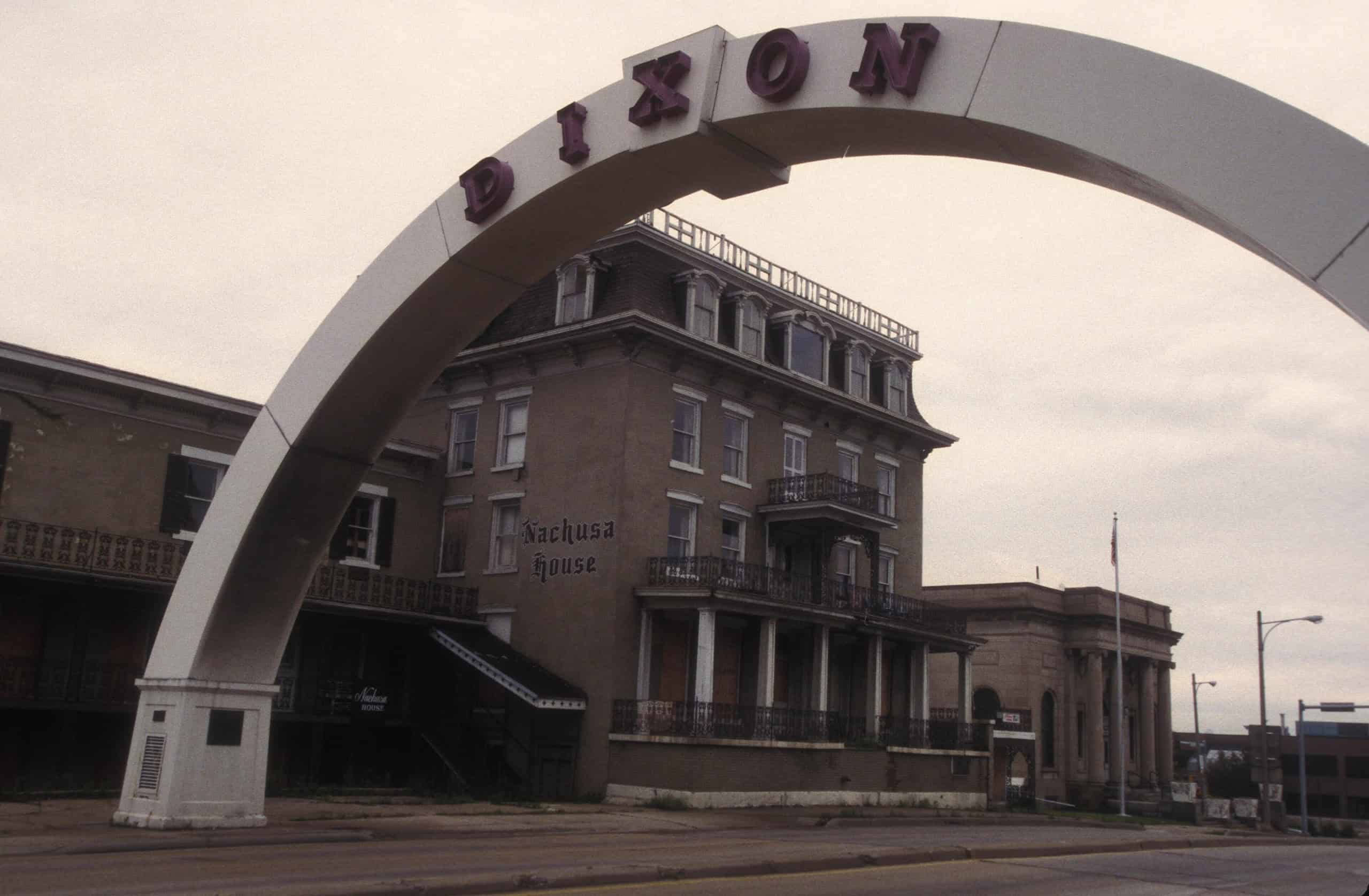
The Dixon arch on Galena Avenue, with the historic Nachusa House in the background (file photo). Photo: Jerrye and Roy Klotz MD, CC BY-SA 3.0, via Wikimedia Commons (https://commons.wikimedia.org/wiki/File:DIXON_DOWNTOWN_HISTORIC_DISTRICT.jpg).
The global problem: fraud by trusted insiders
Crundwell’s crime is an extreme case of what fraud examiners call occupational fraud: an employee or official using their job to steal from the organization they work for. It happens in every country and every kind of organization.
The Association of Certified Fraud Examiners’ “Occupational Fraud 2026: A Report to the Nations”, released in 2026, studied 2,402 cases investigated by fraud examiners in 143 countries and territories. Among its findings:
- The cases caused more than $3.4 billion in losses, with a median loss of $104,000 per case and an average of about $1.46 million.
- Fraud examiners surveyed estimate organizations lose 5 percent of their revenue to fraud each year.
- Asset misappropriation, stealing or misusing an organization’s resources as Crundwell did, appeared in 90 percent of cases.
- The typical scheme ran 12 months before it was caught. Schemes caught within six months had a median loss of $40,000, while those that lasted more than five years had a median loss of more than $1.1 million. Crundwell’s lasted more than 21 years.
- Government and public administration accounted for 217 cases with a median loss of $100,000. Local governments, like Dixon, had a median loss of $79,000.
- Tips were the most common way fraud was detected, in 43 percent of cases, and more than half of those tips came from employees.
- A lack of internal controls was the top weakness, cited in 33 percent of cases, followed by override of existing controls (19 percent) and lack of management review (18 percent).
The Dixon case fits one of the report’s findings closely. Crundwell was caught only because someone else did her job while she was gone. Yet job rotation and mandatory vacation policies were in place at only 27 percent of the victim organizations in the ACFE study, and organizations that had them saw median losses of $65,000, compared with $128,000 for those that did not. Among organizations with fewer than 100 employees, only 8 percent had such a policy.
The problem reaches the federal level as well. The U.S. Government Accountability Office estimated in 2024 that the federal government loses between $233 billion and $521 billion a year to fraud, based on data from fiscal years 2018 through 2022.
The lesson: no one person should hold all the keys
Auditors call the most basic safeguard segregation of duties. GAO’s Standards for Internal Control in the Federal Government, known as the Green Book and updated in 2025, tells managers to separate incompatible duties, such as authorizing transactions, handling the money and keeping the records, so one person cannot both commit and hide an error or fraud. Where a small office cannot split the jobs, the standards call for other controls to make up for it.
In Dixon, one person opened the accounts, moved the money, kept the books, prepared the documents the auditors saw and picked up the bank statements. Common safeguards drawn from the Dixon case and internal-control guidance include:
- Split the jobs of approving payments, writing checks, recording transactions and reconciling bank statements among different people.
- Have bank statements go directly to someone other than the person who handles the money, and have elected officials review them.
- Keep a complete list of every account in the government’s name, and have auditors confirm it directly with the banks.
- Require finance staff to take real vacations, and have someone else do their work while they are out.
- Check that payments to “the state” or any outside agency match real projects and real invoices.
- Give employees and residents an easy, safe way to report concerns.
How Ohio protects its small towns
Ohio handles local government audits differently from Illinois. In Ohio, the Auditor of State is the constitutional officer responsible for auditing all public offices, including more than 5,900 local governments, agencies and organizations such as cities, villages, schools, counties, townships, fire districts and libraries, according to the Auditor of State. Some of those audits are performed by independent accounting firms working under the office.
Under Ohio Revised Code 117.11, the auditor must audit each public office at least once every two fiscal years, and every year for those covered by the federal Single Audit Act. Each audit looks at “the methods, accuracy, and legality” of the office’s accounts and records. The office says it releases about 4,000 financial audits a year, and residents can look up their own local government’s audit reports through its online audit search.
When fraud is suspected, the office’s Special Investigations Unit combines forensic accountants, fraud investigators and attorneys. Tips are reviewed by a Special Audit Task Force, and cases of probable fraud or theft can lead to a special audit, subpoenas for bank records and referral to county or federal prosecutors. Since Auditor Keith Faber took office in January 2019, the unit has secured 172 convictions on 390 charges, with $29,582,159 in findings for recovery, the office’s website says.
Ohio law also sets reporting duties. State agency officials and employees must report alleged fraud, theft in office or misuse of public money to the state inspector general, and all other state employees and elected officials are to report such concerns through the Auditor of State’s fraud-reporting system, the office says.
How to report suspected fraud in Ohio
Any public employee or private citizen can report suspected fraud in an Ohio government at any time, the Auditor of State says:
- Phone: 866-FRAUD-OH (866-372-8364)
- Email: [email protected]
- Online: the complaint form on the Auditor of State’s Reporting Fraud page
- Mail: Ohio Auditor of State, 65 East State Street, P.O. Box 1140, Columbus, OH 43215
The office notes that complaint forms and letters may become public records under Ohio law, and it asks people to mail, not email, any sensitive personal information.
In Dixon, it took one clerk who asked for every bank statement and refused to ignore the one that did not add up. “Unfortunately, this case serves as a painful lesson that trust, without verification, can lead to betrayal,” then-U.S. Attorney Gary S. Shapiro said when Crundwell was sentenced.
Sources
U.S. Attorney’s Office, Northern District of Illinois: Former Dixon Comptroller Rita Crundwell Sentenced to Nearly 20 Years in Federal Prison for $53.7 Million Theft From City (Feb. 14, 2013) – https://www.justice.gov/usao-ndil/pr/former-dixon-comptroller-rita-crundwell-sentenced-nearly-20-years-federal-prison-537
U.S. Attorney’s Office, Northern District of Illinois: Former Dixon Comptroller Rita Crundwell Pleads Guilty to Federal Fraud Charge, Admits Stealing $53 Million From City (Nov. 14, 2012) – https://www.justice.gov/archive/usao/iln/rockford/2012/pr1114_01.pdf
U.S. Attorney’s Office, Northern District of Illinois: Dixon Comptroller Arrested on Federal Charge for Allegedly Misappropriating Millions of Dollars in City Funds for Own Use (April 17, 2012) – https://www.justice.gov/archive/usao/iln/rockford/2012/pr0417_01.pdf
U.S. Attorney’s Office, Northern District of Illinois: Federal Indictment Charges Former Dixon Comptroller Rita Crundwell With Engaging in $53 Million Fraud Since 1990 (May 1, 2012) – https://www.justice.gov/archive/usao/iln/rockford/2012/pr0501_01.pdf
U.S. Court of Appeals for the Seventh Circuit: United States v. Crundwell, No. 13-1407 (Nov. 15, 2013) – https://law.justia.com/cases/federal/appellate-courts/ca7/13-1407/13-1407-2013-11-15.html
Shaw Local/Dixon Telegraph: ‘This is almost surreal,’ mayor says (April 26, 2012) – https://www.shawlocal.com/2012/04/25/this-is-almost-surreal/aomx3ua/
Shaw Local/Dixon Telegraph: Dixon to recoup $40 million (Sept. 25, 2013) – https://www.shawlocal.com/2013/09/25/dixon-to-recoup-40-million/ak4kkcj/
Shaw Local: Dixon settles with auditors, bank for $40 million (Sept. 25, 2013) – https://www.shawlocal.com/2013/09/25/dixon-settles-with-auditors-bank-for-40-million/agzuozw/
CBS News Chicago/AP: Dixon OKs $40M settlement with auditors who missed massive embezzlement (Sept. 2013) – https://www.cbsnews.com/chicago/news/dixon-oks-40m-settlement-with-auditors-who-missed-massive-embezzlement/
Shaw Local/Sauk Valley: Life after Rita: Dixon officials reflect on city transformation 10 years after Crundwell arrest (April 16, 2022) – https://www.shawlocal.com/sauk-valley/news/government/2022/04/16/life-after-rita-officials-reflect-on-dixons-transformation-10-years-after-crundwell-arrest/
Shaw Local/Sauk Valley: Dixon council OKs fiscal 2027 budget (April 23, 2026) – https://www.shawlocal.com/sauk-valley/2026/04/23/dixon-council-oks-fiscal-2027-budget-new-businesses-near-i-88-boosting-sales-hotel-tax-revenue/
BBC News: Rita Crundwell jailed for $53m theft from Dixon, Illinois (Feb. 14, 2013) – https://www.bbc.com/news/world-us-canada-21465390
Quarter Horse News: Prominent Quarter Horse Breeder Released Early From Prison (Aug. 5, 2021) – https://www.quarterhorsenews.com/2021/08/prominent-horse-breeder-released-early-from-prison/
GoHorseShow: Complete Results from Crundwell Auctions (Oct. 2012) – https://gohorseshow.com/2012/10/update-complete-results-from-crundwell-auctions-top-7-2m/
The Horse: Crundwell Horses, Equipment Fetch More Than $4 Million (Sept. 2012) – https://thehorse.com/118249/crundwell-horses-equipment-fetch-more-than-4-million/
NBC Chicago: Remaining Charges Dropped Against Ex-Dixon Comptroller (2013) – https://www.nbcchicago.com/news/local/remaining-charges-dropped-against-ex-dixon-comptroller/1950857/
WQAD: Charges dropped against Rita Crundwell (2013) – https://www.wqad.com/article/news/crime/charges-dropped-against-rita-crundwell/526-f81884d0-bfc4-4a3b-a2f1-4ef9adf95b7c
KWQC: Former Dixon comptroller Rita Crundwell released from prison early (Aug. 4, 2021) – https://www.kwqc.com/2021/08/05/former-dixon-comptroller-rita-crundwell-released-prison-early/
CBS News Chicago: President Biden commutes sentence for former Dixon, Ill. Comptroller Rita Crundwell (Dec. 12, 2024) – https://www.cbsnews.com/chicago/news/president-biden-commutes-sentence-dixon-comptroller-rita-crundwell/
CBS News Chicago: Former Dixon, Ill. comptroller Rita Crundwell released from custody (Dec. 21, 2024) – https://www.cbsnews.com/chicago/news/disgraced-former-dixon-ill-comptroller-rita-crundwell-released-from-custody-after-getting-clemency-from-president-biden/
NBC Chicago: Rita Crundwell commutation sparks angry reactions from Dixon residents (Dec. 2024) – https://www.nbcchicago.com/news/local/chicago-politics/rita-crundwell-commutation-draws-angry-reactions-from-dixon-officials/3623394/
Northern Public Radio (WNIJ): To Avoid Another Crundwell, Dixon Changes Government (April 25, 2016) – https://www.northernpublicradio.org/government/2016-04-25/to-avoid-another-crundwell-dixon-changes-government
Kartemquin Films: All the Queen’s Horses (2017) – https://kartemquin.org/film/all-the-queens-horses/
Reel Chicago: All the Queen’s Horses comes to Netflix (2018) – https://reelchicago.com/article/queens-horses-netflix-soon/
Kelly Richmond Pope: Goodbye Netflix. Hello World. (July 10, 2019) – https://blogs.depaul.edu/kpope2/2019/07/10/goodbye-netflix-hello-world/
Association of Certified Fraud Examiners: Occupational Fraud 2026: A Report to the Nations (full report) – https://cms.acfe.com/-/media/files/acfe/pdfs/rttn/2026/2026-report-to-the-nations.pdf
Association of Certified Fraud Examiners: Key Findings from Occupational Fraud 2026: A Report to the Nations (May 2026) – https://www.acfe.com/acfe-insights-blog/blog-detail?s=key-findings-report-to-the-nations-2026
U.S. Government Accountability Office: Fraud Risk Management, GAO-24-105833 (April 2024) – https://www.gao.gov/products/gao-24-105833
U.S. Government Accountability Office: Standards for Internal Control in the Federal Government, GAO-25-107721 (May 2025) – https://www.gao.gov/products/gao-25-107721
Ohio Auditor of State: Financial Audits – https://www.ohioauditor.gov/financial.html
Ohio Auditor of State: Special Investigations Unit – https://www.ohioauditor.gov/fraud/
Ohio Auditor of State: Reporting Fraud – https://ohioauditor.gov/fraud/report-fraud.html
Ohio Revised Code Section 117.11 – https://codes.ohio.gov/ohio-revised-code/section-117.11
Photo credits: Photo: Joseph Gage from USA, CC BY-SA 2.0, via Wikimedia Commons (https://commons.wikimedia.org/wiki/File:Dixon_Arch_Past_the_Pink_Flowers_(50310003216).jpg) – https://commons.wikimedia.org/wiki/File:Dixon_Arch_Past_the_Pink_Flowers_(50310003216).jpg
Photo credits: Photo: Stevedrone91, CC BY-SA 4.0, via Wikimedia Commons (https://commons.wikimedia.org/wiki/File:Dixon_Panorama-2.jpg) – https://commons.wikimedia.org/wiki/File:Dixon_Panorama-2.jpg
Photo credits: Photo: Jerrye and Roy Klotz MD, CC BY-SA 3.0, via Wikimedia Commons (https://commons.wikimedia.org/wiki/File:DIXON_DOWNTOWN_HISTORIC_DISTRICT.jpg) – https://commons.wikimedia.org/wiki/File:DIXON_DOWNTOWN_HISTORIC_DISTRICT.jpg








Leave a Reply
Want to join the discussion?Feel free to contribute!