
FOSTORIA | Carl C. Anderson: The Underwear Maker Who Became Mayor and Congressman
Author: FFP Ai Bot
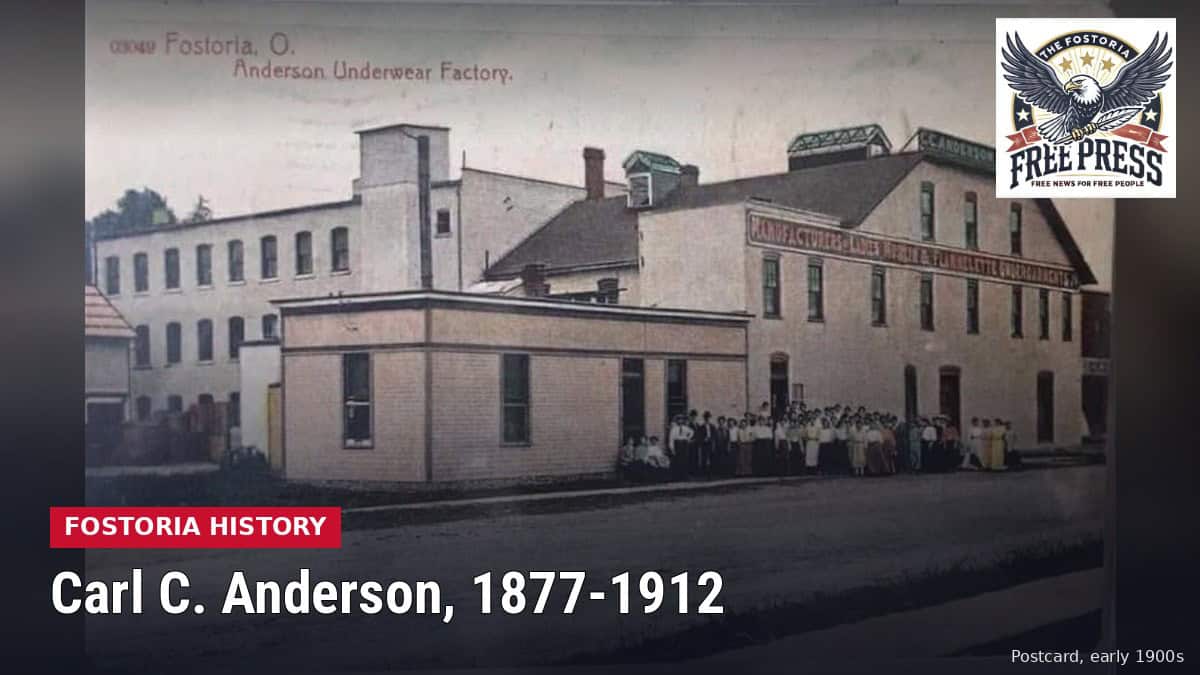
“Fostoria, O. Anderson Underwear Factory,” postcard, about 1905-1909
FOSTORIA — In the first years of the 1900s, few Fostorians rose as fast as Carl C. Anderson. He came to town as a salesman, opened a factory that employed hundreds of women, was elected mayor twice and then won two terms in Congress, all before he turned 35. On the night of Oct. 1, 1912, while campaigning for a third term, he was killed when his car overturned on a country road south of the city.
This installment of our local history series tells his story through a postcard of his factory, his official portrait and a set of photo prints from the week Fostoria said goodbye.
Quick timeline
| Year | What happened |
|---|---|
| 1877 | Carl Carey Anderson is born Dec. 2 in Bluffton, Allen County. |
| 1881 | His family moves to Fremont, where his father is the Lake Erie & Western station agent. |
| 1904 | Anderson and A. Y. Bauman form a partnership in June to make muslin underwear in Fostoria. The C. C. Anderson Mfg. Co. is incorporated that October. Anderson marries Nellie Ford in September. |
| 1905 | Anderson is elected mayor of Fostoria. The factory adds a large addition, and a second plant is built in Findlay. |
| 1907 | He is re-elected mayor. |
| 1908 | The Sanborn fire insurance map shows the C. C. Anderson Mfg. Co. at North and Wood streets. |
| 1909 | He takes his seat in Congress on March 4, representing Ohio’s 13th District as a Democrat. |
| 1912 | He is killed in an automobile accident near Fostoria on the night of Oct. 1. |
The underwear factory at North and Wood
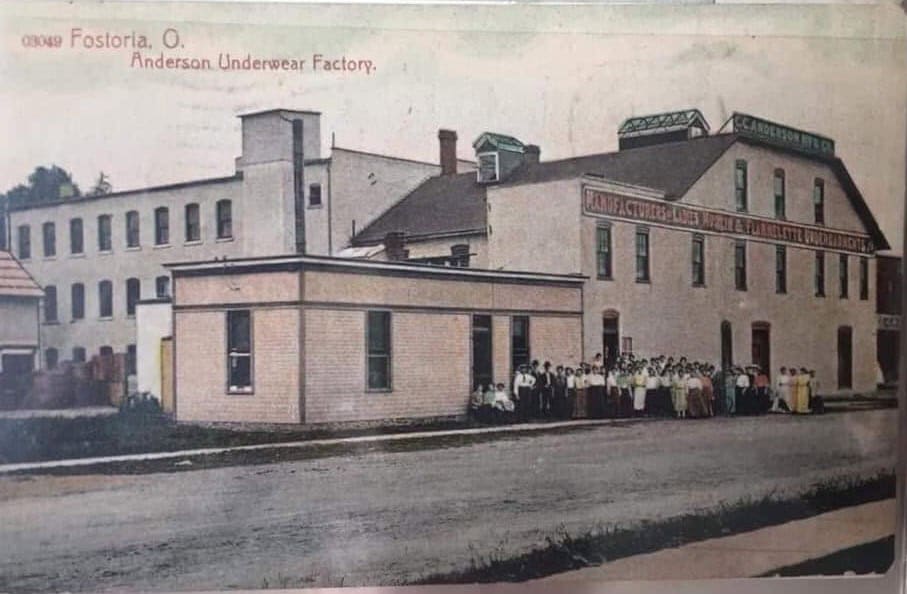
“Fostoria, O. Anderson Underwear Factory,” postcard no. 03049, about 1905-1909
The postcard at the top of this page, shown again here, is titled “Fostoria, O. Anderson Underwear Factory.” Signs on the brick building read “C. C. Anderson Mfg. Co.” and “Manufacturers of Ladies’ Muslin & Flannelette Underwear.” A long line of workers, nearly all of them women in white blouses and long skirts, stands along the front of the building.
Anderson grew up in Fremont, where his father was the Lake Erie & Western agent for 21 years, according to a 1917 biographical history of Ohio. He clerked in railroad offices, then spent five years on the road as a salesman for the A. H. Jackson Manufacturing Co., a maker of undergarments, before deciding to go into the business himself. A 1913 federal appeals court decision in the company’s later bankruptcy case says Anderson and A. Y. Bauman formed a partnership in June 1904 to make muslin underwear in Fostoria, acquiring a factory in Fostoria and moving in equipment and goods bought from a company in Saginaw, Mich. They incorporated that October with $100,000 in authorized stock.
According to a 1978 Fostoria Area Historical Society column, the plant opened in September 1904 at the corner of Wood and North streets. By 1905 it needed a large addition, and a second plant was built in Findlay. A description from the time, quoted in the column, said women were “taught how to sew and paid while they are learning,” that 300 people worked in each factory, and that the company was the largest cutter of muslin and flannelette garments in the world. The May 1908 Sanborn fire insurance map of Fostoria, held by the Library of Congress, labels the building at the southeast corner of North and Wood “The C. C. Anderson Mfg. Co., Mfrs. of Muslin & Flannelette Underwear.”
The company itself did not last long. The 1913 court decision describes how it was renamed the Fostoria Undermuslin Co. and went through bankruptcy, with debts dating to 1909. The building later housed the Allen Motor Car Co. and the A. C. Hoyt Seed Co., according to the historical society, and was torn down when the YMCA expanded. More Fostoria factories appear in our story on factories on early postcards.
Mayor and congressman
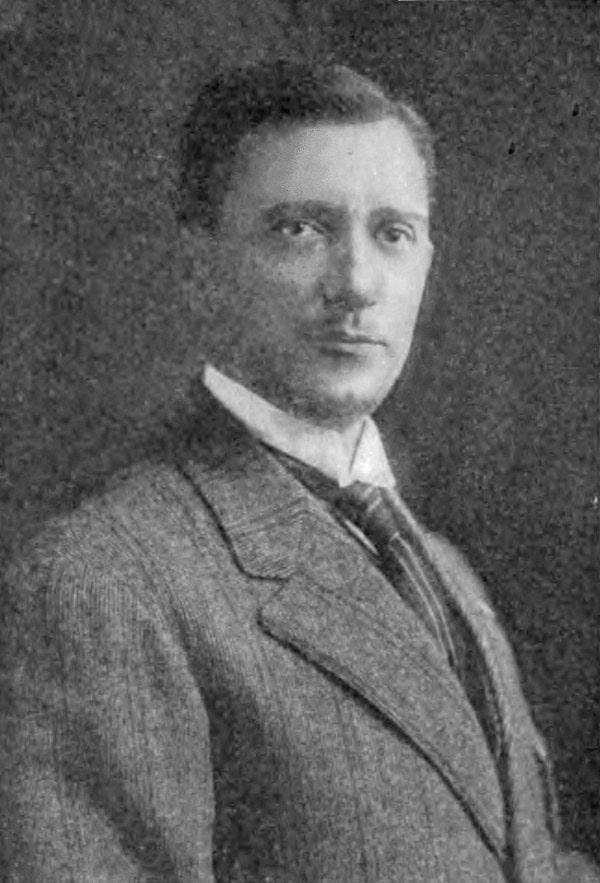
Carl C. Anderson in 1909, the year he took his seat in Congress (Harris & Ewing photo, published in National Magazine, August 1909)
Fostoria voters elected Anderson mayor in 1905 and again in 1907, each time for a two-year term, according to his official biography from the U.S. House of Representatives. He was president of the city hospital board and a director of several manufacturing companies. The historical society adds that he was president of the local Board of Trade and a director of the Seneca Wire & Manufacturing Co.
In 1908 he was elected to Congress as a Democrat from Ohio’s 13th District, and he was re-elected in 1910. He served from March 4, 1909, until his death, according to the Biographical Directory of the United States Congress. The portrait above, by the Washington studio Harris & Ewing, ran in National Magazine in August 1909, his first year in the House.
The night of Oct. 1, 1912
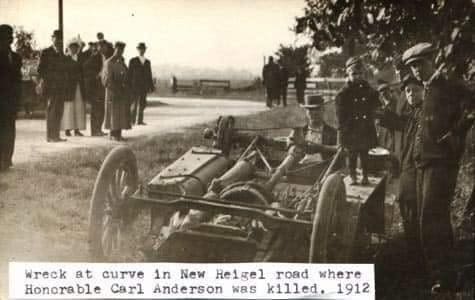
Typed label on the print: “Wreck at curve in New Heigel road where Honorable Carl Anderson was killed, 1912”
Anderson was campaigning for a third term that fall. On the night of Oct. 1, he was riding home from a Democratic campaign meeting at New Riegel with Russell Knepper of Tiffin, the party’s candidate for county prosecutor, and their driver, Paul Myers. A wire report printed in The Mahoning Dispatch of Canfield, Ohio, on Oct. 4, 1912, and preserved by the Library of Congress, said the car was traveling at high speed when it turned a corner and overturned into a ditch about two and a half miles south of Fostoria at about 10:30 p.m. Anderson was killed instantly. Knepper was seriously injured, and Myers suffered a broken arm. The news ran in papers across the country, including on the front page of The Salt Lake Tribune.
The historical society’s 1978 column, written decades later, said a tire blew out, and placed the accident at a curve about half a mile from the Fostoria-Tiffin road, now Route 18. The typed label on this print, “Wreck at curve in New Heigel road,” most likely means the New Riegel road. The photo shows men in hats and overcoats gathered around the damaged car. Anderson was 34 years old. He left his wife, three young sons, the youngest born only a month earlier, and his parents.
Fostoria says goodbye
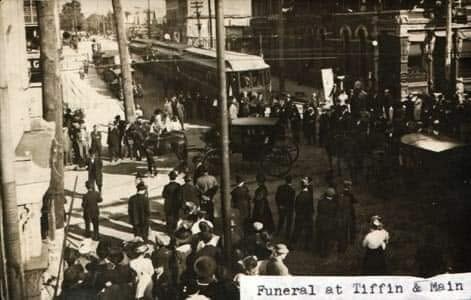
Typed label on the print: “Funeral at Tiffin & Main,” October 1912
Two more prints from the same set show the city in mourning. One, labeled “Funeral at Tiffin & Main,” shows a dense crowd filling the street at the center of downtown, with a streetcar and buggies behind them.
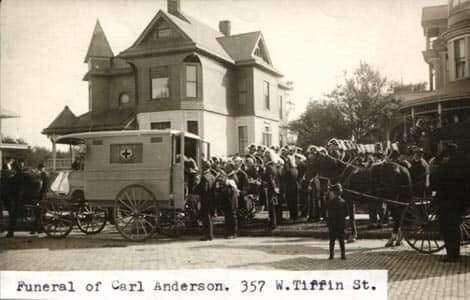
Typed label on the print: “Funeral of Carl Anderson, 357 W. Tiffin St.,” October 1912
The other, labeled “Funeral of Carl Anderson, 357 W. Tiffin St.,” shows a crowd and horse-drawn wagons in front of a large house with a corner tower. The historical society column says private services were held at the family home on West Tiffin Street, which it gives as No. 347, with the pastor of the Presbyterian church officiating, and that hundreds of people viewed his remains. We could not settle which house number is correct. He was buried in Oakwood Cemetery in Fremont, his boyhood home.
Congress later printed a volume of memorial addresses delivered in his honor in the House and Senate. A 1917 biographical history summed up how his friends saw him: “a young man of fine appearance and physique, teeming with health and abounding in enthusiasm over the coming election.”
Did your family work at the Anderson factory or remember stories about Carl Anderson? We would like to hear from you.
Photo note: Photographs and images published before 1931 are in the public domain in the United States. Historical images in this article are shared for educational and historical purposes.
Sources
- U.S. House of Representatives, History, Art & Archives, ANDERSON, Carl Carey: https://history.house.gov/People/Detail/8510
- Biographical Directory of the United States Congress, Anderson, Carl Carey (A000182): https://bioguide.congress.gov/search/bio/A000182
- The Mahoning Dispatch (Canfield, Ohio), Oct. 4, 1912, p. 8, “Auto Kills Buckeye Solon,” Library of Congress, Chronicling America: https://www.loc.gov/resource/sn84028473/1912-10-04/ed-1/?sp=8&st=text
- The Salt Lake Tribune, Oct. 2, 1912, p. 1, “Congressman Killed in Auto Accident,” Library of Congress, Chronicling America: https://www.loc.gov/resource/sn83045396/1912-10-02/ed-1/?sp=1&st=text
- Kingston Daily Freeman (Kingston, N.Y.), Oct. 2, 1912, “Congressman Killed by Auto,” Hudson River Valley Heritage: https://news.hrvh.org/veridian/?a=d&d=kingstondaily19121002.2.10
- Library of Congress, Sanborn Fire Insurance Map, Fostoria, Ohio, May 1908 (sheet 12): https://www.loc.gov/item/sanborn06698_005/
- Kiskadden v. Steinle, U.S. Court of Appeals for the Sixth Circuit (1913), In re Fostoria Undermuslin Co.: https://exa.ai/library/legal/opinion/sdd2f5520mv
- Fostoria Area Historical Society, Anderson Was Respected Industrialist (Jan. 24, 1978): https://www.fostoriamuseum.org/anderson-was-respected-industrialist/
- Fostoria Area Historical Society, Lot That Now Holds YMCA Once Was Citywide Revival Service (Dec. 16, 1982): https://www.fostoriamuseum.org/lot-that-now-holds-ymca-once-was-citywide-revival-service/
- The Political Graveyard, Politicians Killed in Automobile Accidents (Anderson entry, marriage date): https://politicalgraveyard.com/death/automobile.html
- Representative Citizens of Ohio, Memorial-Biographical (1917), Hon. Carl C. Anderson (transcription): http://www.genealogybug.net/oh_biographies/anderson.shtml
- Carl Carey Anderson (late a representative from Ohio), memorial addresses, 62d Congress, 3d session, Internet Archive: https://archive.org/details/carlcareyanderso00unit
- Wikimedia Commons, File:Carl C. Anderson 1909.jpg (Harris & Ewing; National Magazine, August 1909): https://commons.wikimedia.org/wiki/File:Carl_C._Anderson_1909.jpg







Leave a Reply
Want to join the discussion?Feel free to contribute!